
Hidden Fortress, The (BFI) (4K UHD Review)
Director
Akira KurosawaRelease Date(s)
1958 (August 18, 2025)Studio(s)
Toho Co., Ltd. (The British Film Institute)- Film/Program Grade: A-
- Video Grade: A
- Audio Grade: B
- Extras Grade: B-


Review
[Editor’s Note: Parts of the film review here are by Todd Doogan, adapted from his look at the 2010 DVD release. The rest of the review is by Bill Hunt.]
Amid the civil turmoil of 16th century Japan, a pair of ne’er-do-well peasant farmers, Matashichi (Kamatari Fujiwara) and Tahei (Minoru Chiaki), decide to join a clan war but arrive late to the battle. Mistaken for the enemy, their own people quickly press them into work in a prison camp burying the dead. But deciding that enough is enough, the pair soon breaks free and starts back home... which is where the story of The Hidden Fortress truly begins.
As their bickering escalates, Matashichi and Tahei decide to go their separate ways, but both end up in yet another prison camp. Fate steps in, however, when the camp is attacked and overrun. Freed once again, the two unfortunates become petty thieves, stealing rice to support themselves on their journey home. They’re also on the lookout for the missing Princess Yuki (Misa Uehara) of the Akizuki clan, who’s worth ten gold pieces to whoever finds her and turns her in.
But the pair stumbles on an even greater fortune when they discover a twig with a gold piece hidden inside. After their search for more comes up empty, they encounter the famed general Rokurota Makabe (Toshirô Mifune), who claims to know where the rest of the gold is stashed—and if the pair helps him to find it, their reward will be great. Little do they know that Makabe is actually Princess Yuki’s chief samurai, who’s looking for a way to get her home safely.
Reasoning that the best way to hide something is out in the open, Makabe recruits Matashichi and Tahei to help carry the gold (which is needed to rebuild the Akizuki clan) across enemy lines, with the princess tagging along disguised as a peasant girl. Makabe is counting on the pair’s greed to help him protect the princess but—in the end—it’s their remarkable luck that just might save the day.
In many ways, The Hidden Fortress is Akira Kurosawa’s most accessible work—a straightforward action adventure modeled in part on the Westerns of his friend and mentor, John Ford. As such, it’s also Kurosawa’s first foray into widescreen filmmaking and it’s a glorious one at that. Already a master of framing and movement, Kurosawa utilized the wider canvas to full effect here, selecting only the most dramatic and dynamic of camera angles, and staging his action with greater depth and decisiveness than ever. The battle on the steps of Akizuki Castle is a perfect example, every bit as visually arresting and frenetic as any action scene previously staged by David Lean, Fritz Lang, or Sergei Eisenstein.
Star Toshirô Mifune was in his prime of course, but to play the role of the princess opposite him, Kurosawa cast a complete unknown in Misa Uehara, who would star in only a handful of additional films over the next two years before leaving the business entirely. This idea of casting relatively unknown actors proved an inspiration for one of Kurosawa’s own filmmaking admirers, George Lucas, who directly patterned his own Star Wars (1977) after The Hidden Fortress, from its characters (including a wise general, a plucky princess in distress, and the two bumbling and comic peasants who became C3PO and R2-D2) to its basic plot structure. Even the film’s use of horizontal wipes became a Lucas staple.
But the production of The Hidden Fortress was anything but simple. Parts of it were filmed in a deep and rocky gorge, with steep walls covered in loose scree, making movement challenging for the actors. The aforementioned steps of Akizuki Castle weren’t actually made of stone, but were in fact an elevated platform constructed of wood, yet they had to safely hold the combined weight and movement of dozens of extras running at once—a remarkable achievement. And the filming of exterior locations near Mount Fuji was plagued by not one but multiple typhoons, which leveled the forests they’d planned to use, causing a ten-day shoot to extend to over a hundred. In fact, Toho’s frustration with the lengthy production schedule ultimately led to Kurosawa launching his own production company.
But despite these challenges, The Hidden Fortress proved to be a fun and highly entertaining film that thrilled audiences to become not only Toho’s biggest picture of 1958, but also Kurosawa’s most successful film to that point. Though knocked a bit by some critics for its lack of seriousness, many others were swift to praise its style, energy, and seemingly effortless entertainments. And the film’s appreciation has only grown with time—today it’s a favorite of cinephiles for both its ample merits and its influential place in cinema history.
The Hidden Fortress was shot by cinematographer Ichio Yamazaki (The Lower Depths) on 35 mm B&W film in the TohoScope format using Mitchell cameras with Kowa anamorphic lenses, and it was released into theaters at the 2.35:1 widescreen aspect ratio. The BFI’s new Ultra HD edition takes advantage of a new 4K scan and digital restoration of a 35mm fine grain master positive by Toho Archive Co. Ltd, in Setagaya, Japan. The film was then graded for high dynamic range (compatible with both Dolby Vision and HDR10) and encoded for release on a 66 GB disc (with mastering by Fidelity in Motion in NYC).
Once again, Toho’s restoration work is outstanding, making this a terrific upgrade of previous Blu-ray and DVD editions (including those of both the BFI and Criterion). Detail is clean and well refined, rendering very impressive depth of field. The photochemical grain structure is intact and appropriately light-moderate. Despite the use of a 66 GB disc, the video data rate is frequently in the 60-70 Mbps range—Fidelity in Motion’s encoding is a marvel as always. The HDR grade makes a real difference here as well; the shadows are deeply black, while highlights are more luminous, enhancing the overall dimensionality of the image. (A shot of four peasants cowering in the dirt at about 5:15 into the film is a perfect example, with crisp foreground detail even as the background falls into soft focus.) This is a damn great 4K image—not quite reference quality for black and white film, but close.
The film’s original stereo and three-channel Perspecta Stereophonic Sound mixes have also been remastered for this release by Toho to reduce unwanted noise and age-related defects. They’re available here in Japanese 5.1 and 2.0 in DTS-HD Master Audio format. Both tracks are largely clean and sonically pleasing, with clear dialogue at all times. Composer Masaru Sato’s playful score is presented in excellent fidelity. Optional subtitles in English are also included.
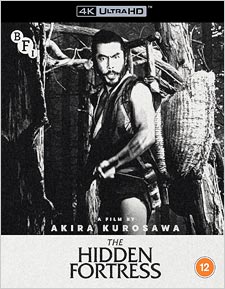
The BFI’s Ultra HD release is a single disc that includes the remastered film in 4K on UHD (a region-free disc, as you’d expect). No movie Blu-ray is included in the BFI package, but one is available separately. The 4K disc includes the following special features:
- Audio Commentary by Tony Rayns
- Akira Kurosawa: It Is Wonderful to Create — The Hidden Fortress (SD – 40:52)
- George Lucas on Akira Kurosawa and The Hidden Fortress (SD – 8:06)
- BFI Screen Epiphanies: Steve Berkoff (HD – 18:11)
- Original Theatrical Trailer (HD – 4:02)
The commentary by the great British critic Tony Rayns, a renowned Asian cinema expert, delivers a steady stream of detail, context, and anecdotes about the production of The Hidden Fortress and its place in Kurosawa’s filmography. The episode of It Is Wonderful to Create is part of a larger documentary series created in 2002. It’s filled with great stories, behind-the-scenes stills, and retrospective interviews with members of Kurosawa’s cast and crew. Fans will already be familiar with the George Lucas piece, in which he talks about his discovery of Kurosawa’s work and his appreciation of this film in particular. In the BFI piece, which is a Q&A shot before a screening of the film, actor and playwright Steve Berkoff describes the impression this film made on him when he first encountered it. The film’s trailer is also included in excellent quality.
The disc also comes packaged in a thicker UK-style Amaray case with a cardboard slipcase. Inside, you’ll also find a 25-page booklet featuring essays by Kenta McGrath, Akira Kurosawa (excerpted from Sight and Sound magazine’s 1964 Kurosawa on Kurosawa article), JWR, and Graham Hughes.
The Hidden Fortress is a terrific and entertaining piece of work, made with such care and craft that it breezes by without your ever noticing that it’s 139 minutes long. If you’re new to the films of Akira Kurosawa, this is a perfect place to start. And if you’re already a fan of Kurosawa, the BFI’s new 4K Ultra HD release presents this film in superb picture and sound quality, making it a splendid and vital addition to your library.
[Editor’s Note: For more on The Hidden Fortress, I highly recommend reading Michael Coate’s excellent History, Legacy & Showmanship retrospective on the film here at The Bits.]
- Bill Hunt and Todd Doogan
(You can follow Bill on social media on Twitter, BlueSky, and Facebook, and also here on Patreon)