
House with Laughing Windows, The (4K UHD Review)
Director
Pupi AvatiRelease Date(s)
1976 (December 2, 2025)Studio(s)
A.M.A. Film (Arrow Video)- Film/Program Grade: B+
- Video Grade: A
- Audio Grade: B+
- Extras Grade: B+

Review
One of the most celebrated giallo titles in all of Italian horror, 1976’s La casa dalle finestre che ridono, or The House with Laughing Windows, is far more popular in European territories than it is outside of them. A partial reason for this is its lack of availability over the years. The film was never released theatrically in English-speaking territories like the US and the UK, and didn’t even make it to home video until 2003 and 2006 respectively. Since that time, it has gained much more of a fan base and is one of the more respected gialli among filmmakers and critics alike.
In an isolated village during the 1950s, art restorationist Stefano (Lino Capolicchio) has arrived to restore a mysterious and disturbing painting, which is located on a rotting wall within the local church. Welcomed with open arms by the local mayor who hopes to improve tourism in the dwindling village, Stefano soon becomes fascinated by the painting’s artist, Legnani, attempting to discover more about him and his methods. Along the way, he meets a beautiful school teacher, Francesca (Francesca Marciano), whom he begins a relationship with, and also becomes more involved with his obsession with Legnani, especially once he begins receiving disturbing phone calls and a peculiar tape recording. It ultimately leads him down a dark and deadly path wherein nothing is as it seems on the surface. Other cast members include Gianni Cavina, Giulio Pizzirani, Vanna Busoni, Andrea Matteuzzi, Bob Tonelli, Pietro Brambilla, and Eugene Walter.
The House with Laughing Windows has always had an uneasy seat at the giallo table. Its mix of giallo, folk horror, and even Gothic horror gives it a unique identity and overall feel. It has much more in common with The Wicker Man than something like Deep Red, which is a prototypical example of what many casual genre fans perceive as a giallo. In truth, a giallo can have a variety of definitions and identities, not just black leather-gloved killers murdering people in extremely horrific ways while a policeman and/or a writer attempts to discover their identity. The House with Laughing Windows isn’t that, but its own multifaceted classification of a giallo instead. It can be as violent and disturbing as many others, but due to its almost vulgar atmosphere, it gets under your skin and lingers with you long after the credits have rolled. Absolutely nothing feels right about this small village, right from the outset, and every fiber of your being should be telling you to run very far away, but that wouldn’t be much of a horror film now, would it?
This is also one of the most beautiful giallo films ever mounted. Cinematographer Pasquale Rachini would go on to lens other projects for Pupi Avati, the film’s director, who’s also known for the 1983 horror film Zeder, released in the US as Revenge of the Dead. Their collective work on The House with Laughing Windows, along with Pupi Avati’s brother, co-writer Antonio Avati, continues to be held aloft as among the finest thrillers of its era, if not one of the finest. Checking your preconceived notions of traditional gialli at the door is essential for this one, with an ending that, if you’re not spoiled by it beforehand, can rock you to your core.
Cinematographer Pasquale Rachini shot The House with Laughing Windows on 35mm film, the results of which were finished photochemically, and presented theatrically in the aspect ratio of 1.85:1. Arrow Video brings the film to Ultra HD with a new 4K restoration of the original camera negative, which has been graded for High Dynamic Range in HDR10 only, and encoded to a triple-layered BD-100 disc. It’s a beautifully rich and organic restoration, featuring a fine layer of well-attenuated grain and high levels of fine detail. Bitrates sit in the 60 to 90Mbps range for the most part, allowing for excellent compression. The HDR grade boosts reds and greens across the board, with deep blacks and excellent contrast. Flesh tones are mostly natural, though they seem a little too hot at times. The image is stable and clean, and outside of a missing frame at the 69:42 mark, it’s virtually flawless. It’s worth noting that Le chat qui fume in France and Shameless Screen Entertainment in the UK have also released their own UHD versions of the film, which I don’t have direct access to, but I can make some educated conjectures. Based solely upon screen captures, they all appear to be based upon the same restoration, but feature remarkably different color grades. Both feature a Dolby Vision option, but the grading seems less accurate, with what appears to be variations of crushed blacks and even some alternate hues for certain scenes. Your mileage may vary on this one, but the Arrow Video grade, at least from a digital distance, appears to be the most accurate overall.
Audio is included in Italian mono LPCM with optional English subtitles. Typical of most post-dubbed films of the era, it has a canned quality to it and it’s a little loose against the picture, but it’s a very clean track with excellent support for dialogue and score. Sound effects aren’t always the best, even if they’re better than most, but again, that’s the nature of the beast. It’s a fine track overall.
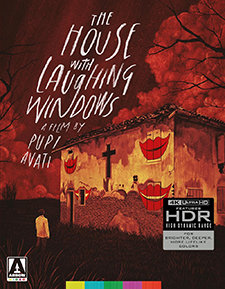
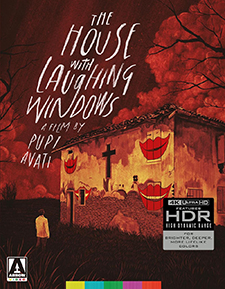
The Arrow Video 4K Ultra HD release of The House with Laughing Windows sits in a black Amaray case alongside a double-sided insert and fold-out poster featuring the original Italian theatrical poster artwork on one side and new artwork by Peter Strain on the reverse. Also included is a 60-page insert booklet containing cast and crew information, the essays A Window Onto Pain: Fascism, Hegemony, and the Paradox of Memori in Pupi Avati’s The House with Laughing Windows by Matt Rogerson, Queer Unmasking: Defilement as an Act of Baptism in The House with Laughing Windows by Willow Maclay, Smooth Like Syphilis, Hot Like Blood by Alexia Kannas, The Resurrection of Saint Sebastian: Suffering, Sacrifice and Secrecy in Pupi Avati’s Restoration Comedy The House with Laughing Windows by Anton Bitel, Outside of Modernity, Outside of History: The Home in The House with Laughing Windows by Stefano Baschiera, restoration information, production credits, and special thanks. Everything is housed in a rigid slipcase featuring the same new Peter Strain artwork. The following extras are included on the disc, all in HD:
- Audio Commentaries:
- Audio Commentary with Alexandra Heller-Nicholas and Josh Nelson
- Audio Commentary with Eugenio Ercolani and Troy Howarth
- Painted Screams (94:30)
- La Casa e Sola – “House Stands Alone”: Chris Alexander on House of Laughing Windows (19:12)
- The Art of Suffering: Apollonian Rationality and Pagan Chaos in The House with Laughing Windows (14:59)
- Theatrical Trailer (3:39)
Outside of the film’s trailer, all of the extras presented here are brand new. In the audio commentary with film critics Alexandra Heller-Nicholas and Josh Nelson, they examine the film’s debated status as a giallo, its ambivalent nature and its association with modernity, and its reflection of post-World War II and Years of Lead violence and fallout. They read from various sources about these subjects, but also take the time to profess their love for the film, how it has influenced others, and its varying connections to other gialli. The other audio commentary featuring writers and film critics Eugenio Ercolani and Troy Howarth is dedicated more to speaking about the content of the film, as well as the careers and filmographies of its cast and crew. It’s perhaps a little more customary, but its nonetheless invaluable.
Painted Screams is a new feature-length documentary about the film, directed by Federico Caddeo of Freak-O-Rama Video Productions, and featuring interviews with co-writer and director Pupi Avati, co-writer Antonio Avati, assistant director Cesare Bastelli, actors Lino Capolicchio, Francesca Marciano, Giulio Pizzirani, Pietro Brambilla, production designer Luciana Morosetti, assistant camera operator Toni Scaramuzza, sound mixer Enrico Blasi, and son of production designer Otello Taglietti, Emanuele Taglietti. La Casa e Sola is a new visual essay by critic Chris Alexander who delves into the film’s effective opening title sequence, comparing its power to the Saul Bass title sequence in Psycho, and exploring how dangerous and ugly the film feels compared to other horror films. The Art of Suffering is a new visual essay by critic Kat Ellinger in which she examines the story’s conflict between Dionysian and Apollonian abstractions as seen through the eyes of its main protagonist. Last is the film’s original Italian theatrical trailer.
There are also several extras missing from previous releases. The Region 1 DVD release from Image Entertainment, part of The Euroshock Collection, features the short Italian documentary Twenty-Five Years of Cult and a lobby card gallery; the Region B French Blu-ray and 4K Ultra HD releases from Le chat qui fume feature an interview with Pupi Avati; and the Region B Blu-ray and 4K Ultra HD releases from Shameless Screen Entertainment include a 2009 interview with Pupi Avati, a 2022 interview with actor Lino Capolicchio, and 2025 interviews with actor Francesca Marciano, writer and producer Antonio Avati, and assistant director Cesare Bastelli.
Despite missing some valuable bonus material from other releases, Arrow Video’s 4K UHD release of The House with Laughing Windows is a must-have for all gialli fans. You might even say it’s an essential purchase. Highly recommended.
- Tim Salmons
(You can follow Tim on social media at these links: Twitter, Facebook, BlueSky, and Letterboxd. And be sure to subscribe to his YouTube channel here.)