
Last Tango in Paris (4K UHD Review)
- Review Date: Jul 25, 2025
- Format: 4K Ultra HD
-


Director
Bernardo BertolucciRelease Date(s)
1972 (May 27, 2025)Studio(s)
United Artists (Distribpix/Vinegar Syndrome)- Film/Program Grade: A+
- Video Grade: A
- Audio Grade: B+
- Extras Grade: C


Review
When we first see Paul (Marlon Brando) in Bernardo Bertolucci’s Last Tango in Paris, he’s walking aimlessly across the Pont de Bir-Hakeim, his head cradled in his hands, screaming blasphemies at the heavens. When we last see him, he’s cradling the head of Jeanne (Maria Schneider) in his hands instead, tenderly proclaiming his love for her after having finally revealed everything about himself. Yet in doing so, he’s broken his own rules, and breaking rules can have dire consequences for everyone involved.
The same thing is true of Last Tango in Paris itself, which took advantage of the way that censorship standards had evolved throughout the Sixties in order to craft a fiercely raw exploration of human sexuality. Relaxation of standards or not, the film still garnered an X rating from the MPAA in 1972 and it was banned in Italy, with Bertolucci, Brando, Schneider, and producer Alberto Grimaldi being put on trial for obscenity (despite years of appeals, Bertolucci’s conviction was ultimately upheld). Yet what was lost amid all of the controversy was that the real taboos violated by Last Tango in Paris weren’t so much sexual as they were personal, with both actors bearing scars from the experience of making the film. But more on that in a moment.
Last Tango in Paris opens with a title sequence that uses two Francis Bacon paintings as its backdrop: Study for Portrait (Isabel Rawsthorne) and one half of the Double Portrait of Lucian Freud and Frank Auerbach. The distorted nature of Bacon’s work reflects the way that Paul and Jeanne allow their true selves to become distorted in the artificial environment that they establish as the backdrop for their relationship (a fact that Bertolucci literalizes later on in the film by cross-cutting between each of them, with the other’s distorted reflection visible in a mirror in both shots). They’re wearing masks with each other that disguise their true selves, and as long as those masks are in place, a tenuous equilibrium is maintained between them. Yet make no mistake here: there’s a clear power imbalance that’s inherent to their relationship, with Paul regularly asserting his dominance over Jeanne. Yet once the masks are dropped, the balance of power shifts, and Paul is the one who pays the price for his lack of faith in his own vision.
At the beginning of the film, Paul is wandering the Pont de Bir-Hakeim because he’s grieving the recent suicide of his wife Rosa, and he’s looking for a way to escape the all too familiar environs of the hotel that they owned together. He inadvertently meets Jeanne at an apartment that’s available for rent, and the two of them end up having a spontaneous sexual encounter, a bit rough, but still consensual. Appreciating the anonymity of the setting, they start meeting at the apartment regularly, but it’s Paul who establishes the rules for their relationship: no names, no backgrounds, and no personal details. They need to leave their external social identities at the door, since Paul considers everything outside the apartment to be “bullshit.” The only way that they’ll really communicate with each other is through their bodies.
The apartment is the perfect place for that kind of relationship, with bare furnishings and nothing to tie them to their surroundings or even to each other. The emptiness of the apartment reflects the hollowness of their relationship. Jeanne agrees to his rules, somewhat reluctantly, and any time that she tries to stretch the boundaries and ask him some personal questions, he responds antagonistically. Yet the game that they’re playing is negotiable, at least within certain limits. When she catches him slipping up by telling her stories about his past, he grudgingly acknowledges that he doesn’t mind if she tells the truth, as long as there are no names. It’s the one bridge that he’s unwilling to cross.
For Paul, it’s a way to escape any painful reminders of his life with Rosa. For Jeanne, it’s a way to restore some personal boundaries. Her boyfriend Thomas (Jean-Pierre Léaud) is a film director who is using her as the subject of his new documentary, putting her own past under a microscope and making her reveal all of the personal details that Paul refuses to contemplate. Compared to that, the stifling nature of Paul’s rules come as something of a relief to Jeanne. At one point, she loses her temper with Thomas and tells him that she’s tired of feeling raped by his documentary—which is ironic, given what Paul does to her during the most notorious scene in the film.
There’s simply no way to discuss Last Tango in Paris without addressing that scene, especially considering that it came back into the news cycle a few years ago after some comments by Bertolucci were publicized (and arguably sensationalized). While the scene where Paul forcibly sodomizes Jeanne was always in the script, Bertolucci and Brando improvised his use of butter as a lubricant, without informing her in advance. As a result, her tears and cries of “No!” were quite real. Now, all of the sex in Last Tango in Paris is simulated, this scene included, but it was still a violation of her trust, and they took advantage of a young actor who didn’t understand that she had the option to really say no and stop them from shooting the scene. (Sadly, the power imbalance between female actors and male directors has always been quite real.) No, she wasn’t actually raped, at least not physically, but she ended up being exposed emotionally in a way that went far beyond mere nudity and simulated sex.
And that brings us full circle to the taboos that Last Tango in Paris actually violated, which do indeed go beyond depicting anal sex. While Bertolucci had considered several other actors for the roles of Paul and Jeanne, he was aiming for emotional authenticity, so Brando’s commitment to Method acting was perfect for the film. Scheider was young and inexperienced, but that made her vulnerable to emotional manipulation, and Bertolucci took full advantage of that fact. She felt utterly humiliated by how they shot the sodomy scene, and she had every right to feel that way. Yet ironically enough, despite having been an active participant in Schneider’s humiliation, Brando was the first one to complain that he felt violated by the film. Just like Schneider, he refused to have any contact with Bertolucci for many years. Both actors believed that they ended up revealing too much of themselves, albeit in different ways, and that Bertolucci had tricked them into doing so. As a result, setting aside all of the nudity and sexuality, Last Tango in Paris is, in essence, emotional pornography.
Still, it’s fair to point out that regardless of how much that Brando may have felt exposed by Bertolucci, the female nudity in the film proves that there was as much of a power imbalance between Brando and Schneider as there was between Paul and Jeanne. While Schneider appears fully nude, Brando was uncomfortable with his own nude scenes that Bertolucci had shot, and in an unsurprising twist of fate, so was Bertolucci. Aside from the famed embrace that became the centerpiece of one of the theatrical posters for Last Tango in Paris, Bertolucci omitted all of Brando’s nudity in the final cut. Yet perversely, that problematic physical imbalance ended up supporting the film’s story, with Jeanne’s frequent nudity making her appear more vulnerable, while Paul’s more guarded nature is matched by how his body is covered. It’s only at the end of the film when he finally exposes himself to her fully, revealing his name and asking for hers, and that’s the point at which clothing becomes irrelevant as a metaphor for the power imbalance between them. He’s unzipped his fly on an emotional level, and that’s when the balance shifts, because Jeanne is unwilling to expose herself anymore.
As all of the above should make abundantly clear, Last Tango in Paris is a complex text that defies straightforward analysis. It’s not like one of Francis Bacon’s paintings, which can be appreciated without knowing anything about how they were produced (although they naturally become much richer after learning more about the artist). The making of Last Tango in Paris has always been inextricably intertwined with the film itself, and the latter can’t be properly analyzed without an understanding of the former. It’s a problematic film in many respects, and there’s plenty of valid criticisms that can be leveled against Bertolucci (and Brando as well). Yet none of that changes the fact that it’s one of the most emotionally authentic films ever made, and a genuinely harrowing experience. Love it or hate it, you’ll never forget it. In exposing the interior lives of both Brando and Schneider, Bertolucci ended up exposing the heart and soul of the human condition in a way that few other filmmakers have ever achieved.
Cinematographer Vittorio Storaro shot Last Tango in Paris on 35mm film using Mitchell BNCR cameras with Bausch & Lomb Super Baltar lenses, framed at 1.85:1 for its theatrical release. He shot the entire film on 100ASA Eastman 5254 stock, tungsten balanced at 3200K but not necessarily filtered in order to compensate for daylight, which was partly responsible for the unusual look of Last Tango in Paris. Storaro used Francis Bacon as his guide, not so much the two paintings featured during the opening credits, but rather the warm orange tones in Bacon’s Triptych Studies from the Human Body. Understanding that is vital to understanding the look of this version of the film, which was digitally remastered in 2018. The 4K scans of the original camera negative and digital restoration work were performed by the Centro Sperimentale di Cinematografia – Cineteca Nazionale in collaboration with Metro Goldwyn Mayer Studios and Alberto Grimaldi Productions, with Storaro supervising the process.
Thanks to the 5254 stock, Last Tango in Paris has always been a moderately grainy film, and that’s equally true in 4K. While that naturally limits the detail visible in the image, it’s still as sharp and well-defined as it’s ever been, and there aren’t any noteworthy compression artifacts, either. While it’s not clear if Storaro was involved with the new High Dynamic Range grades (both Dolby Vision and HDR10 are included), everything seems perfectly in line with his intentions for the film. Those warm orange, gold, and yellow tones are simply gorgeous in this rendition, retaining the stylization without ever exaggerating it. Anyone looking for natural colors will have to look elsewhere, because that’s not what Storaro and Bertolucci had in mind. But anyone who’s willing to be caught up in the visual spell that they created for Last Tango in Paris should be thrilled. It’s a handsome upgrade for the film.
Audio is offered in French & English 2.0 mono DTS-HD Master Audio with optional English SDH subtitles (the disc defaults to a secondary subtitle track with translations for the French dialogue only). The audio was also remastered back in 2018, with Federico Savina serving as supervisor. The dialogue is as clear as it can be, although it’s worth pointing out that it’s sometimes buried in the mix. Gato Barbieri’s iconic score has always been especially loud in Last Tango in Paris, occasionally verging on the edge of distortion on the peaks. While it does overwhelm the dialogue and sound effects at times, that’s intentional. The sound in Last Tango in Paris is as stylized as the visuals, and just like Bacon’s orange hues drive the latter, Barbieri’s music drives the former.
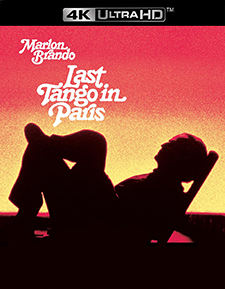
The Vinegar Syndrome/Distribpix 4K Ultra HD release of Last Tango in Paris is a two-disc set that includes a Blu-ray with a 1080p copy of the film. They also offered a Limited Edition version featuring a slip box designed by Adam Maida and a 40-page booklet with essays by Allison Anders, Heather Drain and Jim Hemphill, but that version is long sold out. (There’s a variant edition with the booklet and a different spot gloss hard slipcase and slipcover combo, designed by Steak Mtn, that’s still available from their Mélusine website). The following extras are included on the Blu-ray only:
- From Parma to Paris (via Rome) (HD – 29:36)
- Our Last Tango (HD – 12:28)
- Before the Tango (HD – 29:05)
- A Conversation with Bernardo Bertolucci (Upscaled SD – 30:24)
- Location Scouting for The Tango (HD – 6:20)
The new extras were all produced by Eugenio Ercolani. From Parma to Paris (via Rome) is an interview with Francesco Barilli, an associate of Bertolucci who wasn’t directly involved with the making of Last Tango in Paris. It’s more of a reminiscence about Barilli’s own career and his relationship with Bertolucci, not so much about the actual film—he freely admits that he didn’t do much for the production, but he was present on the set. (That’s going to be a running theme throughout most of these extras.)
Our Last Tango and Before the Tango are both interview with editor Roberto Perpignani. Our Last Tango does focus on the production, release, and legacy of Last Tango in Paris, while Before the Tango concentrates on Perpignani’s earlier collaborations with Bertolucci. Perpignani had served as editor on Before the Revolution, Partner, and The Spider’s Stratagem, while Franco Arcalli cut The Conformist. Arcalli served as primary editor on Last Tango in Paris, but Perpignani stepped in to handle the lion’s share of the film when Arcalli had to be hospitalized.
A Conversation with Bernardo Bertolucci is an archival interviews with Bertolucci that Brendan Young shot in 1992. It was intended as exploratory material for a documentary that never got off the ground—it’s rough footage, too, with the camera spinning around at times and Bertolucci stopping to answer the telephone. Once again, it doesn’t spend much time directly addressing Last Tango in Paris, but it’s a valuable (if unpolished) collection of the director’s thoughts.
Last, and definitely not least, is Location Scouting for The Tango, which compares some of the locations in the film to how they appear today—and interestingly enough, many of them have changed very little over the decades.
While most of these new extras are only tangentially related to Last Tango in Paris, to be fair, they’re still a huge step up over previous releases of the film, all of which have been bare-bones aside from the theatrical trailer (which ironically enough isn’t included here). Still, it would have been nice Vinegar Syndrome could have included the 2004 documentary about the film that was produced for ARTE TV in France: Behind the Scenes: Last Tango in Paris. That included interviews with Bertolucci, Storaro, the first & second assistant directors, and actor Catherine Allégret. Most importantly, it also included a priceless interview with Maria Schneider, candidly talking about her experiences making the film. Unfortunately, that’s never made its way to disc anywhere, so there may not have been anything that Vinegar Syndrome could do about that. (Brando also had a hilariously combative interview with Dick Cavett in 1973 that would have been a nice inclusion, but that would probably be too challenging to license.) Regardless, it’s nice to have extras in any form for Last Tango in Paris after decades of bare-bones releases, and it’s even nicer to have the film available in via this outstanding new 4K master. It’s a gorgeous rendition of an occasionally painful film, and it’s highly recommended for open-minded viewers.
- Stephen Bjork
(You can follow Stephen on social media at these links: Twitter, Facebook, BlueSky, and Letterboxd).