
Better Tomorrow Trilogy, A (4K UHD Review)
- Review Date: May 14, 2026
- Format: 4K Ultra HD
-


Director
John Woo/Tsui HarkRelease Date(s)
1986/1987/1989 (November 18, 2025)Studio(s)
Golden Princess Film Production (Shout! Studios – Hong Kong Cinema Classics #19-21)- Film/Program Grade: See Below
- Video Grade: See Below
- Audio Grade: See Below
- Extras Grade: A-
- Overall Grade: A-

Review
A Better Tomorrow was a breakthrough film for Hong Kong cinema in general and John Woo in particular, the latter of whom had spent more than a decade prior to that point toiling away making wuxia films and broad comedies. But A Better Tomorrow helped cement the “heroic bloodshed” genre that would dominate the rest of his work in Hong Kong until Hollywood came a-calling a few years later. It also cemented Woo’s working relationship with producer Tsui Hark, who had an undeniable influence of his own on Woo during that period—for good and for ill, as it turned out. Their partnership started to fracture during the making of A Better Tomorrow II, and by the time that the second sequel A Better Tomorrow III: Love & Death in Saigon was released just three years after the first film, Hark was in the director’s chair, while Woo had left to make his own Vietnam film Bullet in the Head. Woo would find a much more harmonious partnership with producer Terence Chang, who followed him all the way to Hollywood—but A Better Tomorrow still followed both of them everywhere that they went. It was that influential. (Hark ended up taking his own path to Tinseltown, but that’s a story for another day.)
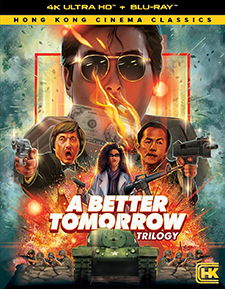
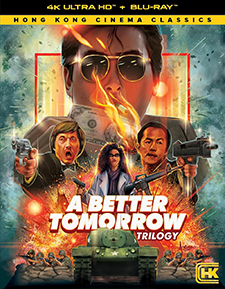
The Shout! Studios 4K Ultra HD release of the A Better Tomorrow Trilogy is #19-21 in their Hong Kong Cinema Classics series. It’s a seven-disc set that includes each film on UHD and Blu-ray, as well as a separate Blu-ray with both the workprint cut of A Better Tomorrow II and the Taiwanese cut of A Better Tomorrow III: Love & Death in Saigon. Each film is housed in its own separate Amaray case, with the seventh disc tucked into the case for A Better Tomorrow III. Everything comes housed in a rigid hardbox featuring new artwork.
DISCS ONE & TWO: A BETTER TOMORROW
It’s nearly impossible to overstate just how much of a breakthrough film that A Better Tomorrow (aka Ying hung boon sik) was in 1986, and not just for John Woo, either. As the wuxia genre began to fade away (at least for a time), comedies were dominating the Hong Kong box office at that point, much to Woo’s dismay. His career was in a downturn, not aided by the fact that he wanted to flex his dramatic muscles more than his comedic ones. Enter an ironic savior in the form of Tsui Hark. Hark’s career was on the rise, but he never forgot how Woo had backed him at Cinema City Enterprises despite the fact that his first few films hadn’t been particularly successful. After Hark formed his own production company, Film Workshop, he approached Woo to co-write and direct a gangster movie, and the results of their partnership changed Hong Kong cinema forever.
Yet that’s still probably understating just how influential that A Better Tomorrow proved to be. It helped usher in the “heroic bloodshed” genre with which directors like Woo became intimately associated, but it also established a new kind of “gangster chic” in Hong Kong cinema, with Woo’s Giogio Armani and Ray Ban clad criminals looking impossibly cool. That look bore an obvious influence from Jean-Pierre Melville’s Le Samouraï, but the crucial factor that really sold that style was the ineffable charm of Chow Yun-Fat—and in another irony, his role started out as little more than a minor supporting character. Cinema City wasn’t even interested in hiring him, since he was only a moderately successful television actor who had yet to translate that success onto the big screen. But all that changed with A Better Tomorrow, and Chow Yun-Fat ended up becoming not just the face of the franchise, but John Woo’s muse during that period.
Still, however much that Le Samouraï may have influenced the look and style of A Better Tomorrow, it didn’t serve as an inspiration for the story. Woo and Hark had both been fascinated by Kong Lung’s 1967 film The Story of a Discharged Prisoner, and that was the creative spark that led to Woo’s story, with the final script fleshed out with the help of Chan Hing-ka and Leung Suk-wah (as well as other uncredited writers, Hark included). It’s a tale of brotherhood and betrayal, filled with the clash between competing codes of honor, laying the thematic template for most of Woo’s Hong Kong work that followed.
When Hong Kong Triad member Ho (Ti Lung) is betrayed by his fellow gangster Shing (Waise Lee), he ends up serving time in prison. His younger brother Kit (Leslie Cheung) is an ambitious young police officer who had no idea what Ho did for a living, so when Ho is finally released from prison, he wants nothing whatsoever to do with his older brother. Ho, on the other hand, wants nothing more than to atone for his past life, so he takes a legitimate job at a taxi company run by “Uncle” Ken (Kenneth Tsang), who is himself an ex-con wanting to stay straight. But it’s not long before Ho finds himself caught in the crossfire between Shing, Kit, Kit’s girlfriend Jackie (Emily Chu), and his old associate Mark Lee (Chow Yun-Fat), who wants to enact some personal revenge against Shing. When you’re searching for a better tomorrow, sometimes it’s hard to escape the ghosts of your past.
Ho, Kit, and Mark form a three-pronged version of one of Woo’s classic unholy duos, where two people who are on the opposite sides of an issue form an uneasy bond between them. In this case, it’s a pair of literal brothers who find themselves on opposite sides of the law, fueled by Kit’s inability to understand Ho’s genuine desire for reform. Mark doesn’t understand it either, and he resents Ho’s unwillingness to help him get revenge. Meanwhile, Shing isn’t willing to stop twisting the knife into Ho, forcing the ex-con to face his fears in order to try to save both Kit and Mark. But as Ken told him earlier, “A man with principles needn’t fear anything.” Ultimately, A Better Tomorrow works as well as it does not because of the gangster chic and not even because of Woo’s patented two-fisted gunplay, but rather because of the melodrama that guides all of it. It’s a compelling story with memorable characters—who just happen to be carrying guns, and know how to use them. So, yes, it’s fair to say that A Better Tomorrow was a massive breakthrough for everyone involved.
A Better Tomorrow certainly worked for the Hong Kong moviegoing public at large. Cinema City had no faith in the film and even wanted to pull the plug and cut their losses at one point, but it ended up becoming the highest-grossing Hong Kong film in 1986. It created a new genre and revitalized not just John Woo’s career, but Chow Yun-Fat’s career as well. A Better Tomorrow also helped cement the dramatic bona fides for Leslie Cheung, who was still better known as a singer at that point, and veteran actor Ti Lung found new cinematic life after its release. Hell, even Ray Ban benefited with a massive spike in sales all across Asia. That meant a sequel was inevitable, but Woo’s natural antipathy toward sequels in general meant that trouble was brewing on the horizon for his relationship with Hark...
Cinematographer Wing-hang Wong shot A Better Tomorrow on 35mm film using spherical lenses, framed at 1.85:1 for its theatrical release. This version is based on a 4K scan of the original camera negative, digitally remastered and graded for High Dynamic Range in Dolby Vision and HDR10. With the usual caveat that any opticals like the opening titles look a bit soft, everything else looks sharp, clear, and nearly pristine aside from a few damage marks that will probably only be noticeable when freeze-framing. There are a few shots where the focus wavers, but that’s simply part of the original photography. The grain varies a bit depending on the shooting conditions (and whether or not opticals were involved), but the encode manages all of it with little issue. The contrast is solid, and the colors are nicely saturated without ever pushing things too far just for the sake of an HDR grade. A few shots seem a touch yellowish at times, but considering that the burned-in titles on the same shots look pure white, that’s also probably true to the source (another artifact from optical printing, perhaps?) Overall, it’s a beautiful 4K makeover for A Better Tomorrow.
Audio is offered in Cantonese and English 2.0 mono, with optional English subtitles. The Cantonese audio has the typically boxy, unnatural sound of Hong Kong cinema from that era, with the dubbing never integrating well into the soundstage. (There’s a bit of excessive sibilance on Leslie Cheung’s song Love of the Past that plays during the closing credits.) The frequency response also sounds a bit constrained. But there’s little noise or other artifacts, and whatever distortion is present was likely inherent to the original elements.
The following extras are included:
DISC ONE: UHD
- Commentary by James Mudge
DISC TWO: BD
- Commentary by James Mudge
- Better Than the Best (HD – 34:26)
- Between Friends (HD – 7:34)
- When Tomorrow Comes (HD – 20:48)
- Thoughts on the Future (HD – 8:15)
- Better and Bombastic (HD – 23:00)
- Hong Kong Confidential (HD – 17:48)
- Trailers (HD & Upscaled SD – 6:24, 2 in all)
- Image Gallery (HD – 3:55)
Aside from the Trailers and the Image Galleries, the extras in the set were all newly created for this release, starting with a commentary by James Mudge, producer and head writer for the easternKicks website. As usual, he’s a Scottish Frank Djeng, packing a ton of information into the track—and just like Woo, he never lets up, either. He delves into the complicated production history of A Better Tomorrow, and he also traces the themes of brotherhood in the film and the nature of the brotherhood between Woo and Hark. In the process, he provides plenty of historical context that helps illuminate the runaway success of the film. It’s another energetic commentary from Mudge.
There’s also a set of new interviews, starting with four that feature participants in the making of A Better Tomorrow (including one who wasn’t credited on the final film). Better Than the Best is with Woo, who acknowledges up front that he couldn’t have made the film without Hark. He admits that he was box-office poison at that point, and Hark was responsible for pulling him out of his funk. Woo also describes his inspirations for A Better Tomorrow; explains the casting decisions; and details shooting the action scenes. He closes with a discussion of the film’s release and its impact.
Between Friends is with Terence Chang, who talks about his background and how he came to work with Woo. When Tomorrow Comes is with co-screenwriter Chan Hing-ka, who also traces all the various inspirations for the story, including The Story of a Discharged Prisoner. He makes the interesting observation that Woo is unfailingly polite on set, but that’s because he saves all of his rage and power for his camerawork. Thoughts on the Future is with uncredited writer Gordon Chan, who says that Woo is still a wuxia person at heart, which is why his gunplay is so stylized and unrealistic.
The last two interviews offer a broader view of A Better Tomorrow. Better and Bombastic is with filmmaker Gareth Evans, who explains how he originally discovered John Woo and the impact that the director had on his own filmmaking. While Evans does spend plenty of time on A Better Tomorrow, he also explores other Woo films from his original Hong Kong period to Hollywood, and back to Hong Kong again with Red Cliff. All that, plus Evans spends some time on his own films like The Raid: Redemption and shows how he borrowed ideas from Woo and other Hong Kong filmmakers.
Hong Kong Confidential is with Grady Hendrix, co-author of These Fists Break Bricks, who calls A Better Tomorrow not just a hit movie (it was the highest-grossing Hong Kong film up to that point), but also a zeitgeist-changing landmark film. He traces the intertwining nature of the relationship between Woo and Hark: Woo had stood by Hark when Hark’s career was fizzling, but Hark ended up coming back to help Woo when his own career had hit a roadblock. Hendrix agrees that A Better Tomorrow shines the most not in terms of its physical pyrotechnics, but rather in its emotional ones.
A BETTER TOMORROW (FILM/VIDEO/AUDIO/EXTRAS): A-/A-/B/A-
DISCS THREE & FOUR: A BETTER TOMORROW II
Cinema City may not have had much faith in A Better Tomorrow, but their lack of faith was still rewarded by the film’s unprecedented box office success in 1986. The reasons why weren’t lost on them, either, so when they pressured John Woo and Tsui Hark to make a sequel, they had one major stipulation for it. A Better Tomorrow may have been the first film that felt like a true John Woo film, but it also turned Chow Yun-Fat into a shining star of Hong Kong cinema despite the fact Mark Lee wasn’t really a lead character. Cinema City wasn’t going to make A Better Tomorrow II (aka Ying hung boon sik II) without him, so Chow had to return, but there was an inconvenient fact that got in the way: Mark hadn’t survived the events of the first film. Woo’s solution to that problem was to make a prequel instead, but Hark overrode that concept and came up with the cheeky idea to have a previously unmentioned identical twin brother become involved with the new story. Ho (Ti Lung), Kit (Leslie Chung), Jackie (Emily Chu), and even “Uncle” Ken (Kenneth Tsang) would all return, but this time they’d be joined by Mark’s doppelganger Ken. (A Chow Yun-Fat by any other name would smell as sweet.)
Yet the key element in the new story wasn’t any of the returning cast members (regardless of the fact that one of them was playing a different character), but rather a new addition to the Better Tomorrow family: Dean Shek. Shek was a veteran actor and producer, and in the spirit of the way that Hark had helped out Woo with A Better Tomorrow when the latter’s career was in a rut, the two of them both ended up paying it forward by asking Shek to appear in A Better Tomorrow II as the linchpin of the entire story. But ironically enough, that ended up laying the seeds for what would drive Woo and Hark apart. Unsurprisingly, Woo was fascinated by the relationship between the two brothers, Ho and Kit, but Hark wanted to focus more on Shek’s new character. Something had to give, and eventually it did.
Woo and Hark still collaborated on the script along with fellow A Better Tomorrow screenwriters Chan Hing-ka and Leung Suk-wah. A Better Tomorrow II opens with Ho being offered an early parole on the condition that he aids the police with investigating his former boss Lung Sei (Shek). But Ho is still living fearlessly by his own principles, so he refuses. Yet when he finds out that his younger brother Kit is working on the investigation, he changes his mind in order to be able to help keep Kit safe. Yet Lung has also been trying to leave his past life and work as a legitimate businessperson, but when he’s framed for a murder, he enlists Ho to help him escape to New York City—where he promptly loses his mind due to a personal tragedy. While in America, they encounter Mark Lee’s brother Ken, who comes to their aid when the Triad tracks them down. Lung recovers his faculties, and the quartet travels back to Hong Kong in order to put the matter to rest once and for all. Yet tragedy follows them all the way to the bitter end.
That’s appropriate, because the growing disagreements between Woo and Hark followed them all the way to the bitter end of making A Better Tomorrow II. Woo’s first assembly cut ran a bite out of three hours, and Cinema City insisted on cutting it down to under two hours. Worse, all of that had to be done quickly in order to hit their targeted release date. (All of the dubbing and editing ended up being completed over a two-week period.) Woo was never happy with the final results, feeling that it gutted the extended familial relationships that he had worked so hard to establish. A Better Tomorrow II still joined its predecessor by becoming a smash hit at the Hong Kong box office in 1987, but it just wasn’t the film that Woo wanted to make.
And yet there’s an argument to be made that A Better Tomorrow II is even more of a John Woo film than the first installment, at least in terms of what most people imagine when they think of a “John Woo Film.” A Better Tomorrow was more of a melodrama than an action film, but flaws or not, A Better Tomorrow II fuses the action with the melodrama in way that’s pure Woo. Ho, Kit, Lung, and yes, even “Uncle” Ken all express themselves as much through the action as they do via the dialogue. And the wildly over-the-top finale of A Better Tomorrow II feels like a dry run for what Woo would pull off later on The Killer and Hard Boiled. Yes, the story feels disjointed (at least in the final theatrical cut), but A Better Tomorrow II is still John Woo through and through.
Cinematographer Wing-Hang Wong shot A Better Tomorrow II on 35mm film using spherical lenses, framed at 1.85:1 for its theatrical release. This version is based on a 4K scan of the original camera negative, digitally remastered and graded for High Dynamic Range in Dolby Vision and HDR10. Overall, the picture quality is quite similar to the first film, save for some slightly more visible signs of damage at a few places. The only major problem that I encountered is that just like the Shout! Studios 4K release of City on Fire, I experienced gamma shifts on some of the bright backgrounds like at 68:22, where the sky brightens and dims repeatedly. I haven’t found any other reports about it online, which may mean that it’s an issue with the HDR10 layer only—as a projector user, I don’t do Dolby Vision (and yes, my auto iris was turned off, so it wasn’t due to that). Since I don’t experience the same gamma shifts with Imprint’s 4K version, which uses Shout’s 4K master, it’s likely a hitch with the encode. You may not encounter the same thing, but caveat emptor.
Audio is offered in Cantonese and English 2.0 mono DTS-HD Master Audio, with optional English subtitles. The dialogue is even boxier than it is on the first film, but they otherwise sound quite similar, with a limited frequency response but no appreciable noise or other artifacts.
The following extras are included:
DISC THREE: UHD
- Commentary by James Mudge
DISC FOUR: BD
- Commentary by James Mudge
- A Tumultuous Tomorrow (HD – 26:28)
- Better Than Ever (HD – 18:58)
- Hong Kong Confidential (HD – 10:14)
- Trailers (HD – 8:41, 2 in all)
- Image Gallery (HD – 3:16)
The Scottish Frank Djeng returns for another energetic commentary track. He admits that the production was troubled and the reaction to the final results was mixed, but he ends up launching his own spirited defense of the film. Mudge goes into great detail about the conflict between Woo and Hark, and says that while Woo has sort of disowned the film and it’s undoubtedly a compromised vision, it still bears all of Woo’s hallmarks. He thinks that it’s not really fair to compare it to its predecessor, but instead to the wave of inferior imitators that followed, which A Better Tomorrow II handily tops. He also breaks down all of the key cast and crew in the film. It’s another reliably informative commentary from Mudge.
A Tumultuous Tomorrow is with Woo, who acknowledges up front that he doesn’t like sequels, and he wanted to make a prequel instead, with younger actors. But Cinema City shot that idea down, at least for the second film, and that’s why they had to scramble to figure out a way to bring Chow Yun-Fat back. It ended up becoming a story about helping a friend, which was exactly what they did by bringing in Dean Shek to play a key role. Woo doesn’t really get into his disagreements with Hark, but he does discuss how the film was edited down from his initial cut and his disappointment with some of the results.
On the flip side, the real Frank Djeng shows up for Better than Ever, where he makes his own case that A Better Tomorrow II is even better than the first film. Seeing it for the first time, no one at the theatre had any idea what directions that the sequel would take, so when Ken shows up, the audience laughed—all except for Djeng, who thought it was an ingenious way to bring Chow-Yun Fat back. Djeng also traces the fallout from Woo’s conflict with Hark, and breaks down some scenes from A Better Tomorrow II—Djeng believes that they hit their creative stride with this film.
There’s also another edition of Hong Kong Confidential with Grady Hendrix, who says that if there’s one hard-and-fast rule about filmmaking, it’s that if a movie makes money, the money men want a sequel. He explains how (and why) Chow Yun-Fat was brought back for the film, and also how Dean Shek was cast. He also explains the conflicting perspectives that whittled the final film down from Woo’s lengthy workprint version. Ultimately, Hendrix feels that despite the issues, A Better Tomorrow II is the film where John Woo truly became John Woo, using action as a way of defining his characters.
A BETTER TOMORROW II (FILM/VIDEO/AUDIO/EXTRAS): B/A-/B-/B+
DISCS FIVE & SIX: A BETTER TOMORROW III: LOVE & DEATH IN SAIGON
The troubles that were brewing behind the scenes on A Better Tomorrow II came to a head during the production of John Woo and Tsui Hark’s next project together, The Killer. It was painfully evident that they were never going to be on the same page regarding the kinds of films that Woo wanted to make, so they parted company, somewhat acrimoniously (although they eventually made their peace with each other years down the road). Hark took over directing duties for the second sequel A Better Tomorrow III: Love & Death in Saigon (aka Ying hung boon sik III: Zik yeung ji gor), but Woo’s influence on the film was still present. It’s not a sequel at all, but rather a prequel, showing how (and why) Mark Lee (Chow Yun-Fat) became the stylish enforcer that he was at the beginning of A Better Tomorrow. That concept was actually Woo’s original plan for A Better Tomorrow II, but Hark shot that idea down in favor of dragging in Mark’s previously unmentioned twin brother Ken in order to make a true sequel. Woo ended up retooling his ideas to make his astonishingly brutal masterpiece Bullet in the Head, but there was plenty of room left over for Hark to mine the conflict as a way of fleshing out Mark’s character.
And that fleshing out was done in typical Hark fashion, too. A Bullet in the Head III was written by committee and heavily rewritten on the fly during shooting and editing. Yet it’s not a case of rushing into a production with an unfinished script; that’s just how Hark liked to work (much to the consternation of some of his actors, who were often redubbed with new dialogue). A Better Tomorrow III is set in 1974, shortly before the fall of Saigon. A young Mark Lee has traveled to the country in the hopes of bringing his cousin Michael (Tony Leung Ka-fai) and Michael’s father (Shih Kien) back to Hong Kong with him. Mark has difficulties entering the country, which end up being smoothed over by a random encounter with Chow Ying-kit (Anita Mui), a beautiful but somewhat mysterious woman. Mark and Michael encounter her again later, and she takes them under her wing as associates in her real business: gun running. That puts all of them in the crossfire between Kit’s former lover Ho (Saburō Tokitō) and the local warlord, and as chaos reigns supreme during Saigon’s fall to North Vietnam, not all of them will be able to make it out of the country alive.
Chaos also reigned supreme during the making of A Better Tomorrow III, but again, Hark was comfortable working that way (even if all of his collaborators may not have been). Yet despite Hark’s own personal connection to the story as someone who was born in Vietnam, the resulting film still feels somewhat shallow and impersonal compared to the previous ones. Ultimately, we learn why Mark Lee dressed the way that he did in the first film (right down to the Ray Bans), but not much else. Sure, the tragedies that he faced while in Vietnam also shaped his personality, but A Better Tomorrow III never really draws a coherent connection between them and how Mark became an enthusiastic Triad killer. John Woo took his pain from the breach in his relationship with Hark and translated it into the themes of friendship, loyalty, and betrayal that suffuse Bullet in the Head, but Hark didn’t pour the same kind of emotional and thematic depth into A Better Tomorrow III. And to be fair, it was never really his kind of material in the first place (well, aside from the tragic romance angle, anyway). Yet it’s still a solid film, just one that lacks Woo’s trademarked way of using action to define his character’s emotional states.
Cinematographer Wing-Hang Wong shot A Better Tomorrow III: Love & Death in Saigon on 35mm film using spherical lenses, framed at 1.85:1 for its theatrical release. This version is supposedly based on a 4K scan of the original camera negative, digitally remastered and graded for High Dynamic Range in Dolby Vision and HDR10. Yet if it is a negative scan, it’s one that’s hard to distinguish from a dupe element like an interpositive. The image is softer and less well resolved than on the first two films, and it’s not due to diffusion or any of the optical work, either. Even the grain seems softer, either due to the use of noise reduction or else the fact that it wasn’t really the negative. That’s picking nits relative to the other two, though, since this is still a significant upgrade over previous versions, just not quite to the same degree as the first two films. There’s only light damage visible, and the colors all look much healthier than they ever have before. I did encounter the gamma shifts again here, like on the windows and ceiling in the shots at 63:30 and 63:55, and also in the skies at 67:42. (And just like A Better Tomorrow II, they’re not present on the Imprint version using the same basic master.)
Audio is offered in Cantonese and English 2.0 mono DTS-HD Master Audio, with optional English subtitles. Unlike the video, the audio for A Better Tomorrow III is a step up compared to the other two films, with a better frequency response and slightly less boxy dialogue. It still shows the limitations of the source, however.
The following extras are included:
DISC FIVE: UHD
- Commentary by David West
DISC SIX: BD
- Commentary by David West
- Third Time Lucky (HD – 24:33)
- Hong Kong Confidential (HD – 10:23)
- All Our Tomorrows (HD – 23:18)
- Nam Flashbacks (HD – 16:55)
- Theatrical Trailer (HD – 5:11)
- Image Gallery (HD – 1:46)
Appropriately enough for a franchise film where there was a change of directors, there’s also a switcheroo in terms of the commentary for it. Instead of James Mudge, it’s David West, author of Chasing Dragons: An Introduction to the Martial Arts Film. He’s the yin to Mudge’s yang, much calmer and more laid-back, but no less informative. “Difference” is a theme in his commentary, which spends plenty of time analyzing the varying approaches of John Woo and Tsui Hark. He also examines the film’s themes and discusses the rest of the cast and crew, with an emphasis on Anita Mui and her own personal activism.
The rest of the extras consist of new interviews. Third Time Lucky is with screenwriters Jason Lam Kee-To and Lau Tai-Muk (aka Damu Lu), who both of whom were former critics who became part of Hark’s writing stable. They considered themselves to be an “ideas research group,” which is why their work sometimes ended up being credited under the pseudonym Tai Foo-Ho. They explain how all of the various ideas came together during the making of A Better Tomorrow III, and how it ended up being a film about nostalgia. That’s also why they feel that it had less of an impact when it was released in 1989 than if it had been released closer to the handover of Hong Kong in 1997.
There’s also a final installment of Hong Kong Confidential with Grady Hendrix. He traces how the growing conflict between Woo and Hark led to Hark directing the third film himself, and yet the basic concept was still Woo’s idea. It was the first foreign film shot in Vietnam since the war, yet while Hark had been born in the country, it wasn’t really a personal story for him. It was still a chaotic production, but Hark has always thrived under those circumstances—he was an expert at making order out of chaos. The title Love & Death in Saigon was appropriate, because Hark saw it as a romance, not an action film, with Anita Mui’s character Chow Yun-Kit becoming the muse that would drive how Mark Lee viewed himself in the first film. Hendrix says that actor/singer Anita Mui was like Madonna if Madonna could act (ouch!).
All Our Tomorrows is with filmmaker Gilbert Po, who offers an overview and analysis of the A Better Tomorrow franchise and how it reshaped Hong Kong cinema. He also examines the later remakes. Finally, Nam Flashbacks is with Vietnam war researcher Dr. Aurélie Basha i Novosejt from the University of Kent. She provides some historical context and discusses how the representation of the conflict in A Better Tomorrow III differs from most American films about the war.
A BETTER TOMORROW III (FILM/VIDEO/AUDIO/EXTRAS): B-/B+/B/B+
DISC SEVEN: BONUS DISC
- A Better Tomorrow II Workprint (HD – 141:39)
- A Better Tomorrow III: Love & Death in Saigon Taiwanese Cut (HD – 129:57)
The workprint version of A Better Tomorrow II was discovered thanks to audio restoration specialist Brandon Bentley during the remastering work on the film. It’s not necessarily the full 160-minute version that Woo has talked about, but at 140 minutes, it’s still 35 minutes longer than the final theatrical cut. The differences are too numerous to detail here, so as usual, we recommend checking out the Movie-Censorship website for a full breakdown. It’s rough, and not just in terms of the picture quality, either (although it is filled with damage, contrast shifts, and even color shifts). Instead, it’s rough in the sense that it’s clearly not a final cut, but it does give a glimpse of Woo’s original intentions for how he wanted the relationships to be established in the film.
The Taiwanese cut of A Better Tomorrow III on the other hand, runs about 10 minutes longer than the Hong Kong version. In this case, however, it’s a hybrid version that uses the remaster of the film and adds in the missing footage via inserts, so they’re easier to spot. (Note that both of these extended cuts have Cantonese 2.0 mono DTS-HD Master Audio with English subtitles.)
Between the new commentaries, interviews and the extended cuts, it’s an impressive slate of extras for all three films. Yet there are still a few things missing from previous Chinese and Hong Kong releases: interviews with Kenneth Tsang, Waise Lee, Chow Yun-Fat, John Woo, and Tsui Hark, as well as the featurettes Code of Bullets parts 1-3 and some deleted scenes from A Better Tomorrow III. The R2 DVD from Optimum Releasing in the U.K. also offered a commentary with Bey Logan and the documentary Crossings: John Woo (both of which were carried over to Chinese releases). So, on the off chance that you have any of those discs, you’ll want to hang onto them for the extras alone, but in all other respects this Shout! Studios set is the one to beat for North American collectors. (For those who don’t mind importing, Via Vision in Australia is offering a set that adds back some of the missing extras from older releases, but stay tuned for more about that.)
-Stephen Bjork
(You can follow Stephen on social media at these links: Twitter, Facebook, BlueSky, and Letterboxd).