
Bullet in the Head (4K UHD Review)
Director
John WooRelease Date(s)
1990 (June 10, 2026)Studio(s)
Golden Princess Film Production (Imprint Asia/Via Vision Entertainment)- Film/Program Grade: A-
- Video Grade: A-
- Audio Grade: B-
- Extras Grade: A+
Review
[Editor’s Note: This is a Region-Free Australian 4K Ultra HD import.]
Great art is sometimes born out of great pain, serving as a means for artists to exorcise their demons. That can get a wee bit complicated when it comes to the cinema, since this kind of personal expression can be at odds with the commercial nature of the medium. Yet there are exceptions, like when Roman Polanski took Robert Towne’s script for Chinatown, fused it with the trauma that he was experiencing after the murder of Sharon Tate, and crafted a film that was an instant critical and commercial success (despite the bleakly nihilistic ending that Polanski added over Towne’s objections). Still, in the world of Hollywood filmmaking, that kind of caliginous success is generally the exception, not the rule.
Yet while Hong Kong filmmaking has always been more open to the somber side of personal expression, John Woo’s 1990 foray into the heart of darkness, Bullet in the Head, proved to be an expensive flop. It didn’t help that Woo had ventured out on his own to make it, even investing his own money in the project. His breakthrough film A Better Tomorrow had been a hit thanks in no small part to the fact that it united three very different Hong Kong talents into a smoothly functioning whole: Woo, producer Tsui Hark, and rising star Chow Yun-Fat. It was successful enough to garner a sequel, A Better Tomorrow II, which overcame the inconvenient fact that Chow’s character had died at the end of the first film by introducing a previously unmentioned twin brother. That was a tough trick to pull off twice, so Woo made the decision to go the prequel route for a proposed third film, which was to be set during the Vietnam war.
Unfortunately, there was another inconvenient fact at play, which was Woo’s burgeoning interpersonal conflict with Hark. Their 1989 film The Killer would prove to be their last collaboration together, and Hark left to make his own prequel A Better Tomorrow III: Love & Death in Saigon, taking Chow Yun-Fat along for the ride. Woo ended up retooling his original script as a standalone story (with help from Patrick Leung and Janet Chun), and thus Bullet in the Head was born out of the challenging personal circumstances that led to it. (Of course, Woo would have the last laugh when he reunited with Chow to make his final Hong Kong magnum opus from that period, Hard Boiled, but that’s a story for another day.) Bullet in the Head wouldn’t have been the same film minus the conflicts that led to it—or the sociopolitical upheavals taking place in China in 1989, but more on those in a moment.
There’s a common misconception that a given work of art is considered “personal” primarily because it involves autobiographical details from the artist’s own life. That’s certainly one kind of personal project, but the reality is that any time artists create a work about subject matter near and dear to their heart, it’s by definition a personal project. Bullet in the Head ended up being both kinds of personal for Woo. It addresses the themes of brotherhood, loyalty, and betrayal that have always fascinated him, but it also incorporated autobiographical details taken from his own life, with some of the main characters inspired by friends that he had while growing up. Yet there’s also no question that Woo felt like he had been betrayed by Hark, and that betrayal became the core conflict that drives the story of Bullet in the Head.
Bullet in the Head is set in 1967, when three friends are dealing with the political unrest of the Cultural Revolution by trying to avoid it entirely. They’re concerned about the present, not the future, getting into pointless fights with rival gangs and taking none of it seriously. There’s a strong hint of West Side Story in the first section of the film, when the fun and games turn serious after one of them kills a rival gang member. Since they’re sworn to stick together, they all go on the run together. Based on some dubious advice that there’s money to be made where chaos runs supreme, they decide to leave Hong Kong and go to Vietnam. They quickly discover that the war is spilling over into the streets, and when their schemes go sour, their loyalty to each other ends up being put to the test in a Vietcong concentration camp—at which point Bullet in the Head leaves West Side Story far behind and lands firmly in Deer Hunter territory instead.
Woo has always been fascinated by unholy duos, where two figures on rival sides of an issue end up in a love/hate relationship, and he’s sometimes flirted with a Sergio Leone style unholy trinity as well. Bullet in the Head may be his most explicit nod to Leone, openly incorporating the Italian director’s structure of the Good, the Bad, and the Ugly. Of course, as with Leone, “good” in this case is a relative term. The closest thing to Good in Bullet in the Head is Ah Bee (Tony Leung), who would never turn his back on his friends. The Bad is represented by Ah Wing (Waise Lee), whose competitive nature (and naked greed) results in him doing just that once they reach Vietnam, breaking bad in the worst possible way by betraying the friends who have stood by him through thick and thin. The Ugly was always Leone’s flawed superwarrior, so in this case it’s represented by Fai Jai (Jacky Cheung), whose erratic behavior from repeated head injuries is taken to tragic levels thanks to treachery from Ah Wing.
Granted, there’s a fourth person in this unholy trinity in the form of Ah Lok (Simon Yam), a mob enforcer who teams up with the three friends, and even a fifth wheel if you count Sau Ching (Yolinda Yam), a Hong Kong singer who Ah Lok wants to help escape the degradations she’s experienced in Vietnam. But Woo always remains focused on Ah Bee, Ah Wing, and Fai Jai. In For a Few Dollars More and Once Upon a Time in the West, the nominal Good characters were driven by a need for revenge, with musical objects serving to symbolize why. Ultimately, Ah Bee finds himself on the same kind of quest, but with an artifact of a very different sort serving the same symbolic value. The three friends had sworn to stick together, and Ah Bee ends up delivering on that promise regardless of how much that Ah Wing may have forgotten about it.
This was a traumatic period for Woo, not just because of his own perceived betrayal by Hark, but also because of current events. Just like Ah Bee, Ah Wing, and Fai Jai, there were larger sociopolitical conflicts going on that dwarfed Woo’s interpersonal ones. The 1989 Tiananmen Square protests and massacre had affected him deeply, and he incorporated them into Bullet in the Head in surprisingly direct ways. The protests and riots that took place during 1967 provided a perfect way to comment on what was happening in 1989 without being too obvious and incurring the wrath of the Hong Kong censors. Yet Woo also made explicit references to real-world events like the infamous 1968 Eddie Adams photograph of Vietnamese police chief Nguyễn Ngọc Loan executing handcuffed prisoner Nguyễn Văn Lém.
The pain runs deep in Bullet in the Head, both in terms of the events that it portrays and the circumstances behind its making. It’s an emotionally devastating film, with one of the bleakest endings that Woo has ever created (outside of The Killer, anyway). Woo’s pain resulted in a harrowing work of art that may or may not be his best film, but it’s unquestionably his most personal. It’s a potent fusion of the themes that interested him, details from his own life, and his emotional reactions to larger sociopolitical events beyond his control. That makes it a personal film in every possible sense of the term, which mean it’s essential viewing for John Woo fans. Just be forewarned that all of the pain behind it means that it’s a genuinely harrowing experience. Bullet in the Head isn’t for everyone, but it’s an unforgettable trip into the darkest regions of Woo’s imagination for those who are willing to go along for a particularly traumatic ride.
Cinematographers Andy Lam (aka Lam Kwok Wa), Wilson Chan (aka Chan Pui Kai), Somchai Kittikun, and Horace Wong (aka Won Wing Hang) shot Bullet in the Head on 35mm film using spherical lenses, framed at 1.85:1 for its theatrical release. This is the same 4K remaster from the Shout! Studios UHD, with digital restoration and grading performed by Duplitech. High Dynamic Range grades are provided in both Dolby Vision and HDR10. (The encoding is different here, but that doesn’t seem to have resulted in any significant differences.) Like Hard Boiled, the opening titles look like they’ve been recreated digitally against a clean background, but given Woo’s predilection for dissolves, wipes, superimpositions, and step-printed slow motion, there’s still some dupe footage in the credit sequence anyway.
Needless to say, that’s also true of the film itself, and the various cinematographers also used diffusion at times. So, the sharpness and definition can vary from shot to shot, but footage derived from earlier-generation elements is nicely resolved. (There are a few shots that look like dupe elements even though they don’t involve opticals, like the brief one at 76:27, but that’s relatively infrequent). There’s no damage of note, but there is quite a bit of static scanner noise visible against the skies in several shots. (The same thing was true of The Killer and Hard Boiled, but it was much less frequent.) The colors and contrast both seem a bit bolder than they were before, but he HDR grade never stretches things beyond a naturally filmic look. While all of that may seem like a lot of caveats, don’t let that deter you: this 4K version of Bullet in the Head is a major upgrade, looking significantly better than any other version of the film that I’ve seen, including a 35mm print.
(Note that this is Woo’s 131-minute “final cut” of Bullet in the Head. Like many Hong Kong films, it played in different versions in different circumstances and markets. Woo’s first cut ran nearly three hours, but that was whittled down drastically after some back-and-forth with distributor Golden Princess. There was also a shortened 120-minute theatrical version that dispensed with the final battle, and a longer 136-minute cut that played at festivals. But the 131-minute cut is Woo’s preferred version, so it’s the one that’s been remastered in 4K.)
Audio is offered in Cantonese 2.0 mono LPCM and 7.1 DTS-HD Master Audio; Mandarin 5.1 DTS-HD Master Audio; and English 2.0 LPCM, all of them with optional English subtitles. Like some other Hong Kong soundtracks from that era, the mono audio sounds a bit thin and compressed, with the dialogue in particular sounding compressed enough that it can push into distortion whenever characters are shouting (which happens frequently in Bullet in the Head). The frequency response is also limited, with little to no deep bass. That tends to rob the explosions and gunfire of dynamic impact, and it also doesn’t do the music by James Wong and Romeo Diaz any favors. But it’s not any worse than the audio in previous releases of the film, so it’s likely just the limitations inherent to the source.
The 7.1 remix solves many of those issues, but it does so by adding new sound effects and replacing many of the old ones—for example, thunder has been added to the scenes in the rain, and the weak-sounding mono gunfire has been replaced with newer and more potent effects. It’s well done as such things go, but there’s no getting around the fact that it significantly alters the character of the original mix. The good news is that it’s consistently immersive, with substantially better dynamics and deeper bass. The downside is that the more familiar that you are with the mono mix, the harder it will be not to get distracted by the differences. As always, audition both and decide for yourself, but I preferred the original Cantonese mono in this case.
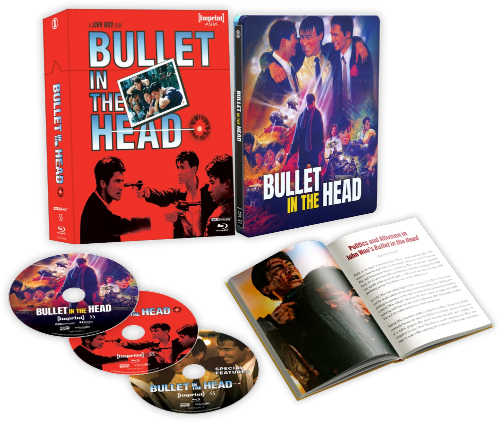
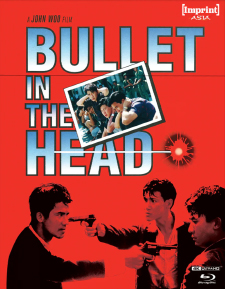
Via Vision’s Region-Free Limited Edition Steelbook 4K Ultra HD release of Bullet in the Head is #55 in their Imprint Asia line, and it’s limited to 1,500 units. It’s a three-disc set that includes one Blu-ray with a 1080p copy of the film and a second Blu-ray with the longer festival cut of the film, as well as a 52-page hardbound booklet featuring essays by Paul Bramhall and James Guild. Everything comes housed in one of Imprint’s rigid Hardboxes that opens up at the top. The following extras are included:
DISC ONE: UHD
- Commentary by Frank Djeng
- Trailers (HD & Upscaled SD – 7:38, 2 in all)
DISC TWO: BD
- Commentary by Frank Djeng
- Head Case (HD – 18:23)
- Army of One (HD – 4:41)
- Apocalypse Woo (HD – 7:50)
- Tumultuous Times (HD – 15:10)
- Hong Kong Confidential: Inside Bullet in the Head (HD – 13:08)
- Image Gallery (HD – 4:38, 55 in all)
- Trailers (HD & Upscaled SD – 7:38, 2 in all)
DISC THREE: BD
- Festival Cut (HD – 136:20)
- Brilliance with a Bullet (HD – 43:27)
- Apocalypse How? (HD – 27:08)
- Alternate Boardroom Ending (HD – 5:31)
- John Woo and the War (SD – 33:04)
- Baptism of Fire (SD – 15:05)
- Paradise Lost (SD – 14:36)
- Biting the Bullet (SD – 15:43)
- Tempting Fate (SD – 20:21)
- A Walk on the Wild Side (SD – 15:05)
- Natural Selection (SD – 33:54)
- Life Through a Lens (SD – 13:33)
- Code of Bullets – Part 5: Guns Mean Power/Gone with the Wind (SD – 8:52)
- Archival Interview with Waise Lee (SD – 10:05)
- Archival Interview with Terence Chang (SD – 6:47)
- Deleted Scenes (SD – 4:55)
Via Vision has included all of the extras from the Shout! Studios set as well as a healthy batch of archival extras. The Shout! extras kick off with a commentary featuring programmer and former Tai Seng Entertainment marketing manager Frank Djeng, who wastes no time letting us know his feelings regarding Bullet in the Head: he says that without a doubt, it’s Woo’s finest film. Djeng explains some of the background behind the film, including the conflict between Woo and Tsui Hark, and then dives into all the minutiae of the production with plenty of stylistic and thematic analysis along the way. As usual, that means not just identifying all of the actors and providing biographical information about them, but also noting when they were dubbed by others in the final cut. He offers some helpful details about the political context behind the story—while Bullet in the Head never specifies the exact year in which it takes place, it’s recognizable as 1967 based on the protests and riots that Woo dramatizes. Djeng also provides details about Bullet in the Head’s budget, box office, the various cuts, and much more. Djeng is always a fountain of information, and this track is no exception.
Shout! also offered five new interviews with various participants in the making of Bullet in the Head, starting with the master himself. In Brilliance with a Bullet, Woo ruminates on the nature of friendship and how that inspired the story for the film. He based the main characters on some of his own friends when he was younger, with Ah Bee being based on himself. He acknowledges his debt to The Deer Hunter, and describes some of the challenges on the lengthy shoot for Bullet in the Head, including the location work in Thailand. He also discusses his much longer original cut and the process of whittling it down into the various shorter versions. Challenging circumstances or not, he’s unquestionably proud of the film.
Head Case is with Waise Lee, who describes his journey from working as a part-time model to being a full-time actor. John Woo was instrumental in that process, casting him first in A Better Tomorrow, and eventually offering him one of the key roles in Bullet in the Head. Army of One is with producer Terence Chang, who offers an overview of Woo’s break with Tsui Hark and his own involvement with Bullet in the Head. Apocalypse Woo is with editor David Wu, who says that Bullet in the Head really is a John Woo film, in every way imaginable. He explains how losing some of the original negatives for the location work complicated the editorial process (which may be why there’s some odd dupe footage here and there). He also comments on how the score helped bring the whole film together. Tumultuous Times is with associate producer/production planner Catherine Lau, who recounts some of her other work in the Hong Kong film industry before explaining how she was hired for Bullet in the Head. It was a difficult production, logistically speaking, and she steps through some of what was involved.
There are also two more interviews that offer some outside perspective on Bullet in the Head. The first is another edition of Hong Kong Confidential with Grady Hendrix, co-author of These Fists Break Bricks. He explains the historical context behind the two key years that impacted the film’s story: 1967, when Woo was a young person during the Cultural Revolution in China, and 1989, when the Tiananmen Square protests occurred. Woo was brokenhearted by the Tiananmen massacre, and he was equally brokenhearted by his split with Tsui Hark, all of which informed the making of the film. Apocalypse How? is with Dr. Lars Laamann, author and associate professor at SOAS University in London. He builds on what Hendrix started, breaking down the protests during the Cultural Revolution in much greater detail, including the violence and the bombings. He also delves into 1989 and Tiananmen Square, some of which he personally witnessed as a student in China.
Last but not least, Shout! included a hybrid version of the 136-minute “festival cut” of Bullet in the Head, utilizing footage from the 4K remaster and adding back the missing, alternate, and/or extended scenes from the best available elements. Previous attempts to rebuild the longer cut have had plenty of issues, but this one is definitely superior to all of them (although it’s still not quite perfect). The differences are too numerous to detail here, but yes, it does include the infamous urine-drinking sequence. On the other hand, the Alternate Boardroom Ending is from the shorter 120-minute theatrical version, which dropped the entire car chase and gunfight from the end of the film in favor of a simpler and much more direct confrontation in the boardroom. It actually works surprisingly well, although most viewers will still prefer the prolonged battle instead. (Both extras are presented here in full HD at 1.85:1 with Cantonese 2.0 Mono DTS-HD Master Audio, although the subtitles do vary depending on the source.)
John Woo and the War first appeared on a DVD from HK Video in France. It’s an interview with Woo that takes a broader view of the way that the Vietnam war has shaped his filmmaking, from the way that it impacted his family to how he’s examined wartime settings in his film. Naturally, that means there’s an extended section devoted to Bullet in the Head, but he also addresses older films like Heroes Shed No Tears and later Hollywood efforts like and Windtalkers. Woo says that he offered more hope in the latter film because while he hates war, he still believes in humanity. The Archival Interview with Terence Chang came from the same source, with Chang once again covering his work at the intersection between John Woo and Tsui Hark. The Archival Interview with Waise Lee, on the other hand, was originally included on the DVD from Joy Sales in Hong Kong, as was Code of Bullets – Part 5, which is probably the most masturbatory of all the various episodes of Code of Bullets. It lauds the way that guns provide an extension of the power of those who use them. Yay.
The rest of the extras consist of interviews from the 2004 Hong Kong Legends Platinum Edition DVD in the U.K. Baptism of Fire is with Jackie Cheung; Paradise Lost is with Waise Lee; Biting the Bullet is with Simon Yam; Tempting Fate is with Patrick Leung; A Walk on the Wild Side is with Lau Chi-Ho; Natural Selection is with David Wu; and Life Through the Lens is with John Woo. (The latter interview wasn’t produced by Hong Kong Legends, but it still made its first appearance on their disc.) Finally, the Deleted Scenes montage includes some of the footage from the “festival cut.” Note that as usual these days, anything involving the problematic Bey Logan has been excised, so his Reflections on Bullet in the Head interview isn’t included, nor is the commentary track that he recorded for that release. (Needless to say, their text-only biography of Logan is also MIA.)
The only other significant extra that’s missing here is the HK Revisited Episode 5 documentary that was on the 2026 Édition Limitée UHD set from Metropolitan Film in France. The 2026 Arrow Films UHD does offer branching versions of the “festival cut” that can be played with or without the boardroom ending, although technically that doesn’t use any footage that isn’t included here. On the other hand, Arrow regraded the Shout! 4K master while it’s presented here unaltered, and they also created a new Atmos remix, so there are aural and visual differences between their version and all others. But they do appear to be missing the archival Terence Chang and Waise Lee interviews, so there’s that. Excluding the Metropolitan Film version since it wasn’t designed for English-speaking viewers, that means there are three different English-friendly UHD sets for Bullet in the Head from which to choose. We live in interesting times indeed. For my money, Via Vision has the edge thanks to their superior collection of extras and Steelbook/hardbox packaging, and I’m content with the Shout! Studios grade, too. Your own mileage may vary, but this fantastic release from Via Vision is well worth your consideration. Highly recommended.
-Stephen Bjork
(You can follow Stephen on social media at these links: Twitter, Facebook, BlueSky, and Letterboxd).