
Confessions of a Police Captain (Blu-ray Review)
- Review Date: Jun 05, 2026
- Format: Blu-ray Disc
-


Director
Damiano DamianiRelease Date(s)
1971 (April 21, 2026)Studio(s)
Euro International Films/Explorer Film ’58 (Radiance Films)- Film/Program Grade: B
- Video Grade: B
- Audio Grade: B
- Extras Grade: B-

Review
In 1972, writer/director Damiano Damiani told the French film journal Écran that “political cinema is simultaneously a long walk made of several steps, and a series of shocks aimed at shaking up public opinion.” He was tracing the evolution of Italian cinema from relatively populist forms like neorealism to later works that were more explicitly political, but on a personal level, it’s an apt description of his 1971 film Confessions of a Police Captain (aka Confessione di un commissario di polizia al procuratore della repubblica)—and on both a literal and a metaphorical level, too. Confessions of a Police Captain opens with Commissioner Bonavia (Martin Balsam) striding confidently through a mental institution in Palermo, comfortably trading in the kind of power that’s been granted to him via his authority as a police officer. And yet he seems just a tiny bit hesitant, too, since he’s about to take much larger steps into a world far outside the strictures of the Italian legal system.
Bonavia is visiting the institution in order to compel the release of a prisoner, Michele Li Puma (Adolfo Lastretti). The reasons why aren’t immediately clear, and as Bonavia tails the new parolee, there’s little doubt that Li Puma has plans of his own. It turns out that both of them have a target of a different sort in mind: corrupt local building magnate Ferdinando Dubrosio (Luciano Catenacci). Bonavia has been attempting to bring Dubrosio down, but the man has been safely in bed with the equally corrupt legal system that Bonavia is forced to serve. As a result, no charges ever stick to him, and Bonavia has had enough. That puts him in the crosshairs of idealistic deputy district attorney Traini (Franco Nero), with Li Puma’s sister Serena (Marilù Tolo) caught in the crossfire. But Boniva has stared long enough into the abyss that the abyss is staring back at him, making him willing to go to any lengths to stop the systemic corruption—even if that means allowing himself to be corrupted in the process.
That description may sound like a conventional Italian poliziotteschi, but Damiano Damiani was anything but a conventional director, and Confessions of a Police Captain is anything but a conventional film. Damiani had long since decided that he was no longer interested in making films based on other people’s conceptions, and Confessions of a Police Captain was a very personal project for him. Bonavia and Traini are both fictional characters, but Bonavia is a composite of various real Sicilian police officers that Damiani had known, especially in terms of their frustrations at being unable to secure convictions against leaders of the mafia. Bonavia is essentially all of them put together, pushed to the logical extremes that the real-life officers were unwilling to take. And Damiani also peppered his story with details inspired by actual events, in some cases only very thinly veiled, although the mafia’s economic interests with city planning in Palermo was a harsh reality that would have been all too familiar to Italian audiences at the time.
Yet Damiani wasn’t just trying to take a long walk of several steps in his own political cinema; he also wanted to provide a series of shocks in order to shake up public opinion. Bonavia may have been corrupted by his own inability to curb organized crime, but Damiani’s real target was the Italian judicial system that made conventional policework difficult if not impossible. Traini may be an idealist who’s disgusted by Bonavia’s willingness to bend the rules past the breaking point, but he’s about to have his eyes opened regarding his own department’s complicity in pushing Bonavia over the edge. Bonavia ultimately does get his man, one way or the other, but he still can’t beat the system that Traini serves. Bonavia ruefully acknowledges that even his own demise afterward will be a useless gesture, and Traini finally understands why after it’s far too late to make any practical difference.
Confessions of a Police Captain concludes with a sequence that shows the sickeningly casual way that innocent lives form the foundations for the city life that we all take for granted, and if Bonavia wasn’t able to do anything about that fact, then neither will Traini. Confessions of a Police Captain may offer the shocks that Damiani was after, but it can’t offer any real solutions. The more things change, the more they stay the same.
Cinematographer Claudio Ragona shot Confessions of a Police Captain on 35mm film (in 2-perf Techniscope) using spherical lenses. Release prints were anamorphic blowups, framed at 2.35:1. This version is billed as a 2K restoration, but it was delivered to Radiance as is, and there’s no other information available about the elements used or the remastering itself. But the results are far from the sharpest 1080p presentation out there, so the source may have been the interpositive or even an internegative. Still, it’s generally clean with only minimal damage visible, and the grain is fairly even (although it can look a little noisy at times against bright backgrounds like the sky). The colors are somewhat muted, probably intentionally so, but the contrast range is solid. It’s a fine if unremarkable HD version of the film.
Audio is offered in Italian and English 1.0 mono LPCM, with removable English subtitles. It may be tempting to stick with English since Confessions of a Police Captain appears to have been shot that way, and it also offers Martin Balsam’s own voice. Yet whoever performed the Italian dubbing for him did a credible job, and while the voice doesn’t quite sound like Balsam’s, it still seems natural coming out of his mouth, so it’s easy to get lost in the story and forget about the dubbing. That’s good, because the voice acting in the Italian version is superior. The Italian track does tend to sound a bit thin and tinny, with no real low end, and while that doesn’t do Riz Ortolani’s score any favors, it’s still free of distortion or major artifacts. Audition both and decide for yourself, but I narrowly preferred the Italian.
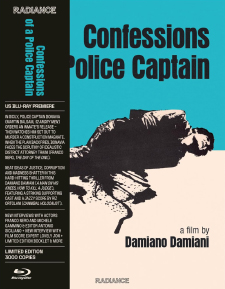
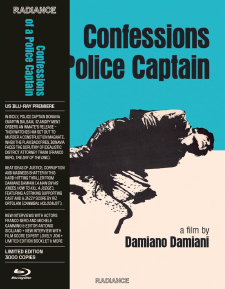
The Radiance Films Limited Edition Blu-ray release of Confessions of a Police Captain comes with a reversible insert with alternate theatrical poster artwork on each side, as well as one of their removable obi strips with the disc details and UPC code. It also includes a 24-page booklet featuring two different 1972 interviews with Damiani. The set is limited to 3,000 units. The following new extras are included, all of them in HD:
- Franco Nero (29:15)
- Michele Gammino (22:47)
- Antonio Siciliano (26:49)
- Lovely Jon (31:00)
- Gallery (78 in all)
With the exception of the Gallery, all of the extras consist of interviews. Franco Nero discusses working with Damiani and the rest of the cast and crew, from Martin Balsam to the various non-professional actors that Damiani favored. He also talks about the impact that the film had on his career, and his legacy as an actor. Michele Gammino discusses how Damiani helped him break out from voiceover work into a full cinematic acting career. He also offers his thoughts about the rest of the cast, and how he feels about the film’s presentation of his hometown of Palermo. Editor Antonio Siciliano describes his much lengthier working relationship with Damiani and the offbeat way that they communicated with each other—Damiani would send audio cassettes from the set describing what happened and asking Siciliano to deal with it. Editing for him is all about finding the proper rhythms, and that was challenging on Confessions of a Police Captain due to the different acting styles involved.
Finally, musician and soundtrack expert Lovely Jon is on hand to cover Riz Ortolani’s score, exploring his background, influences, what set him apart from other film composers of his era, as well as his work on Confessions of a Police Captain. Lovely Jon also examines some of Ortolani’s other scores like Mondo Cane, Day of Anger, The Great Silence, Don’t Torture a Duckling, and Cannibal Holocaust, many of which demonstrate Ortolani’s innovative way of juxtaposing moments of extreme violence with lush and even somewhat saccharin music.
The only thing that’s missing here from previous releases of Confessions of a Police Captain is an older interview with Franco Nero that appeared on various DVD versions. But that wasn’t just the only missing extra; it was pretty much the only extra that’s ever been available for the film, full stop. The new interview more than makes up for it, and rounding it out with even more interviews makes Radiance’s Blu-ray edition the best home video version of Confessions of a Police Captain to date. If you’re already a Damiano Damiani fan, it’s a must-buy, and if you’re not, it’s a great way to get started. (Even the archival interviews in the booklet are illuminating.) Recommended.
- Stephen Bjork
(You can follow Stephen on social media at these links: Twitter, Facebook, BlueSky, and Letterboxd).