
Conquest (4K UHD Review)
Director
Lucio FulciRelease Date(s)
1983 (April 28, 2026)Studio(s)
Conquest Productions/Golden Sun (Cauldron Films)- Film/Program Grade: C
- Video Grade: A-
- Audio Grade: B+
- Extras Grade: A
- Overall Grade: A
Review
Lucio Fulci’s 1983 foray into fantasy filmmaking, Conquest, can perhaps best be summed up this way: it was the first and last film in a two-picture deal that he had with Italian producer Giovanni Di Clemente. Needless to say, the experience wasn’t a happy one, and the final film wasn’t exactly what Fulci set out to make. To be fair, though, it really wasn’t what anyone set out to make. Conquest was a coproduction between Clemente’s Clemi Cinematografica, the Spanish company Golden Sun, and the Mexican company Producciones Esme S.A. International coproductions were nothing new in the world of Italian cinema, but there were a lot of cooks involved with creating the uneasy stew that is Conquest, and Fulci was caught in the middle (or at least until he wasn’t, since he left during postproduction and wasn’t involved with the editorial process).
Yet the chaotic roots of Conquest (not Chaotic Good ones, unfortunately) started much earlier than that. The project actually began under the aegis of Spanish writer/director José Antonio de la Loma, who wrote the initial script and intended to direct it. Esme S.A. producer Carlos Vasallo offered his own contributions, but Clemente took the next step by bringing in Italian screenwriter Gino Capone to do a complete rewrite. That eventually brought about the exit of de la Loma and the entrance of Fulci as director. Clemente wanted to capitalize on the success of fantasy films like Excalibur, The Sword and the Sorcerer, and Conan the Barbarian, but Fulci had never worked in that genre, so his involvement became yet another misshapen piece to the puzzle that is Conquest.
And oh, what a puzzle that it is. Attempting to describe the actual story for Conquest is a bit of a fool’s errand, but we’re all mad here, so let’s try. After receiving a magic bow from his father, young Ilias (Andrea Occhipinti) heads out into the wilderness to—well, exactly what his mission may be is never entirely clear. But he soon runs afoul of mysterious creatures led by the equally mysterious Orcon (Sabrina Siani), who has dreamt of her downfall at the end of a magic bow, so she wants to take Ilias out of the equation. Yet the young man ends up befriending the renegade Mace (Jorge Rivero), pitting the two of them against Orcon and her associates Zora (Conrado San Martín) and Fado (José Gras Palau). And that’s when things really start to get weird, because as it turns out, Ilias isn’t even the true hero of the story.
Conquest is really a series of disconnected incidents with only the barest of narrative threads in order to hold them together. You could disassemble all of those pieces, throw them up in the air, put them back together randomly, and it wouldn’t make any less sense. Yet it’s an undeniable fact that Lucio Fulci was never particularly concerned about narrative coherency in the first place. His horror films exist in dream states, both literal and figurative, and the lines between dreams and reality usually end up being blurred to the point of there being no line at all. Fulci treated all of Conquest as a waking dream, using every visual trick in his arsenal to disorient viewers and draw them into the realm of pure fantasy. Conquest doesn’t make a lick of sense, but it doesn’t have to make any sense in order to be effective.
Fulci had a real knack for presenting unique visions of the uncanny, and it’s a small step from the visionary horrors of The Beyond to his work on Conquest—different genres, similar effects. Fulci worked with cinematographer Alejandro Ulloa to cover all of Conquest in an impenetrable haze of smoke and diffusion, mirroring the inscrutable nature of the story in pitch-perfect fashion. Conquest is difficult to follow both visually and narratively, but Fulci was always far more interested in his set pieces than he was in the story that (vainly) tried to tie them together. And make no mistake: Conquest is filled with unforgettable brutal set pieces, including a woman torn in two like a wishbone (Ruggero Deodato must have been insanely jealous). It may not be a horror film, but it still looks and feels like a Lucio Fulci film from the first frame to the last.
Fulci didn’t feel the same way, of course, and that ended his brief partnership with Clemente before they even got around to thinking about what they wanted to do for a second film together. Between budgetary issues, interference from Clemente, and other production woes, Conquest just wasn’t the film that Fulci set out to make. Here’s the thing, though: it’s not the film that Clemente set out to make, either. Fulci may have left the project early, but he still left enough of his own unique stamp on the production that Conquest is unquestionably a Lucio Fulci film regardless of what his original intentions may have been. Yes, it’s borderline incomprehensible, but it doesn’t look or feel like any other fantasy film ever made. As with all things Fulci, just sit back, relax, and go with the flow. Don’t try to connect dots that were never intended to be connected in the first place, and you’ll find plenty to appreciate here (or just enough to appreciate, anyway, but sometimes you have to take what you can get).
Cinematographer Alejandro Ulloa (credited as Alejandro Alonso Garcia) shot Conquest on 35mm film using spherical lenses, framed at 1.85:1 for its theatrical release. This version is based on a 4K scan of the original camera negative, digitally remastered and graded for High Dynamic Range in Dolby Vision and HDR10. Scanning, basic grading, and digital restoration work were handled by Augustus Color in Rome, with some additional work performed by Outer Realm Studio and Gamma Ray Digital. The Dolby Vision grade was added by Fidelity in Motion, which also handled authoring and quality control.
Let’s get this out of the way up front: any way that you slice it, Conquest is a somewhat odd choice for receiving the full 4K treatment. There’s diffusion, then there’s diffusion, and then there’s Conquest. To give everything an otherworldly feel, Ulloa employed diffusion filters, fog filters, smoke, fog machines, and possibly even silks and/or Vaseline over the lens. If you’re looking for 4K worth of fine detail, you were never going to find it here; in terms of cinematography, Conquest is Excalibur on steroids. Yet all of that combined with the naturally heavy grain from the stocks that Ulloa used means that there’s plenty of potential pitfalls when encoding to disc, and David Mackenzie at FiM took full advantage of all the available breathing room that the UHD format can offer (it’s a BD-66 in this case, but Conquest is an 89-minute film and there aren’t any extras on the disc aside from a commentary track, so there was plenty of space to work with).
Given all of the diffusion involved, the contrast range is naturally somewhat muted, but the black levels are still as deep as they can be, and the equally muted color scheme seems to be reproduced as accurately as possible. There’s nothing particularly vivid here, but that’s because there was nothing particularly vivid on the camera negative in the first place. It’s a striking look that won’t be to all tastes, but it’s hard to imagine that Conquest could possibly look any better than it does here. Is it 4K demo material? Hardly. But it still looks exactly like it should.
Audio is offered in English 2.0 mono and 2.0 stereo DTS-HD Master Audio, plus Italian 2.0 mono DTS-HD Master Audio, with optional English SDH for the English track and English translated subtitles for the Italian one. Conquest was released theatrically in Dolby Stereo, at least in North America, so the English-language mono track can be safely ignored. But the subject of languages is a tricky one in this instance. While many of Fulci’s films from the period were shot primarily in English (even though all of the audio was post-synced), Conquest was an Italian-Spanish-Mexican coproduction with no English-speaking actors, which is an argument in favor of Italian. Yet there’s another factor that tilts the balance in favor of the English stereo track: Claudio Simonetti’s score. It’s as much responsible for the atmosphere of Conquest as is Ulloa’s cinematography, and it fills the soundstage in Dolby Stereo. There’s little in the way of surround activity other than some reverb for the score, but it still easily trumps mono regardless of language.
Note that there are some other differences between the English and Italian tracks that go beyond Dolby Stereo and the dubbing in general. The Italian track utilizes a different piece of music during the closing credits, and some of Orcon’s dialogue is handled differently in both versions. She speaks straight Italian in the Italian track, but the English track has some of her chants spoken in a “mystery language” instead, which is arguably more effective. But it’s still going to be a matter of taste. I recommend the English Dolby Stereo track, but compare it to the Italian and judge for yourself.
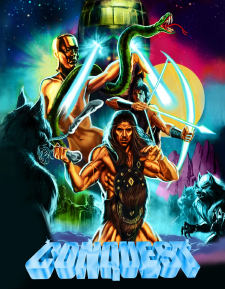
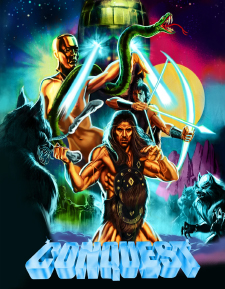
The Cauldron Films Limited Edition 4K Ultra HD release of Conquest is a four-disc set that includes a Blu-ray with a 1080p copy of the film; another Blu-ray with the bulk of the extras; and a CD copy of Simonetti’s soundtrack. It also includes a 48-page booklet with essays by Michael A. Martinez and Andrea Meroni, as well as a set of NSFW puffy stickers (and if you’re not familiar with some of the grotesque imagery in the film, trust me when I say that it’s very NSFW). The insert is reversible, with alternate theatrical poster artwork on each side, and everything comes housed in a rigid slipcase featuring new artwork by Justin Coffee. (Cauldron will also be releasing a standard version once the Limited Edition sells out, minus the CD, booklet, and slipcase.) The following extras are included, all of them in HD:
DISCS ONE AND TWO: UHD & BD
- Commentary by Eugenio Ercolani and Nanni Cobretti
The new commentary teams film historian and extras producer Eugenio Ercolani with critic Nanni Cobretti, the latter of whom calls Conquest a film that could have been Fulci’s masterpiece but it’s still one of his favorites in Fulci’s filmography. They cover Fulci’s somewhat complicated history during the period in which he made Conquest, as well as the other fantasy films that may or may not have provided some inspiration. They explore the production of Conquest, from the cinematography to the score (interestingly enough, since Fulci wasn’t involved with postproduction, he never even met Simonetti). They also address the budgetary issues and the box office failure of the film. It’s really more of a conversation than a screen-specific commentary, but Ercolani and Cobretti have plenty to talk about, so it’s well worth a listen.
DISC THREE: BD
- Jorge the Outlaw (10:43)
- A Catalan Wolfman in Sardinia (33:15)
- Post-Goblin Conquests (23:56)
- Operating the Conquest (14:39)
- Caveman Talk (18:21)
- More Than Just a Name (23:12)
- A Conversation with Jorge Rivero (23:08)
- The Arsenal of Fantasy (14:32)
- Conquering Occhipinti (12:55)
- Conquest or: How I Learned to Stop Worrying and Love Fulci’s Bomb (13:20)
- Fulci Beyond Conquest (29:15)
- Serurta (10:00 + 42:55)
- Theatrical Trailer (1:11)
- Grindhouse Trailer (1:25)
With the exception of the trailers and A Conversation with Jorge Rivero, the rest of the extras here have all been newly produced for this edition, with the first six consisting of interviews. Jorge the Outlaw is with Jorge Rivero, who says that Fulci is one of the most creative directors that he ever worked with, and they were able to sync with each other despite the language barriers between them. He also tells stories about the production and shooting in Sardinia. A Catalan Wolfman in Sardinia is with José Gras Palau, who also discusses the Sardinian shoot and other details about Conquest, as well as spending some time on the other films that he made during that period, like Bruno Mattei’s Hell of the Living Dead.
Post-Goblin Conquests is with Claudio Simonetti, who provides an overview of his scoring efforts after the breakup of Goblin in 1978, including the tools that he used like the Minimoog, focusing on his work with Fulci and Dario Argento (although he gives Conquest somewhat short shrift). Operating the Conquest is with camera operator Frederico Del Zoppo, and like Simonetti, he gives a broader overview of his career with only a small portion focusing on working with Fulci. Caveman Talk is with screenwriter Gino Capone, who started writing for the theatre when he was 12 and never looked back. His work with producer Giovanni Di Clemente included Conquest, which started out with José Antonio de la Loma’s script that Di Clemente asked him to rewrite in the vein of Conan the Barbarian (so whatever Fulci may have had in mind, the Milius film was still an influence). More Than Just a Name is with cinematographer Paco Marin, who is on hand to discuss his own work in the film industry and the career of de la Loma (although he doesn’t cover Conquest at all).
Cauldron has also added four new visual essays. The Arsenal of Fantasy is by Heather Wixon, and it examines the broader context of Eighties fantasy films like Excalibur, Dragonslayer, and Clash of the Titans, but she also expands the field to include the likes of Krull, The Sword and the Sorcerer, The Beastmaster, Conan, and even The Secret of N.I.M.H. The Italian film industry during that period was usually quick to follow trends, so it was inevitable that they would jump into the world of fantasy films as well. Yet for all of the issues involved with the production of Conquest, Wixon still feels that it’s clearly a Fulci film through and through. A few of her pronunciations are a little wonky, but it’s still a good overview.
Conquering Occhipinti is by Pier Maria Bocchi. He focuses on the elusive actor/producer/distributor Andrea Occhipinti, who rarely talks about his early life and acting career. Bocchi tries to determine why that’s the case, and in lieu of any actual participation from Occhipinti, he offers an outsider’s perspective on the actor’s genre films from the Seventies and Eighties.
Conquest or: How I Learned to Stop Worrying and Love Fuci’s Bomb is by Mike Foster, who makes no bones about the fact that it’s his favorite Fulci film—not because it’s better than The Beyond or any of Fulci’s classic horror films, but rather because it’s so unique. Further, he believes that it’s more faithful to the works of Robert E. Howard than even the Conan films. With all of that as a foundation, Foster addresses the singular look and feel of Conquest, from its visuals to the way that it expresses the essential weirdness of Howard’s tales better than any of the “official” adaptations—in this case, the weirdness (including the hazy cinematography) is a feature, not a bug.
Fulci Beyond Conquest is also by Foster, this time tracing Fulci’s career during the Eighties from Zombie all the way to the troubled Zombie 3. Foster feels that the (debatable) decline in quality in Fulci’s work tracks with the general decline in Italian genre cinema during that period. And yes, Foster once again defends Conquest while still admitting that it’s the first misstep in a series of missteps that Fulci would continue to take as the decade progressed (that’s still a debatable point, although even the most ardent of Fulci fans will probably agree).
Finally, there’s an archival interview with Rivero, A Conversation with Jorge Rivero (which was originally produced for the 2019 Blu-ray from Code Red), as well as the 2016 short film Seruta along with an introduction by writer/producer Merlyn Roberts and writer/director Steven Lyons. They say that Seruta was influenced by fantasy films and fantasy literature, principally the works of Robert E. Howard (and especially the Marvel Conan comic series). But fantasy films of the early Eighties were also influential, like Conquest, Beastmaster, and Krull. They also discuss the challenges of putting the project together, including starting out without a finished script (so Seruta has more in common with Eighties fantasy than may meet the eye). They never finished the film, either, but it’s shown here as an incomplete short, presented at 2.39:1 with 2.0 LPCM audio, and with the various invented languages subtitled in English.
There’s also at least one Easter Egg on this disc:
- VHS Version (SD – 88:26)
It’s the English-language videotape version (although it’s got the Italian Clemi Cinematografica logos up front), presented at full-frame 1.33:1 with 2.0 Dolby Digital audio. To locate it, remember that the arrow keys on your remote are always a part of your arsenal...
Last (no, really this time) but certainly not least, there’s Simonetti’s soundtrack, which appears to be the same track listing and run times as Rustblade’s 2016 vinyl version, making this the first time that it’s appeared on CD:
DISC FOUR: CD
- Conquest Main Theme (2:36)
- Flutes in the Night (4:26)
- Night Creatures (2:18)
- Capture (1:31)
- Cavern (1:08)
- Killer Moles (2:26)
- Black Bird (1:17)
- Zombies in the Dark (2:39)
- Lonely Man (1:27)
- Cavern (Claudio Simonetti Remix) (4:39)
- Funny Hunt (:37)
- Night Creatures (Stefano Rossello Remix) (3:40)
- Dolphin (1:09)
- Night Creatures (Claudio Simonetti Remix) (4:00)
- Conquest 2016 (4:02)
While most of Lucio Fulci’s better-known horror films have been home video perennials, with numerous releases and rereleases over the years, Conquest has never received the kind of lavish attention that Cauldron Films has given it here. So, there aren’t a ton of things missing here from previous versions, but there are just a few. While Code Red’s A Conversation with Jorge Rivero did make the transition to Cauldron, their featurette Jorge Rivero and Banana Man didn’t. They also offered their own commentary with Troy Howarth and Nathaniel Thompson. Other than that, the only other thing is that the 2012 30th Anniversary Collector’s Edition DVD from ’84 Entertainment in Germany had a German-language commentary with Marcus Stiglegger and Ivo Ritzer (although it’s definitely worth pointing out that the soundtrack CD included with that set was the original abbreviated 9-track version).
But that’s all small potatoes. Needless say, this Cauldron Films Limited Edition 4K Ultra HD release of Conquest easily beats any and all previous versions of the film, and it’s going to stand as the definitive release of Conquest for some time to come. While Cauldron’s eventual standard release will include the film and all of its extras, the inclusion of the soundtrack CD alone makes this the one to jump on while it’s still available. No, Conquest isn’t The Beyond, but it doesn’t have to be. Troubled production or not, Fulci’s desired end product or not, it’s still indisputably a Lucio Fulci film, with all that entails, for good and for ill. Highly recommend for fans who are willing to accept things as they are, not as they might have been.
-Stephen Bjork
(You can follow Stephen on social media at these links: Twitter, Facebook, BlueSky, and Letterboxd).