
Cross Creek (Blu-ray Review)
- Review Date: Apr 13, 2026
- Format: Blu-ray Disc
-


Director
Martin RittRelease Date(s)
1983 (February 25, 2026)Studio(s)
Thorn EMI Films/Universal Pictures (Imprint Films/Via Vision Entertainment)- Film/Program Grade: B
- Video Grade: A
- Audio Grade: A
- Extras Grade: B


Review
[Editor’s Note: This is a Region-Free Australian Blu-ray import.]
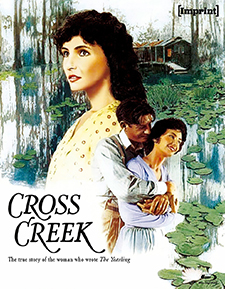
Marjorie Kinnan Rawlings is best known as the author of the 1938 novel The Yearling, which was adapted into a film eight years later. The novel grew out of her experiences during a period in her life that she spent in rural Florida. Her memoirs recounting these experiences form the basis of the motion picture Cross Creek.
Cross Creek opens in 1928 as Rawlings (Mary Steenburgen, Melvin and Howard) decides to leave the security of marriage to a New York writer to live, alone and undisturbed, in a remote area of Florida where she and her husband had purchased an orange grove so she can at last indulge her passion for writing. She intends to live off the proceeds from selling the oranges.
She endures the hardships of rural life while writing day and night, yet there’s little interest from publishers for her submitted work. The residents of the region are at first wary of this outsider but eventually warm to her as she gets to know them and they trust her. Her letters to a publisher are filled with such vivid descriptions of life in Cross Creek and its colorful residents that he encourages her to write about them for publication.
Rawlings gradually develops a relationship with local hotel owner Norton Baskin (Peter Coyote, Erin Brockovich), revitalizes her land through hard physical work, and becomes friends with her housekeeper, Geechee (Alfre Woodard, Annabelle). She also gets to know the backwoods Turner family, including the father, Marsh (Rip Torn, Men in Black), and their young teenage daughter, Ellie (Dana Hill, Shoot the Moon).
The theme of the film is how, in stages, the writer comes to love her new life and how it inspires her to find her own literary voice. Steenburgen embodies this feisty, stubborn woman unafraid to stand up for herself and willing to get her hands dirty cleaning a ramshackle house and removing debris from the creek to improve irrigation.
The film’s leisurely pace is essential to show the locals’ gradual acceptance of Rawlings and her dawning admiration for their values and dignity. She’s initially condescending to Geechee as an inconsequential servant and is often downright rude to Baskin, a true southern gentleman who makes his interest in her quite clear. In anger, she shoots a hog belonging to Marsh Turner, then displays brutal honesty as she suggests how to make things right.
The screenplay raises several questions. As portrayed in the script, Rawlings is an enigma. What was her life like with her first husband? What prompted her to abandon a life of comfort and security? Was it necessary for her to give up her personal relationships in order to write? Was she really proficient at painting and carpentry and physically able to lift heavy logs?
Director Martin Ritt has elicited very fine performances from the cast. Steenburgen conveys a combination of steely independence, empathy for the locals, and focused dedication to her craft as she negotiates a new and different world. Woodard is hugely entertaining as Geechee, a woman with unbridled energy and a simple sense of what friendship means. Torn is a man who loves his family but must balance that love with practicality as he deals with Ellie’s pet deer. Malcolm McDowell, who was then married to Steenburgen, turns up in one scene as Max Perkins, the publisher who travels to Cross Creek to tell her personally that he will publish one of her stories.
There’s a gentle tone to Cross Creek that reflects Rawlings’ musings on the area and its inhabitants. Some scenes focus on the beauty of the Florida wilderness. Leonard Rosenman’s evocative score adds resonance to the images and captures the lush, unspoiled environment in musical poetry.
Cross Creek was shot by director of photography John A. Alonzo on 35mm film with spherical lenses, processed by Technicolor, Hollywood, and presented in the aspect ratio of 1.85:1. The color palette on the Imprint Films Blu-ray release is vibrant, with rich greens dominating and contrasting with the more subdued browns, tans, and whites of clothing and Rawlings’ shack-turned-home. Complexions are well rendered with Steenburgen’s peaches-and-cream face especially rosy and sunny. The picture is sharp, with good detail. There are no physical imperfections to impair enjoyment. The Florida backwoods look especially beautiful when Rawlings rides in a small boat through the marshes. Period cars and clothing set the film in the time period of the late 1920s.
The soundtrack is English 2.0 LPCM. English subtitles are an available option. Dialogue is clear and distinct. Steenburgen’s narration ties the sequences together and quotes passages from Rawlings’ memoir. The sounds of chirping birds are prominent in most of the outdoor scenes. As Rawlings and some helpers clear debris from the creek, there are grunts and sounds of heavy logs being moved. Later, the sound of water lapping through a freshly dug ditch is the payoff for the hard work. A dramatic gun shot pierces the quiet of the woods, and the Turner children scamper through underbrush to corral a pet deer that escapes from its pen. Leonard Rosenman’s music nicely adds to the gentle mood of the film with its often moving arrangements.
Bonus materials on the Region-Free Blu-ray release from Imprint Films include the following:
- Audio Commentary by Scott Harrison
- Cross Creek: A Look Back with Mary Steenburgen (17:08)
- Theatrical Trailer (2:28)
Audio Commentary – Film historian Scott Harrison comments on the opening credits, since many modern films start with the action. The film provides a sense of place and belonging and is about human mistreatment of the environment. The message resonates today because of global warming. The landscape of Cross Creek is “a character in its own right.” Referred to as the Big Scrub, it’s an area where the affinity between people and places is strongly felt. Harrison reads an expansive passage from Rawlings’ memoir in which she writes poetically about the beauty of her surroundings. Cross Creek was a “hangover of the auteur films of the 1970s,” when projects were driven by such directors as Peter Bogdanovich, Martin Scorsese, William Friedkin, and Francis Ford Coppola. With the success of Jaws, studios began to take control of their own projects, hoping to produce the next blockbuster. Cross Creek was a passion project for producer Robert B. Radnitz, but every major studio turned down the script until Thorn EMI agreed to finance it with Universal distributing it in the United States. Filming began in April, 1982 in various Florida locations. In a rare interview for the book Writers on Writing, Rawlings said “writing is agony” and discussed her daily routine working eight hours a day to obtain maybe three pages of usable narrative. Many cast members met with people who actually knew Rawlings. Mary Steenburgen didn’t want her performance to “stray into the overdramatic and sentimental.” Rawlings moved to Cross Creek in 1928 when she was 32. As mistress of a small plantation, she kept animals, grew gardens, harvested, and hired and fired workers. She won the Pulitzer Prize in 1939 for The Yearling, which focuses on dilemmas and challenges common to all people. Her memoir Cross Creek is exceptional in the way it depicts life in Florida in the first half of the twentieth century. It’s a portrait of a woman who sets out for what she wants, faces and overcomes obstacles, and achieves her goals. Commentator Harrison reads from four reviews, two favorable and two negative. He regards Cross Creek as “a visually stunning film.”
Cross Creek: A Look Back – Actor Mary Steenburgen reminisces about her experiences making Cross Creek. She read The Yearling when she was a child and spoke to the real Norton Baskin, who provided considerable insight into the character of Marjorie Kinnan Rawlings. She was hard-drinking, stubborn, and gutsy. Steenburgen wanted to show both the writer’s good and bad qualities. Rawlings, an outsider when she arrived in Florida, was eventually accepted by the locals. The area was “exotic,”—lush with multiple shades of green. The film is about a writer trying to “tame” a little piece of it. “The sensuality of that place was so palpable.” Martin Ritt, who was blacklisted during the HUAC hearings, had the ability to be both idealistic and real. According to Steenburgen, he “was a dream to work with.” He loved actors. Working with Rip Torn, Steenburgen never knew what to expect, since he brought different nuances to each take. Alfre Woodard was risk-taking and fun. Peter Coyote had a “southern sleepy-eyed thing going.” About 70% to 80% of the film was shot hand-held. Cross Creek was screened at Cannes and was received enthusiastically.
Not included from the Kino Lorber Studio Classics release is an audio commentary with film historians Julie Kirgo and Peter Hankoff.
Cross Creek reminded me of Little Women, a novel with a feminist subtext, in which a young woman is determined to become a published writer yet doesn’t realize the best material lies right before her. The film unfortunately omits information about Rawlings that would have provided a richer characterization. Lovingly shot by director of photography John A. Alonzo, the milieu contributes visual atmosphere. Conflicts never achieve monumental proportions but deal with day-to-day obstacles, so there are no dramatic pyrotechnics. Instead, many of the episodes portray simple people, their humanity, and the journey Rawlings takes to find success as a writer.
- Dennis Seuling