
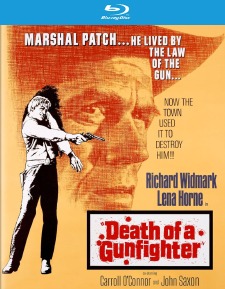
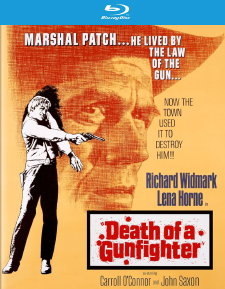
Death of a Gunfighter (Blu-ray Review)
Director
Allen Smithee (Robert Totten and Don Siegel)Release Date(s)
1969 (May 5, 2026)Studio(s)
Universal Pictures (Kino Lorber Studio Classics)- Film/Program Grade: B
- Video Grade: A
- Audio Grade: A-
- Extras Grade: B-

Review
Like the stylized, italicized font of its main title design, Death of a Gunfighter (1969) is somewhat askew. Made when the Western movie genre was in decline, pulled in multiple directions from various influences, this uneven if character-driven Western drama offers many interesting ideas and a good central performance by Richard Widmark, but in other respects this very uneven film has the tired look of a perfunctory backlot Western; visually, it’s like an expanded episode of Gunsmoke.
Death of a Gunfighter was a troubled production that led to a cinematic landmark of sorts: it was the first movie to credit “Allen Smithee” as its director. Most of it was helmed by Robert Totten, but he didn’t get along with Widmark, and so Totten was replaced about three-quarters of the way through by Don Siegel. Siegel didn’t want to take credit, nor did Totten, who felt his vision of the film had been compromised, thus the notorious, official pseudonym (usually as “Alan Smithee”) was born.
At the turn of the century, Frank Patch (Widmark) is the longtime marshal of Cottonwood Springs. Luke Mills (Jimmy Lydon), mean-drunk after being unable to “perform” in bed with a local prostitute, goes on a late-night rampage, targeting Patch, who years before had a brief affair with Mills’s wife, Laurie (Jacqueline Scott). When Mills takes a shot at Patch from a hayloft, Patch fatally wounds him.
This does not sit well with the town council—Mayor Chester Sayre (Larry Gates), Ivan Stanek (Morgan Woodward), newspaper publisher Andrew Oxley (Kent Smith), and others—who want to develop Cottonwood Springs into a big, modern, and respectable city, and who believe Patch’s violent, Wyatt Earp-like methods for maintaining law and order is deterring local investment. They want to oust him and establish a modern police force, but Patch, hired in desperation 20 years before, was promised a lifetime appointment, and he refuses to budge. The conflict escalates quickly.
Original director Robert Totten had a busy career similar to earlier Columbia second feature director Fred F. Sears. Both were actors who became very prolific directors, burning hot but dying relatively young, perhaps from overwork. Totten’s first film was the low-budget war movie The Quick and the Dead (1963), which he co-wrote and which co-starred frequent collaborator Victor French, who later alternated between acting and directing himself. Totten directed episodes of ’60s TV shows like Bonanza, Hawaiian Eye, and Temple Houston, but most famously 25 episodes of Gunsmoke during that series’ 11th through 17th seasons. Further, he wrote one episode and had large acting parts in two shows directed by others. Gunsmoke was enjoying something of an inexplicable resurrection; after facing cancellation in 1967 only to get a last-minute reprieve, at the time of Death of a Gunfighter, it had bounced back in a big way and was the No. 2 primetime series that year.
That would explain why Death of a Gunfighter is so loaded with actors who were regular guest stars on Gunsmoke, particularly Jacqueline Scott, Morgan Woodward, and Totten’s old friend Victor French, but also Carroll O’Connor, Harry Carey Jr., Royal Dano and others.
The movie, based on Lewis B. Patten’s novel of the same name, aims for a kind of elegiac Western story along the lines of Ride the High Country and the later The Shootist, in this case the violent lawman (not a gunfighter) of the Old West who has no place in a west of horseless carriages, powered by electric lights and gas streetlamps. Indeed, one clever touch is that the shootout in the barn with Mills is resolved when Patch simply turns on an electric light, so that he can see where Mills is hiding. Nevertheless, the screenplay is awkward; from beginning to end, Patch only fires his gun in self-defense, yet by the end he’s also killed at least a half-dozen of his fellow townsmen, and driven another to commit suicide.
On one hand, the town council is unsympathetically motivated by commerce; conceptual art in their boardroom envisions a big, bustling modern city, while others, like Carrol O’Connor’s character, are merely troublemakers trying to incite violence. But with Widmark’s Patch, the filmmakers are trying to have it both ways with a stubborn man who admits to a having a bad temper and indirectly winds up killing half the town, but who also spends much of the story in folksy scenes serving as a role model for unformed young adult Dan Joslin (Michael McGreevey), who idolizes him. Widmark and McGreevey had a very similar relationship in The Way West (1967); Death of a Gunfighter almost plays a continuation of that friendship.
The film marked the big-screen return of Lena Horne, her first movie in 13 years, playing Patch’s love interest, she even singing over the main and end titles. They’re seen in bed together, they kiss, and their characters even marry, yet this interracial marriage plays no role at all in the plot; no one reacts to this relationship one way or another. Conversely, there are undercurrents of racism and antisemitism in the script, in the form of Patch’s old friend, Sheriff Trinidad (John Saxon), a Hispanic lawman who faced discrimination; and a Rosenbloom (David Opatoshu, wasted), a Jewish councilman. The screenplay doesn’t do much with these components, but their presence, particularly Horne’s character, adds a little interest.
Death of a Gunfighter definitely is peculiar at times. The art direction and costume design are a jumble of standard Western genre designs with attempts to create a turn of the century look, but the results are mixed. Carroll O’Connor, for instance, might be wearing clothes authentic to the period, but the way he’s dressed he looks like a 1960s racetrack tout. Dan Joslin is attracted to pretty Hilda Jorgenson (Darleen Carr), conferring with Patch about matters of sex. One scene has Dan going nuts watching Hilda wash a window, she sashaying her butt back-and-forth, a sequence almost certainly inspired by the infamous car washing scene with Joy Harmon in Cool Hand Luke. The film over-emphatically emphasizes the heat by making the actors sweat profusely throughout the story, which eventually becomes a little comical. But the oddest aspect, fleeting as it is, is that during the big shootout at the end, an uncredited O.J. Simpson peeks out from behind a window. Where did he come from?
Kino’s Blu-ray, licensed from Universal, presents Death of a Gunfighter in its original 1.85:1 widescreen format. The video transfer is excellent, very sharp throughout (the better to see all that dripping sweat) with strong, vibrant color and good contrast. The DTS-HD Master Audio (2.0 mono) is also fine, with optional English subtitles provided. The disc itself is Region “A” encoded.
Extras are limited to a trailer and a new audio commentary track by film historians Steve Mitchell and Dwayne Epstein.
Death of a Gunfighter is an odd, smaller-scale studio film, ambitious in some respects that pay off, at times only partway, and with other ideas that don’t work or lead nowhere. It’s not exactly a good film, but neither is it a bad, perfunctory outing along the lines of Five Card Stud or Stay Away, Joe. Its combination of the familiar and unusual has its share of rewards.
- Stuart Galbraith IV