
Hyena in the Safe, A (Blu-ray Review)

Director
Cesare CanevariRelease Date(s)
1968 (November 25, 2025)Studio(s)
Fering (Celluloid Dreams)- Film/Program Grade: C+
- Video Grade: A-
- Audio Grade: B+
- Extras Grade: A

Review
Made primarily by a cast and crew that had rarely if ever made a film before and disappearing not only from theaters, but in all forms of aftermarket media all around the world, 1968’s A Hyena in the Safe (Una iena in cassaforte) is one of the more unusual giallo films of its time. Today, gialli are mostly pigeonholed as psychological thrillers and horror films with black-gloved killers whose identities aren’t revealed until the final minutes. In fact, the giallo comes in many forms, even in an Agatha Christie-type package like A Hyena in the Safe, which is concerned more with aesthetic than just about anything else. Whether that’s enough or not is up for some debate.
During the annual Carnival festival, a group of master thieves have reconvened one year after their successful diamond heist from an underground vault at a private villa to share in their ill-gotten gains. Their employer, Boris, has died since then, and his widow Anna (Marie Luise Greisberger) is now in charge. Among the thieves are Klaus (Stan O’Gadwin), Juan (Ben Salvador), Karina (Karina Kar), Steve (Dmitri Nabokov), Albert (Sandro Pizzochero), and Albert’s fiancée Jeanine (Gaioni). Each of them has a key that will open an impenetrable underwater safe once all of the keys are inserted at the same time, rewarding them with the coveted gems. When one of them claims to have lost their key, it leads a series of murders before the diamonds can be harvested and carefully examined by hired gem expert Callaghan (Otto Tinard).
A Hyena in the Safe’s most attractive asset is its set design and cinematography. Shot on a luxurious private villa in Varese, the sense of scale and the opportunities for picturesque moments are numerous. There’s also a mix of attractive gel lighting (an Italian cinema staple), unusual angles, stark compositions, and gorgeous color schemes. It’s impeccably-designed by cinematographer Claudio Catozzo and director Cesare Canevari, the latter of whom only made nine films, including the 1970 Western Matalo!, the 1969 erotic drama A Man for Emmanuelle, and the 1977 UK video nasty The Gestapo’s Last Orgy.
The other main star of the film is Gian Piero Reverberi’s score, which features a frequent use of an uptempo number that winds up being a sort of an overall theme for the film. However, it’s the start of some of my issues with this particular production. This theme is played entirely too many times, breaking any tension or tone that the film might be going for. It almost feels like a parody of caper films in a way, which were certainly not unheard of in Italy at that time, and by the end the fake-out of a superimposed yellow pulsating shape on the lower left corner of the screen that eventually morphs into “FIN” sort of signifies that the film is playing with the audience a bit. Twist after twist after twist is revealed at the end, making light of everything we’ve seen up to this point.
Genre experts will disagree with me, but A Hyena is the Safe feels disjointed and doesn’t exactly know what kind of film that it wants to be. It attempts some occasionally disturbing death scenes, one involving a man screaming his head off as he’s slowly drowned, but it also wants to be playful and even humorous. It’s by no means a mess, but it doesn’t feel cohesive enough to be entirely effective. Watching it with the sound off will definitely remind you of just how important the visuals are. Many of its sequences are memorable, but its presentation is more important.
Cinematographer Claudio Catozzo shot A Hyena in the Safe on 35mm film with spherical lenses, the results of which were processed photochemically, and presented theatrically in the aspect ratio of 1.33:1 (according to commentator Guido Henkel). Celluloid Dreams debuts the film on Blu-ray worldwide with a “new high-definition, restored transfer from [a] studio provided master,” which was sourced from a 2021 scan of the original camera negative, and has been encoded by Ryan Masciola of Diversified Video Solutions to a dual-layered BD-50 disc. As this has only been released on home video one other time, fourteen years ago on DVD in Italy, there’s nothing to previously compare this to unless you own a bootleg copy of the film. Even if that’s not the case, this presentation should knock your socks off. It offers an amazing amount of fine detail in every frame, from interiors to exteriors, with maxed out bitrates sitting mostly in the 30 to 40Mbps range, and even beyond. The color palette is beautiful and features a wide array of hues, as well as perfect contrast and super deep blacks. It’s also a stable image and only a minor amount of damage to the negative is leftover, which is infrequent, as well as minor speckling and lines throughout. Otherwise, this is a marvelous-looking disc.
Audio is included in Italian 2.0 mono DTS-HD Master Audio with optional subtitles in English. As Guido Henkel explains in his audio commentary, the film died in Italian cinemas after only one week, and therefore was never exported to English-speaking territories. As such, there’s only an Italian mono soundtrack presented in a split channel container. The score actually has some nice boost to it, despite the track’s obvious constraints. Dialogue is discernible and syncs fairly well against the picture, while sound effects are offered decent presence in the mix. The track is also clean without any problems to speak of.
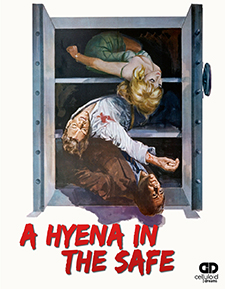
The Blu-ray release of A Hyena in the Safe sits in a clear Amaray case with a note about the restoration and a double-sided insert featuring artwork from one of the film’s Italian theatrical posters, with the English title on the front and the Italian title on the reverse. Exclusive to the Celluloid Dreams website is a slipcover featuring new artwork by Thu Lieu Pham and a set of eight 12”x8.25” reproductions of the original Italian lobby cards. The following extras are included on the disc, all in HD:
- 7 Guests for a Massacre (51:10)
- Schrödinger’s Diamonds: The Duplicitous Mystery of A Hyena in the Safe (36:04)
- The Mysteries of Villa Toeplitz (7:52)
- Audio Commentary by Guido Henkel
- Image Gallery (15 in all)
- Italian Trailer (4:10)
Carried over from the Cecchi Gori TV (Cinekult) DVD release is the two-part featurette 7 Guests for a Massacre. Part one interviews director Cesare Canevari about his career and the film at hand. Part two interviews the film’s general organizer Nini Della Misericordia, journalist Adriana Morlacchi, journalist and film critic Diego Pisati, and actor Sandro Pizzochero about the filming locations, primarily the Villa Toeplitz in Varese, Lombardi. Schrödinger’s Diamonds is a video essay by Andy Marshall-Roberts that delves into the film’s characters, thematics, and plot twists. The Mysteries of Villa Toeplitz is a short tour of the main filming location, hosted by Francesco Pollanetti, who also speaks about aspects of the film. Guido Henkel delivers another fantastic audio commentary that covers all aspects of the production, its release, its aftermarket life (or lack thereof), its restoration, and details about those who participated in it. Last is an Image Gallery containing 15 stills of lobby cards and posters, and the film’s Italian trailer. Not carried over the 2012 Region 2 DVD release in Italy is a promo for Nocturno magazine.
Fans of Italian cinema, especially the deepest of cuts, will appreciate this release of A Hyena in the Safe the most, especially since it’s never before been made available on disc in North America. It has a great picture and a terrific set of extras, making it another winner from Celluloid Dreams.
- Tim Salmons
(You can follow Tim on social media at these links: Twitter, Facebook, BlueSky, and Letterboxd. And be sure to subscribe to his YouTube channel here.)