
Lake Mungo (4K UHD Review)
Director
Joel AndersonRelease Date(s)
2008 (December 3, 2025)Studio(s)
SBS Independent/Screen Australia/Mungo Productions (Umbrella Entertainment)- Film/Program Grade: A
- Video Grade: A
- Audio Grade: A
- Extras Grade: A+
Review
[Editor’s Note: This is a Region Free Australian 4K Ultra HD release.]
Time has been kind to 2008’s Lake Mungo. It’s one of those films that had very little distribution, and what it did have didn’t do it any favors, especially in the United States. Look no further than its DVD release artwork, which for my money, is one of the worst pieces of artwork to ever represent a film on home video. Because it was released as part of the After Dark Films series, it was perceived by most (myself included) to be more of a generic horror film, yet it’s anything but. It’s now considered by many to be one of the best found footage films ever produced, though even the “found footage” moniker doesn’t fully encapsulate what it is or what it’s about. This isn’t that type of horror. This is something that gets into your soul and lingers with you long after you’ve seen it, in a way that’s both haunting and satisfying.
Presented as a documentary, Lake Mungo interviews an Australian family, the Palmers, whose sixteen-year-old daughter Alice (Talia Zucker) drowned while swimming, though her body was never recovered. Several days later, search and rescue efforts finally locate her, and her father Russell (David Pledger) is brought in to identify her body. Not fully believing that she’s really gone, her mother June (Rosie Traynor) seeks out the help of recognized psychic Ray Kemeney (Steve Jodrell). Meanwhile, the surviving son Mathew (Martin Sharpe) sets up camcorders around the house and purportedly captures footage of Alice’s ghost. This all leads to a series of events in which the family discovers many secrets about Alice leading up to her death.
Lake Mungo is a near perfect storm of all the right elements coming together and working perfectly. The verisimilitude of the documentary style makes you believe in what’s happening, even when you know going in that it’s not. The performances and the legitimacy that the filmmakers give the subject matter is very convincing. You may also get a sense of frustration since you’re not given all of the answers, because the Palmers don’t know all of the answers either, and many things are left inconclusive or unexplored, making it all seem more mysterious. There are very few contrivances, but this is one of those films that is incredibly difficult to discuss in detail without giving anything anyway, so I won’t go into them... other than to say that they are no more than a blip on the radar because everything else surrounding them is so well executed.
In true documentary fashion, you’re presented with a number of perspectives, including those from the police, friends, and neighbors, but also in mixed media form. The film uses various video sources taken from VHS and MiniDV camcorders, as well as mobile phones and still photos, because in the reality of the subject matter, this is all of the evidence that’s left to go on. It also constantly subverts your expectations in ways you’re not expecting. You walk in anticipating a traditional haunted house story, but it goes off in other, more interesting directions. You think the story is going one way, then it diverts and goes down other paths, delving deeper into Alice’s past. As one of her friends points out, “Alice kept secrets. She kept the fact that she kept secrets a secret.” Ultimately, this is a film about grief, and the effect that a death has on those around her.
The less you know about Lake Mungo going in, the better. Many may be turned off by its slow burn nature, but outside of one very effective jump scare, this is a mood piece, carrying a sadness with it that may affect you all the more deeply if ever you’ve lost anyone close to you. It’s one of the most haunting ghost stories and one of the best “found footage” films ever mounted, and a one and done by filmmaker Joel Anderson, who desperately needs to return and make another film.
Cinematographer John Brawley shot Lake Mungo on a combination of Super 35mm, Super 16mm, and Super 8mm film, as well as HD, Digital Betacam, Hi8, mobile phone, and VHS, some of the latter of which was dubbed and degraded as much as seven times to achieve the final look. The majority of the film was shot on Super 16mm film using Aaton XTR Prod cameras, in addition to Arriflex and Aaton 35-III cameras, as well as a Panasonic HVX-200 camcorder to capture some of the other material. The results were finished as a 2K Digital Intermediate and presented theatrically in the aspect ratio of 1.85:1. Umbrella Entertainment doesn’t provide any details about their new 4K restoration, which they have advertised on social media as being “director approved,” but it’s been graded for High Dynamic Range in HDR10 and Dolby Vision, authored by Fidelity in Motion, and encoded to a dual-layered BD-66 disc.
As the primary portion of the film is negative-based, be it 16mm or 35mm, it appears that this footage has been newly-transferred, while the rest of the footage has either been sourced from the original files or has possibly been upscaled. It’s difficult to discern on the latter because it can sometimes be so degraded, but by design. That said, this is a marvelous upgrade, with the film-based portions taking the obvious larger leaps in quality. From the interiors of the Palmers’ home to exteriors in and around Ararat, Victoria, there’s an enormous amount of depth gained by this new restoration. Grain can be heavy but it’s tighly-woven, thanks in no small part to maxed out bitrates by FiM, most of them sitting in the 80 to 100Mbps range and beyond. The HDR grades mightily improve the contrast, with deeper blacks and better gradations of color. Hues can appear bold or pallid, depending upon the moment at hand, while flesh tones are natural. The image is clean and stable, outside of the aforementioned VHS, mobile phone, and even security camera footage. With the caveat in place that Lake Mungo was meant to at least partially look imperfect, it’s doubtful that it could look any better than it does here.
Audio is included in English 5.1 and 2.0 DTS-HD Master Audio with optional English subtitles. The film was released in 5.1, and the 2.0 option appears to be a downmix, but both options are solid. The 5.1 gives the film some ambient spread, as well as room for David Paterson’s score to breathe. This is a low-key, atmospheric soundtrack with low rumbling and environmental ambience, outside of the aforementioned jump scare which uses its sound design very effectively. Outside of a new object-based mix, which could add some height to the surroundings, the multi-channel option can’t be topped.
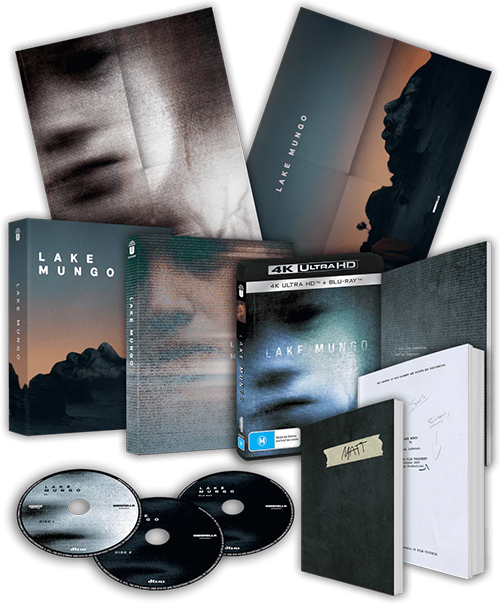
The 3-Disc Region Free Collector’s Edition 4K Ultra HD release of Lake Mungo sits in a black Amaray case with a double-sided poster featuring the original Australian theatrical poster artwork on one side and new artwork by Time Tomorrow on the reverse; a double-sided insert with the same theatrical poster artwork with a blue tint, with and without the Australian Classification Board ratings logo; and a slipcover with another variant of the same artwork. Also included is a 100-page re-creation of the film’s shooting script; a re-creation of Mathew Palmer’s photo scrapbook; and a 100-page hardback book featuring the essays Alice Doesn’t Live Here Anymore: Spectres of Sadness in Joel Anderson’s Lake Mungo by Matt Glasby, Denegation of the Undead in Lake Mungo by Kevin Fisher, Lake Mungo – A Picture Never Lies... by cinematographer John Brawler from April 1st, 2011, a family photo album re-creation, set photos and other ephemera, production design notes, and a page of thanks. Everything is housed in a rigid slipcase, also featuring new artwork by Time Tomorrow. This release is limited to 8,000 units and is only available from the Umbrella webstore, but they’re also offering a standard version minus everything but the discs in an Amaray case with the slipcover. The following extras are included on each disc, as well as both versions of this release:
DISC ONE: LAKE MUNGO (UHD)
- Audio Commentary with David Rapsey and John Brawley
- Audio Commentary with Chris Stuckmann
DISC TWO: LAKE MUNGO (BD)
- Audio Commentary with David Rapsey and John Brawley
- Audio Commentary with Chris Stuckmann
- Moodreel (HD and Upscaled SD – 5:00)
- Auditions (Upscaled SD – 10 in all – 56:09)
- Rehearsals (Upscaled SD – 10 in all – 74:30)
- Behind-the-Scenes (Upscaled SD – 88:13)
- Rushes (Upscaled SD – 73:39)
- Deleted Scenes (Upscaled SD – 9 in all – 13:38)
- Found Footage (Upscaled SD – 36 in all – 83:15)
- On the Road: Ray and Mathew (Upscaled SD – 7:16)
- Ghost Stories with Pat (HD and Upscaled SD – 29:22)
- Ararat (Upscaled SD – 5:42)
- Dead Girl Rise: The Ancestors and Legacy of Alice Palmer (HD – 16:59)
- Trailer (HD – 1:40)
DISC THREE: LAKE MUNGO REVISITED (BD)
- Teaser Trailer (HD – 1:21)
- Extended Interviews:
- Filmmaker Mike Flanagan (HD – 44:57)
- Actor David Dastmalchian (HD – 24:31)
- Filmmaker Eduardo Sánchez (HD – 53:17)
- Filmmaker Justin Kurzel (HD – 41:21)
- Filmmakers Colin & Cameron Cairnes (HD – 46:11)
- Filmmaker Neil Marshall (HD – 25:50)
- Filmmaker [sic] Paul Tremblay (HD – 40:56)
First is the 2009 audio commentary with co-producer and script editor David Rapsey and cinematographer John Brawley. It’s a fine track that goes over a lot of the minutia of the production, with particular regards to how “mistakes” were baked into it to give it more of an authenticity, as well as praises for the cast and crew. The new audio commentary features Youtuber and filmmaker Chris Stuckmann, director of Shelby Oaks (of which Lake Mungo was an obvious influence on). It’s a more laid back fan observing and commenting upon the film, more so than providing details of its creation. It also, unfortunately, dips in and out a little too often.
Included for the first time is the original Moodreel, featuring an introduction by producer Georgie Nevile and cinematographer John Brawley, which was shot prior to Lake Mungo and helped get funding for its production. The collection of Auditions features Talia Zucker, Martin Sharpe, David Pledger, Rosie Traynor, Steve Jodrell, James Lawson, Carole Patullo, Simon Wilton, Natasha Herbert, and Tammy McCarthy. The Rehearsals footage includes Talia Zucker, Rosie Traynor, David Pledger, Martin Sharpe, Robin Cuming and Judith Roberts, Stephanie Capiron, Michael Ormond Robinson and Natasha Herbert, James Lawson, Simon Wilton, and Steve Jodrell.
Next is a collection of raw Behind-the-Scenes footage and Rushes. The Deleted Scenes and Found Footage intertwine a little, containing some of the same material. The former is a more prepared selection, while the latter is a new compilation featuring alternate and deleted moments from the film’s various early edits. On the Road is a short collection of footage used for Ray’s and Mathew’s road trip. Ghost Stories with Pat was partially shot during the making of the film by behind-the-scenes filmmaker Tim Fleming and Martin Sharpe who interviewed Ararat local ’Pat’ about his experiences with ghosts. Ararat is a set of raw footage from early camera tests of the area the film was shot in set to composer David Paterson’s score. Dead Girl Rise is a video essay by Alexandra Heller-Nicholas about the history of found footage films, how they’re tied to each other, and how technology figures into Lake Mungo’s themes. Last is Umbrella’s re-release trailer. Interestingly, the webstore lists The Legacy of Lake Mungo featuring interviews with various filmmakers and others as an extras, but it appears to have been incorporated into what follows.
Michael Kratochvil’s Lake Mungo Revisited is a massive three hour and 45-minute documentary that not only covers the history of the film, its production, post-production, release, and aftermath, but also explores the metaphysical and the supernatural with its cast, crew, and other participants. In a very touching exercise, it also allows the family from the film to bring closure to Alice, complete with new footage of the still-existing house where the film was shot. Though the running time is daunting at the outset, it quickly becomes engrossing. Participants from the cast and crew includes actors Talia Zucker, Martin Sharpe, Rosie Traynor, David Pledger, Steve Jodrell, Judith Roberts, Carole Patullo, Tania Lentini, James Lawson, Natasha Herbert, Simon Wilton, Stephanie Capiron, and Tammy McCarthy; producers Georgie Nevile and David Rapsey; cinematographer John Brawley; editor Bill Murphy; composer David Paterson; production designer Penny Southgate; production coordinator Rita Walsh; first assistant director Iain Pirret; casting director Dina Mann; script and continuity supervisor Jo Kasch; hair stylist and makeup artist Jo Fletcher; special effects makeup artist Justin Dix; and visual effects supervisor Mathew Mackereth. Others include filmmakers Mike Flanagan, Justin Kurzel, Eduardo Sánchez, Neil Marshall, and Cameron & Colin Cairnes; actor David Dastmalchian; producer Roy Lee; author Paul Tremblay; film critic and author Alexandra Heller-Nicholas; author and independent scholar Dr. Kevin Fisher; senior lecturer in screen studies at the University of Melbourne, Dr. Janice Loreck; Palmer house owner Graeme Meldrum; JWard tour guide Patrick McAloon; and head of programming at Beyond Fest, Evrim Ersoy.
Included as bonus materials on this disc are the documentary’s teaser trailer and a set of Extended Interviews with Mike Flanagan, David Dastmalchian, Eduardo Sánchez, Justin Kurzel, Cameron & Colin Cairnes, Neil Marshall, and Paul Tremblay (the latter author incorrectly listed on the menu as a filmmaker).
This is a massive extras package, but there are several notable things missing from previous releases. The 2011 Region Free German Blu-ray release by Savoy Film includes a pair of trailers for the film, and the 2025 Region B French Blu-ray release from ESC Editions includes the interview The Power of Images with journalist Antoine Desrues. The biggest losses are all of the materials from Second Sight’s 2021 and 2022 Blu-ray releases in the United Kingdom. They include an audio commentary with Alexandra Heller-Nicholas and Emma Westwood; Captured Spirits, an interview with cinematographer John Brawley; Ghost in the Machine, an interview with producer David Rapsey; A Cop and a Friend, an interview with actors Carole Patullo and James Lawson; Kindred Spirits: Filmmakers Justin Benson and Aaron Moorhead on Lake Mungo; Hosting Spirits: Filmmaker Rob Savage on Lake Mungo; Simulacra and Spirits, a video essay by Josh Nelson; and Autopsy of a Family Home, a video essay by filmmaker Joseph Wallace. Definitely hang on to those releases if you have one of them.
Nevertheless, had I made a top ten list for 2025, Umbrella’s 4K release of Lake Mungo would definitely had been on it. This is special package for a very special film, and though the Second Sight extras are absent, this release definitely eclipses them, and then some. If you can afford the hefty price tag, this is a must for fans of slow burn horror. Very highly recommended.
- Tim Salmons
(You can follow Tim on social media at these links: Twitter, Facebook, BlueSky, and Letterboxd. And be sure to subscribe to his YouTube channel here.)