
Phantom, The (Blu-ray Review)
Director
Simon WincerRelease Date(s)
1996 (April 14, 2026)Studio(s)
Paramount Pictures (Kino Lorber Studio Classics)- Film/Program Grade: B+
- Video Grade: B+
- Audio Grade: A-
- Extras Grade: B+

Review
FOR THOSE WHO CAME IN LATE...
While the short-lived superhero boom that followed the release of Tim Burton’s 1989 blockbuster Batman was still in tenuous motion by the middle of the next decade, Lee Falk’s 1936 creation The Phantom was always going to be a bit too anachronistic for that era. It was really the stuff of serials, and to be fair, it had already been adapted into a 15-part serial all the way back in 1943. It just wasn’t the kind of thing that audiences wanted in the post-Batman moviegoing environment. Disney had fizzled when they took a shot at Dave Stevens’ retro comic The Rocketeer in 1991, and Universal took an even bigger bath in 1994 when they tried to revive the pulp hero The Shadow. The Phantom had been in development at Paramount at the same time, with Joe Dante and writer Jeffrey Boam working on a script that would have treated the character satirically, if not openly parodically. While it’s fun to imagine what Dante would have done with the material, that’s arguably the wrong approach for an earnestly old-fashioned character like the Phantom, and in any event, it simply wasn’t to be.
That wasn’t the end of the project, however (or the Boam script, for that matter). Enter Simon Wincer, the Australian director who had already displayed a deft touch on adventures like Quigley Down Under and The Young Indiana Jones Chronicles, and he also veered into comic book territory with the underrated Harley Davidson and the Marlboro Man. That, plus the man sure as hell knew how to handle horses after films like Phar Lap, The Lighthorsemen, The Lonesome Dove, and yes, Quigley Down Under, so Hero was in damned good hands. Wincer understood that whimsy works best when there isn’t any cynicism involved, and that a tongue-in-cheek approach doesn’t have to involve open mockery. There’s absolutely nothing cynical in Lee Falk’s conception of the Phantom, which is one reason why he suits the earnestness of classic serials much better than the sardonic nature of postmodernism. Wincer grabbed that earnest bull by the horns and never let go.
Wincer makes the serialized nature of his version of The Phantom abundantly clear from the opening sequence, with an adventure through the jungle featuring mercenary grave robbers, ancient artifacts, fedoras, a vintage truck, and a rickety suspension bridge (with the latter two elements ending up combined in a way that recalls William Friedkin’s Sorcerer). All of that is an obvious nod to Raiders of the Lost Ark, but there’s a key difference: while that film was also inspired by classic serials, it never really seems like one, at least from a tonal perspective. The Phantom doesn’t just look and sound like an old serial; it actually feels like one, with a sense of common decency that’s always been lacking in the Indiana Jones films. The Phantom is an inherently decent character, which isn’t something that can be said about Henry Walton Jones, Jr.—the line between his own mercenary endeavors and those of the villains is tenuous at best, if not openly blurred. That’s not to say that The Phantom is a better film than Raiders of the Lost Ark; far from it. It’s just that it lacks the postmodern cynicism that has always been part and parcel of the Indiana Jones franchise.
The rest of the story for The Phantom is also the stuff of classic serials, with ancient mystical skulls that hold the key to unlocking unimaginable power (sorry, George, The Phantom beat you to the punch on that score); a wealthy industrialist (Treat Williams) who will do anything to gain that power; an aviatrix (Catherine Zeta-Jones) who does his bidding, but isn’t immune to the charms of the Phantom; an even less scrupulous minion who takes care of things on the ground (James Remar); an ancient secret society, the Sengh Brotherhood; and the underground lair where the Sengh leader (Cary-Hiroyuki Tagawa) lurks. Williams has a field day as the cheerfully amoral Xander Drax, and the rest of the cast is picture-perfect down to the smallest role, with various supporting characters filled out by familiar faces like Patrick McGoohan, Samantha Eggar, Bill Smitrovich, David Proval, Al Ruscio, John Tenney, and John Capodice. Still, none of that would have mattered if Wincer hadn’t found the perfect Phantom in the form of Billy Zane (although to be fair, Zane was the one actor who had already been cast when Wincer took over the project).
Billy Zane was born to play the Phantom, but make no mistake: he also did his homework, both physically and mentally. He eschewed the foam rubber muscle suits that were de rigueur after Batman, spending extra time at the gym in order to pack on muscle of his own. Yet perhaps counterintuitively, the fact that those real muscles are clearly visible under a thin layer of spandex helps to make the character seem more vulnerable. The Phantom may be a superhero, but he’s a very human one—this Ghost Who Walks is no ghost at all, but rather the 21st in a long lineage of all-too mortal Phantoms. Zane is equally good as the Phantom’s current alter ego Kit Walker, displaying the perfect combination of faux befuddlement with furtive observational skills. Yet it’s what he does while wearing the mask that’s so crucial to capturing the right tone for The Phantom. Zane studied the comics (and, one suspects, the 1943 serial) in order to devise the ideal physicality for the Phantom, performing with his entire body in theatrical fashion, almost like a character in a silent film. He intuitively grasped the inherent earnestness of the character, and didn’t rely on the dialogue to convey it—he lived it. Billy Zane is the Phantom.
Yet every good hero needs a great heroine at his side, and Wincer scored in that regard by casting Kristy Swanson as Kit Walker’s love interest Diana Palmer. Swanson delivered on the unfulfilled promise of previous female characters like Marion Ravenwood and Princess Leia, both of whom started out as tough, independent heroines, but who ended up having to be rescued while wearing slinky dresses and metal bikinis. Oh, the Phantom does end up rescuing Diana, twice, but he quickly realizes that she can handle herself, and more importantly, he stands back and lets her do it. He never once drags her by the hand, and when he swings over on rope to rescue her the second time, he just hands her the rope and trusts her to make her own escape. The first time, she had sarcastically told him “Fine, go ahead, it’s your rescue,” but this time, he took the lesson to heart.
Put all of that together, and The Phantom is the right kind of adaptation of Lee Falk’s comic, with the right tone, the right director, and the right cast (and we haven’t even mentioned yet that it also has the right kind of score by David Newman). So, what went wrong in 1996 when the film bombed even harder than The Rocketeer and The Shadow had? Well, to begin with, the Batman superhero boom was already over at that point, so it was definitely the wrong time. Worse, audiences and critics alike didn’t know what to make of it. The Tarantino indie boom was already in full swing by 1996, so viewers who were craving postmodern irony weren’t in the mood for an earnestly whimsical film about an earnestly decent superhero. As a result, The Phantom never stood a chance at the box office.
Joe Dante offered his own post-mortem to Den of Geek in 2011, telling them that after he left the project, “It was put back into production... only nobody seemed to notice it was written to be funny, so it was—disastrously—played straight.” Yet while Dante may have been right about what audiences wanted in 1996, his analysis proves that he was dead wrong about the character. Lee Falk’s Phantom didn’t need Police Squad style parody; it needed to be taken seriously, even when it was being humorous. Oh, The Phantom is indeed amusing, but contrary to what Dante may have believed, that’s quite intentional. It’s just that the humor is droll and witty, not farcical. Instead of mockery, it offers something far more satisfying: pure joy. You watch The Phantom with a smile on your face, delighting in the way that it re-creates the earnest decency of classic serials—which is exactly what Lee Falk had in mind. Audiences in 1996 may have been baffled by it, but The Phantom has stood the test of time as a superhero classic. Sit back, let go of your cynicism, and enjoy it for what it was always intended to be: good clean fun.
Cinematographer David Burr shot The Phantom on 35mm film using Panavision and Arriflex cameras with anamorphic Panavision lenses, framed at 2.39:1 for its theatrical release. This version is based on 4K scans of the original camera negative, digitally remastered, with the final results approved by Simon Wincer. It’s an improvement over the previous HD master that was used on the Lionsgate Blu-ray, with slight improvements in fine detail, although it falls short of the levels of detail that are available on the 4K version. The colors are gorgeous, the contrast is strong, and the black levels are deep. The Phantom has always been a colorful film, but the old master gilded the lily a bit too much and veered into oversaturation. That’s not an issue here, with everything still looking larger-than-life but much more natural. Yes, there’s just a bit less definition to those colors than what’s available via the new HDR grades on the UHD, but it’s still a step up compared to the Lionsgate disc. The geometry issues with the previous master have also been fixed, where some shots were still horizontally squeezed, which resulted in long faces and circles turning into ovals. The flip side of the fix is that the sides of the frame are slightly cropped here, but it doesn’t affect the compositions, and it’s not something that you’d ever notice without comparing screenshots. While the bitrate is high, the encoding is less than perfect, and there are some artifacts visible in the grain field, especially against backgrounds like the sky. But it’s not as noticeable from normal viewing distances.
Audio is offered in English 5.1 and 2.0 DTS-HD Master Audio, with optional English subtitles. The Phantom was released theatrically in 5.1 Dolby Digital and DTS, so that’s the only proper choice here. It’s a typically aggressive mix from that era, with plenty of directionalized effects as bullets and other projectiles go whizzing around the viewer. There are also plenty of ambient effects that support the jungle, cave, and urban environments, as well as an abundance of dynamic slam to help the Ghost Who Walks whenever he Slams Evil. David Newman’s score strikes the perfect tone for the film, perhaps best described as earnest whimsy. Sit back, turn it up loud, and enjoy.
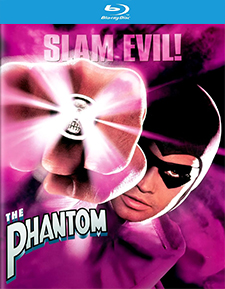
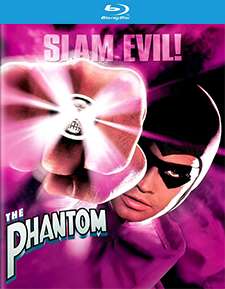
The Kino Lorber Studio Classics Blu-ray release of The Phantom includes a slipcover that matches the theatrical poster artwork on the insert. Aside from a collection of trailers, the rest of the extras are all-new for this release:
- Commentary by Simon Wincer
- Kismet in the Jungle (HD – 27:07)
- Slam Evil: Scoring The Phantom (HD – 14:49)
- The Phantom Trailer (SD – 1:23)
- Treasure of the Four Crowns Trailer (HD – 2:00)
- Remo Williams Trailer (SD – 2:18)
- Hudson Hawk Trailer (HD – 2:05)
- Mystery Men Trailer (HD – 2:24)
The commentary with Simon Wincer is moderated by Kino Lorber’s Douglas Hosdale. They discuss his background and how he got involved with The Phantom, including the ways that he shaped it after he came aboard. Billy Zane was already attached, but none of the rest of the cast was, and Wincer brought in crew like Australian cinematographer David Burr and stunt coordinator William Burton. His visual touchstone was the original comic, and he made sure that Burton captured that long-ago world without any fancy filtration, pre-flashing, desaturation, or any of the other techniques that were common at the time. Wincer and Hosdale also delve into the rest of the cast and crew, the story, the stunts, and the overall production of The Phantom, and while they do elide its troubled prehistory, they acknowledge the disappointing box office performance.
Kismet in the Jungle is a wonderful new interview with the effortlessly charming Billy Zane (still sporting his Marlon Brando look from Waltzing with Brando), who says that The Phantom crackled with a level of kismet like no other project that he knew. He wasn’t a comic book guy, but he was a Phantom guy, so he was ready when they came knocking—and this interview demonstrates that he really does understand the character. He wanted to capture the level of whimsy behind classic swashbuckling adventures, without the moral ambiguity that plagues modern heroic ventures. Zane has nothing but praise for Simon Wincer and Jeffrey Boam, who let him collaborate on shaping the project (using his guns as brakes on the elevator cable was Zane’s idea, as was accidentally knocking the purse out of the woman’s hand so that he could gentlemanly hand it back to her). Zane name checks all of the other collaborators, too, including William Burton, costume designer Marlene Stewart, and the rest of the cast, so it’s clear that he has fond memories of his experiences. He also tells plenty of interesting stories about those experiences, and even expresses disappointment at some of the material that didn’t make the final cut. This is a great interview, so don’t make the mistake of skipping it.
Slam Evil: Scoring The Phantom is an interview with David Newman, who had just worked with Wincer on Operation Dumbo Drop before following him into The Phantom. It was a rushed production, so he focused on making sure that he got the main theme right. He breaks down the way that he structured it, including the chords, rhythms, and instrumentation. He also discusses some of the other themes in the film, like the love theme that ended up only having a single place where they could fit it. The post-production phase was just as rushed, but he’s still proud of the work that he was able to accomplish in a short period of time.
It’s not an extensive collection of extras, but considering that all previous releases of The Phantom have been bare-bones aside from trailers, it’s still a huge upgrade. I’ve always said that one good making-of documentary is worth its weight in static interviews, but in this case, one good static interview is worth its weight in damned near everything else. Oh, the interview with Newman is fine and it’s also a solid commentary track, but The Phantom wouldn’t have worked without Billy Zane, and the extras wouldn’t work without his interview, either. This is a mandatory upgrade for fans of The Phantom, and if you’re not already a fan, then I’m not sure that I can help you. But remember: God helps those who help themselves, and if you’re not yet 4K capable, then Kino Lorber’s Blu-ray release of The Phantom is an excellent place to start crawling out of darkness and into light.
- Stephen Bjork
(You can follow Stephen on social media at these links: Twitter, Facebook, BlueSky, and Letterboxd).