
Target (Blu-ray Review)
- Review Date: Apr 15, 2026
- Format: Blu-ray Disc
-


Director
Arthur PennRelease Date(s)
1985 (February 25, 2026)Studio(s)
CBS Theatrical Films/Warner Bros. (Imprint Films/Via Vision Entertainment)- Film/Program Grade: B
- Video Grade: A
- Audio Grade: A
- Extras Grade: B+

Review
[Editor’s Note: This is a Region-Free Australian Blu-ray import.]
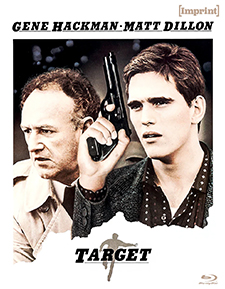
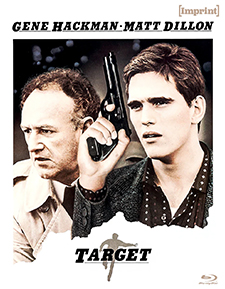
Target, an international thriller, reunites actor Gene Hackman with director Arthur Penn, who first teamed on Bonnie and Clyde. The plot involves how the strained relationship between a father and son figures into a frantic search to save a kidnapping victim.
Walter Lloyd (Hackman, The French Connection), manager of a Dallas lumber yard, is an affable person but a somewhat distant parent. His son, Chris (Matt Dillon, Tex) is put off by his father’s cautious, stodgy personality. Walter is bothered by his son’s recklessness and that he recently dropped out of college to work as a hot rod mechanic. Chris feels hampered by his father’s genuine concern for his welfare and regards him as an irritation. It’s hard for them to have a normal conversation, and they put up with each other rather than enjoy a loving relationship.
Walter’s wife, Donna (Gayle Hunnicutt, Dream Lover), is about to leave on a trip to Europe with friends. Her parting words to Walter and Chris are a plea that they improve their relationship while she’s gone. So they head off together for a weekend fishing trip, but nothing changes and they continue to get on each other’s nerves.
A late-night phone call delivers the alarming news that Donna has disappeared in Paris. Against Walter’s wishes, Chris insists on flying with him to France to find out what’s happened to her. Chris soon finds himself in the midst of a decades-old score to settle and learns there’s more to his father than he ever could have suspected.
At this point, director Penn turns the family drama into a tale of foreign intrigue, beginning with a shooting at the Paris airport that opens up a past Walter wanted to keep secret. Bad guys enter the scene, seemingly to murder Walter, caring little if Chris gets in the way. Recognizing the danger, Walter must reveal his long-hidden past to his disbelieving son. Their relationship evolves into one of trust as Chris becomes Walter’s partner in evading killers and searching for Donna. Individuals known to Walter appear periodically as the astounded Chris sees his father in an entirely new light.
Hackman delivers a strong performance. His genial work persona and mild-mannered dad of the first fifteen minutes gives way to a seasoned man of intrigue and action as various skills emerge. With little nuance, Hackman conveys determination, intelligence, and courage. This is a guy not to be messed with.
Dillon, known for teen movies like The Outsiders, My Bodyguard and Little Darlings, stretches his dramatic abilities as a son whose low opinion of his father gives way to a new respect. His body language early on shows disdain for Walter by avoiding eye contact, evading conversation, and adopting a dismissive posture. Unfortunately, his performance is uneven. At times, he overacts when he should do less emoting. In some scenes, he doesn’t seem to have a grip on what’s required, as his expression changes from serious to that of a kid at the circus for the first time—all google-eyed and awestruck.
The chemistry between Hackman and Dillon is solid, establishing a cornerstone for the plot. They play well against each other, but some touches of humor, especially in the latter part of the film, might have helped the viewer accept their growing respect for one another. The transition appears too abrupt, and Chris’ transformation from sullen kid to action hero rings impossibly silly.
The action sequences in Target dominate about two-thirds of the film. They’re staged excitingly but often seem overblown and more about amping the plot than being integral to it. Hackman will always be associated with the amazing car-and-train chase in The French Connection, and director Penn seems to have capitalized on it.
Target was shot by director of photography Jean Tournier on 35mm film with Panaflex cameras and lenses by Panavision, and presented in the aspect ratio of 1.85: 1. The Blu-ray edition contains a presentation taken from a 4K scan of the original camera negative with an aspect ratio of 1.78:1. Clarity and contrast are excellent. Detail delineation is sharp, particularly in stubble on Hackman’s face, Hunnicutt’s individual hair strands, decor in the Lloyd home, shops and cafes in Paris, and the intricacies of a booby-trapped bomb. The color palette varies from brighter hues in the Lloyd home to darker tones in Paris. In one sequence set outdoors, long shots appear to have been filmed during a light rain while close-ups in the same scene show no rain.
There are two soundtracks available, English 2.0 LPCM and English 5.1 DTS-HD Master Audio. English SDH subtitles are an available option. Dialogue is clear and distinct. In Paris, both Hackman and Dillon speak French in a few brief scenes. The chase scene is filled with the sounds of engines, skidding cars, cars hitting obstacles and a car driving up a staircase. In a key scene, ambient noise of an airport is broken by gun shots. Machine gun and handgun fire, shattering glass, and a massive explosion are dominant sound effects. Michael Small’s score is at its best during chase sequences but otherwise seems too subdued, missing opportunities to give a musical boost to many scenes.
Bonus materials on the Region-Free Blu-ray release from Imprint Films include the following:
- Audio Commentary by Adrian Martin
- Archival Interview with Actor Gene Hackman (6:48)
- Archival Interview with Director Arthur Penn (6:06)
- Archival Interview with Producers Richard D. Zanuck and David Brown (5:44)
Commentary – Film critic Adrian Martin points out that the first fifteen minutes of Target consist of misdirection. The audience is given a first impression of Walter Lloyd’s working man, who has a shaky relationship with his teenage son. Chris is resentful of his father, whom he regards as a conservative “stick-in-the-mud.” Everything about our assumptions is flipped. Martin provides an overview of d director Arthur Penn’s career, beginning with his early days working in television. Penn incorporated a lot of action into the script to give it considerable kinetic energy and contrived the elaborate chase scene, a highlight of the picture. On Target, he worked with many crew member he had worked with previously. The film deals with different notions of the term “family.” In a few key scenes, for example, the CIA is referred to as a family. The personal story focuses on the changing relationship between Walter and Chris. The 1980s was a difficult time for American directors. The film industry preferred proven money-making genres—teen comedies, horror films, and action pictures. These genres were not in the wheelhouse of many directors who had achieved successes in the 1970s. To keep working, directors such as William Friedkin, Peter Bogdanovich, and Martin Scorsese signed onto uninspiring projects.
Interview with Gene Hackman – Hackman says that a location originally planned for Dallas had to move farther south in Texas because of an imminent snow storm. He compares the chases in Target to those in other pictures he had done. Director Arthur Penn designed the stunts and a professional stunt coordinator staged them. Hackman decided to do his own dive into the river. He appreciated an exposure suit under his clothes, especially as he had to do the scene two or three times. When asked why he volunteered to do the stunt, Hackman says it’s fun to integrate actor into action, since it makes the scene more authentic. He speaks briefly about his upcoming film, Twice in a Lifetime.
Interview with Arthur Penn – Penn, who works in theater as well as film, looks for opportunities to incorporate action when he reads a script. When a personal story is mixed with action, it’s “a bit of heaven.” Penn says Target was complex in structure but fairly easy to shoot. The script wasn’t completed when Hackman agreed to play Walter. Penn never considered anyone else for the role. He says that Hackman can slip into any part and is also a great comic actor. Penn singles out Young Frankenstein as an example. During production, Penn and Hackman would exchange thoughts about a scene before shooting it. Penn had to put Matt Dillon at ease early in filming because the young actor was nervous about working on a major film with Gene Hackman, though Dillon was never intimidated by Hackman.
Interview with Richard D. Zanuck and David Brown – Zanuck says the main element of a film is story. If you make a mistake with the story, the production will suffer. The producers attribute the downturn in box office revenue at the time to a glut of teen movies flooding the market. The industry has to be vigilant about tracking other forms of entertainment in order to compete. To attract customers back, exhibitors are updating their theaters and new theaters with large seating capacities are being built.
Target is entertaining, even with handy coincidences, obvious red herrings, and conveniently incompetent bad guys. It’s fun watching a globe-trotting father and son out-maneuver obstacles in search of their loved one, even though things play out predictably. Target isn’t one of the finest spy thrillers, but it has plenty of action and it’s always fun to watch Hackman in peak form.
- Dennis Seuling