
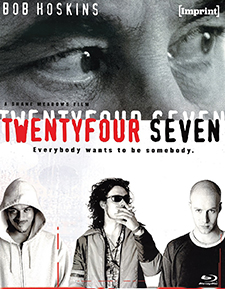
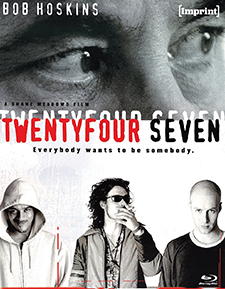
TwentyFourSeven (Blu-ray Review)
Director
Shane MeadowsRelease Date(s)
1997 (November 26, 2025)Studio(s)
BBC Films/Scala Films (Imprint Films/Via Vision Entertainment)- Film/Program Grade: B+
- Video Grade: A
- Audio Grade: B
- Extras Grade: A

Review
[Editor’s Note: This is a Region-Free Australian Blu-ray import.]
TwentyFourSeven refers to the monotony of working-class English East Midlander youths who live the same routine over and over their entire lives, not believing there could be a life beyond their dead-end environment.
As a man searches for his wandering dog, he comes across a dirty, bearded, homeless old man. The younger man recognizes him, carefully helps him up, takes him to his own home and puts him to bed. While the old man sleeps, the young man finds in the pocket of his shabby coat a book. Its pages reveal who the homeless man is as his story unfolds in flashback.
Alan Darcy (Bob Hoskins) is a tough former soccer coach who lives in the poor suburb of Nottingham and keeps a diary where he jots down observations about the people in his community. The diary is the device through which we learn about his past.
In his younger days, Darcy resolves to do something meaningful to help the idle and alienated youth in town who are pessimistic about their future. He reopens an old boxing club and recruits young men from two different gangs to join. Serving as both coach and mentor, Darcy strives to inspire community spirit in the depressed area among a group of lads who are drug addicts, victims of abuse, and have uncontrolled anger issues. These and other social ills have led to resentment, cynicism, violence, and camaraderie.
Hoskins’ Darcy is a bulldog of a man, short, stocky, rough-spoken, who truly feels for the young men he tries to put on track to a better life. A touching sub-plot involves Darcy’s attraction to store clerk Sharon (Gina Aris). Shy and a bit tongue-tied, he’s like a teenager about to ask a girl on his first date. Hoskins shows Darcy’s vulnerability in these scenes. When he’s with the boys, it’s all about tough love.
The boys reminded me of the Jets in West Side Story. In both pictures, they’re the underclass—looked down upon by “proper” society, disadvantaged socially and emotionally, never having ventured beyond the few blocks that constitute their world. Darcy’s boys are played by Danny Nussbaum (Tim), Justin Brady (Gadget), James Hooton “Wolfman” Knighty), Darren Campbell (Daz), Karl Collins (Stuart), Johann Myers (Benny), Mat Hand (Wesley Fagash), and James Corden (Tonka). All convey a chip on the shoulder that gives way to trust in Darcy and eventually pride in learning how to box rather than brawl.
TwentyFourSeven falls into the tradition of British realism. Actual locations are used with often non-professional local actors. Apart from Hoskins, the cast is composed of unknowns. Director Shane Meadows shines more light on some of the characters with vignettes that give the film an unbalanced feel. Several are more like extras and aren’t fully developed. Darcy is a father figure to the boys, many of whom come from broken or single-parent homes. He sees the boxing club as a means to instill structure and meaning into the boys’ lives. Darcy is contrasted with the boys’ fathers, particularly that of Tim, whose father (Bruce Jones) uses his fists on Tim and even his mother, Pat (Annette Badland). A confrontation between Darcy and Tim’s father provides a climactic scene.
TwentyFourSeven was Meadows’ second feature film. He decided to shoot it in black & white to give it a gritty, documentary-like effect. He felt color would make the locations look too pretty and wouldn’t allow for appropriate lighting effects. The monochrome is a big part of what makes TwentyFourSeven work. It doesn’t look at all like a studio film. No glamor, no stars, no fancy special effects. We are immersed in a setting the director knows well, having been raised there. His knowledge of the people, ranging from decent to misguided to rotten, gives the film authenticity. We believe these individuals.
TwentyFourSeven was shot by director of photography Ashley Rowe on 35mm black & white film with Arriflex 535B cameras and Zeiss lenses, processed photochemically by Rank Film Laboratories, Denham, UK, and presented in the spect ratio of 1.85:1. The Blu-ray from Imprint Films is sourced from a 2K restoration of the original negative. Thought it’s common these days to shoot black & white films on color stock because color is more light sensitive and requires less lighting, TwentyFourSeven was shot on black & white stock. Blacks are deep and rich, there’s a range of grays, and there’s a natural, film-like grain. The cinematography captures the bleak daily life of the British working-class.
The soundtrack is English 2.0 LPCM. Optional English SDH subtitles are available. The film was released in theaters with a Dolby soundtrack, and this is the basis of the Blu-ray’s sound mix. Dialogue is clear, but the regional accents might be difficult to understand, since actors often speak quickly amid ambient sound. Turning on the subtitles will help. Sound effects include body pummeling during the fight scenes. A crude expletive is used often. Songs heard in the film include Wild Night (Van Morrison), Look at the Fool (Tim Buckley), North Country Boy (The Charlatans), and Monkey Dead, Crazy, and Fallen Flower (Sunhouse).
Bonus materials on the Region-Free Blu-ray release from Imprint Films and Via Vision Entertainment include the following:
- Audio Commentary by Shane Meadows and Paul Fraser
- Interview with Actor Tony Nyland (21:02)
- Interview with Actor Johann Myers (19:44)
- Interview with Actor Karl Collins (21:44)
- Interview with Director of Photography Ashley Rowe (22:38)
- Theatrical Trailer (2:08)
Audio Commentary – Director Shane Meadows and writer Paul Fraser share this commentary. Meadows says it was an “achievement” to make the film in black & white. He was surprised at the large size of the crew, having worked previously with far fewer crew members. Director and writer had to think of ways to tell the story with and without dialogue. Meadows was inspired by Scorsese films, especially Mean Streets and the black & white Raging Bull. TwentyFourSeven is a character study because it covers a long period in a person’s life. The rapport among the cast during filming was excellent. Often, when the camera was turned off the repartee among cast members continued. Some of the banter wound up in the final film. The entire cast was composed of “Nottingham people.” Meadows was struggling with a limited budget. He discusses the kinds of music chosen and where it’s heard in the film. Meadows and Fraser speak about “magic hour,” a period of about 15 minutes each day when light offers beautiful results. When the guys in the boxing club actually compete, they feel that they’re better than they are and are beaten by the other team. All cast members worked hard in the fight scenes to make them appear authentic. For the fight competition, more than one camera was used. Actual fighters were hired to portray the competing team. When Darcy thinks he’s had no effect on the boys, he starts drinking. At the end, Darcy’s story is fully realized. Meadows was 23 when he made the film.
Interview with Actor Tony Nyland – Nyland was given a guitar at a young age which gave him a reason to improve his lot. He identified with the young men in TwentyFourSeven. He started acting in small films and on TV. He was interviewed by the casting director of TwentyFourSeven while the director was in the room. Nyland based his character of Gadget’s dad on a real person he knew. The director helped him with improvisation. He learned to fill in the background of his character. In one scene, director Shane Meadows warned him to use only one F word. After the premiere, he and Bob Hopkins thought the film was a “diamond in the rough.”
Interview with Actor Johann Myers – Myers was inspired to act when he saw his brother working on a TV show. He speaks about workshopping the outline of the film. The overall idea and improvisation led to how the script was developed. His character, Benny, is intimidated by the tougher boys. When Myers first met the director, Meadows was more serious than he was during the shoot. Filming was “a joyous time.”
Interview with Actor Karl Collins – Collins was accepted into the Junior Television Workshop in 1983, when he was 13. He had to audition along with kids from all walks of life. He got his first acting job at age 14. He regarded the work as fun. At 16, he was told he was good enough to make acting his career. He decided to go to London to study. Before his role in TwentyFourSeven, he did a lot of fringe theater. He had connections in Nottingham who told him about Shane Meadows. He wasn’t upset that there wasn’t a final script. No film had focused on Nottingham and he was eager to be part of the film. The idea of the film was to bring together the two gangs. Some improvisation encapsulated the character. There was a lot of “stupid stuff” when the actors went off on a tangent during improvisation and the film was unusable. Working free-style, Collins says, is a luxury.
Interview with Director of Photography Ashley Rowe – Rowe received a big break when he was offered the job of director of photography on the feature Second Best. He had an interview with Shane Meadows, who was in his 20s and had never made a feature film, only short films. Hoskins, who was receiving many scripts, liked TwentyFourSeven and agreed to do it at a reduced fee. It was Meadows’ first film in 35mm. The production team agreed to avoid hand-held type filming. Meadows loved black & white photography. The project would be made “cinematic.” Rowe used super fine grain film which enabled the variation of contrast by using various filters. Color is less amenable to manipulating technique. Black & white gave the film an “other-worldly” look. Outdoor shots had to be planned according to the position of the sun at specific times of the day.
As in Rocky, The Karate Kid, and Hoosiers, the characters in TwentyFourSeven are underdogs who strive to achieve a goal. Director Shane Meadows captures a depressed town and its people shored up by a ragtag boxing club that offers hope not only to the boys in it but to the community as a whole. Because attention is divided among so many, it’s hard to fully know all characters. Tim and Fagash are most prominent. We get limited information about the others’ backstories in dialogue. Meadows and co-writer Paul Fraser provide an honest, unglamorized depiction of the British working class, incorporating humorous moments that balance the film’s serious themes.
- Dennis Seuling