
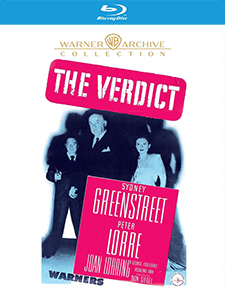
Verdict, The (1946) (Blu-ray Review)
Director
Don SiegelRelease Date(s)
1946 (January 27, 2026)Studio(s)
Warner Bros. (Warner Archive Collection)- Film/Program Grade: A-
- Video Grade: A
- Audio Grade: A
- Extras Grade: B+

Review
Sydney Greenstreet and Peter Lorre made eight films together, positioning themselves in film history as an always intriguing screen team—Greenstreet the portly and proper English gentleman, Lorre the small and squirmy Hungarian. The Verdict, a stylish period mystery melodrama, was their final film together.
Scotland Yard Superintendent George Grodman (Greenstreet) is forced to resign despite decades of honorable service after it’s discovered that he’s sent an innocent man to the gallows on a case built solely on circumstantial evidence. A clergyman corroborates the condemned man’s alibi but arrives shortly after the man has been hanged in London’s Newgate Prison. Humiliated, Goodman is forced to resign. He’s to be replaced by a rival who has long schemed to undermine him, the arrogant inspector John R. Buckley (George Coulouris). Incensed that Buckley now has the job, Grodman contemplates revenge.
At home, Goodman finds his good friend Victor Emmric (Peter Lorre) and another man, chilling champagne to welcome him. Emmric is an artist with a taste for the finer things in life. The other man, Arthur Kendall (Morton Lowry), is a young and handsome playboy.
Next morning, Goodman is jarred awake by a panicky landlady of a nearby bordinghouse. One of her roomers, Kendall has requested a wake-up call and she has been unable to rouse him. Grodman rushes over, forces Kendall’s locked door open, and discovers that he has been murdered. But how could the murderer have entered and left the room with the door still locked? Grodman notifies Scotland Yard at once.
This mystery consumes Buckley, who’s consistently baffled and even enlists the help of a burglar to suggest ways the murder could have been committed. These efforts lead nowhere and, in desperation, Buckley invites Grodman to consult on the case. Suspicion falls on a number of individuals until the actual culprit is revealed.
Emmric becomes enmeshed in the mystery because he lives in the same house as Kendall. Another roomer, Clive Russell (Paul Cavanagh), who has had a running conflict with Kendall, is a prime suspect in his murder. Emmric, too, becomes a suspect when his dislike for Kendall is revealed.
Greenstreet commands the screen with his pompous manner and sheer size. A tall man of huge girth, he dwarfs those around him. When he enters a room, all eyes are on him. As Grodman, his bulldog expression suggests he’s all business when on the job and his face and bearing after his humiliation show resolute dignity. Greenstreet was usually cast in a character role, but in The Verdict he’s clearly the star.
Lorre’s playful, inebriated portrayal of Emmric adds humor to the drama with his penchant for popping the cork on a bottle of champagne and enjoying a hedonistic lifestyle in other ways. The scenes between Greenstreet and Lorre have a special magic, thanks to dialogue well suited to their rhythms and the comfortable relationship they developed in numerous co-starring roles.
The supporting cast includes Holmes Herbert as Grodman’s superior, Sir William Dawson; Joan Lorring as Lottie Rawson, Kendall’s mistress; Rosalind Ivan as landlady Mrs. Benson; and Arthur Shields as Rev. Holbrook, the man who arrives too late to corroborate the condemned man’s alibi.
Director Siegel and screenwriter Peter Milne move the story along briskly. Even though there are several characters, it’s easy to keep track of their relationships with one another. The film was shot at the studio but the production design nicely suggests fog-shrouded London streets, giving the film considerable period atmosphere. A scene in a cemetery where a body is exhumed is especially eerie and looks like it could have come from one of Universal’s horror pictures. The black & white photography adds to the 1890s feel.
Shot by director of photography Ernest Haller on 35mm black & white film with spherical lenses and presented in the aspect ratio of 1.37:1, The Verdict uses side black mattes to fill out the screen. Clarity and contrast on the Blu-ray from the Warner Archive Collection are outstanding. Haller’s use of mysterious shadows and fog-shrouded streets add atmosphere. Greenstreet is often shot from a low angle, making him seem larger and more imposing. Lorre peers from around corners or huddles in doorways, making his Emmric hard to figure. Is he just eccentric or does he have something to hide?
The soundtrack is English 2.0 mono DTS-HD Master Audio. English SDH subtitles are an option. Dialogue is clear and distinct. Greenstreet speaks with a gruff, condescending manner. Lorre’s Hungarian accent is distinctive and gives his character an air of the exotic. As Lottie, Joan Lorring sings Give Me a Little Bit. The score by Friedrich Hollander (as Frederick Hollander) contains dark chords and sustained notes at suspenseful points and bridges dialogue scenes with often playful themes.
Bonus materials on the Blu-ray release from the Warner Archive Collection include the following:
- Hair Raising Hare (7:42)
- Birth of a Notion (7:04)
- Inner Sanctum (28:41)
- Suspense (29:37)
- New Adventures of Nero Wolfe (28:44)
Hair Raising Hare – In this 1946 Technicolor Merrie Melodies cartoon directed by Chuck Jones, a wind-up toy in the shape of an alluring female rabbit lures Bugs Bunny out of his rabbit hole and into the castle of an evil scientist with a startling resemblance to Peter Lorre. The scientist wants to feed the rabbit to his gigantic, sneaker-wearing monster. The beast, completely covered in orange hair, terrifies Bugs…at least temporarily. Soon, however, the wily rabbit puts on many disguises, tricking his scary adversary time and again. Mel Blanc provides the voice characterization for Bugs Bunny.
Birth of a Notion – Directed by Robert McKimson, this 1947 Technicolor Merrie Melodies cartoon stars Daffy Duck, who scams a dog named Leopold to avoid flying south for the winter. Daffy’s realization that the dog’s master is a mad scientist seeking a duck wishbone leads to a series of frantic, comedic attempts to survive.
Inner Sanctum – The Black Seagull aired on March 7, 1943 and stars Peter Lorre as a grieving widower who has just lost his wife Barbara in a boating accident. Her skull crushed, with her dying breath she promises to return and be with him forever. But is it the widower’s madness or the ghost of Barbara he hears in a cat’s meow or the cry of a black seagull? He goes to his good friend Dr. Griffin, beseeching him to open the casket.
Suspense – The thriller Till Death Do Us Part, written by John Dickson Carr, was aired on December 15, 1942 on CBS. Set in a desolate English location, the episode is a tense, dark tale centered on themes of premeditated murder and suicide. The production stars Peter Lorre and Mercedes McCambridge.
New Adventures of Nero Wolfe – Originally aired on October 20, 1950, Stamped for Murder stars Sydney Greenstreet as Nero Wolfe, a brilliant, oversized, eccentric armchair detective created in 1934 by American mystery writer Rex Stout. A woman seeks help from Wolfe to recover a $10,000 treasure map from two swindlers. Wolfe becomes suspicious when the con men return the money too eagerly.
The Verdict is a neat little thriller packed with first-rate character actors. Sydney Greenstreet displays a range of emotions as the disgraced superintendent determined to solve a perplexing murder. Peter Lorre adds a dash of enigmatic charm as a pleasure-loving bon vivant. Seeing Greenstreet and Lorre act together is always a treat. The London setting is convincingly recreated on studio sets and backlot streets. For his first feature film, director Don Siegel succeeds in creating and sustaining suspense while juggling red herrings. The Verdict contains considerable exposition which could have been pared to allow for more visual storytelling.
- Dennis Seuling