
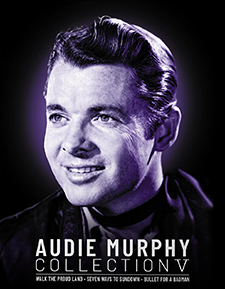
Audie Murphy Collection V (Blu-ray Review)
- Review Date: Jul 28, 2025
- Format: Blu-ray Disc
-


Director
Jesse Hibbs/Harry Keller/R.G. SpringsteenRelease Date(s)
1956/1960/1964 (June 10, 2025)Studio(s)
Universal-International Pictures (Kino Lorber Studio Classics)- Film/Program Grade: See Below
- Video Grade: See Below
- Audio Grade: See Below
- Extras Grade: B-
- Overall Grade: B+

Review
Thankfully, Kino’s Audie Murphy Collection V has none of the video transfer issues of Collection IV, and the films are better, too. Murphy (1925-1971), the most decorated American soldier of the Second World War, became a film actor in 1948, mostly under long-term contract at Universal-International. He was never a top-tier of Box Office star, peaking at #15 in 1955, but his movies, mostly Westerns, were profitable and he developed a strong fan following that continues to this day. His biggest success was a non-Western, To Hell and Back, about Murphy’s war exploits and adapted from his 1949 autobiography (actually ghost-written by David “Spec” McClure). He nurtured a clean-cut, calm and polite screen persona, but offscreen he was racked by PTSD and addiction issues leading to violence both at home and at work, and he died tragically at 45 in a plane crash.
Somewhat dated but sincerely made with the best of intentions, Walk the Proud Land (1956) is an account of real-life Indian agent John Clum’s (1851-1932) efforts to change white racist attitudes toward Native Americans through (limited) self-governance at the San Carlos Apache Indian Reservation in Arizona Territory in the 1870s.
Tenderfoot Clum (Murphy), appointed by the Dutch Reformed Church, they given control of the reservation by Ulysses S. Grant’s Department of the Interior (removing previous U.S. Cavalry control), arrives in Tucson where he immediately encounters whites proudly showing off the scalps taken from both Indian men and women, which disgusts him, as well it might.
Territorial Governor Safford (Addison Richards) and General Wade (Morris Ankrum) doubt Clum’s appointment and humanistic ways will succeed, but Clum immediately wins points with the Apache by insisting that their chief, Eskiminzin (Robert Warwick), and sub-chiefs, including Taglito (Tommy Rall), Disalin (Anthony Caruso), and Santos (Victor Millan), be unshackled from the chains the Army has been using. Clum is provided the services of an Apache widow, Tianay (Anne Bancroft) to look after him, an awkward arrangement as he’s engaged to be married. Nevertheless, she quickly falls in love with the nantan (“Boss”).
Most of the picture explores the tensions between Clum, pushing for self-governance for the Apaches, and the racism within the military and by most of the townsfolk in nearby Tucson. This is exacerbated by Geronimo (Jay Silverheels) and his attempts to compel the emasculated former warriors on the reservation to join him instead.
Based on Apache Agent, a 1936 biography by Clum’s son, Woodworth (future Incredible Shrinking Man Grant Williams narrates the film as Woodworth), the picture mostly works as a kind of proto-Dances with Wolves, the empathetic senior Clum calmly but determinedly pressing for Indian rights opposed white men who can’t see the Apache as anything other than sub-human savages. By today’s standards the casting of mostly white and Hispanic actors as Native Americans undermines this slightly, and the love triangle between Anne Bancroft’s Tianay and Clum’s bride (Pat Crowley) is particularly trite. Bancroft, of course, would soon go on to bigger and better things, but it’s a strange sight indeed to see her in this, though her performance is fine. Equally bizarre is the appearance of celebrated ballet and acrobatic dancer Tommy Rall (Seven Brides for Seven Brothers) as Taglito, though he’s good also. Veteran actor Robert Warwick is surprisingly effective as the real-life Eskiminzin, but Jay Silverheels is downright superb, charismatic and unflinching in his resolve as Geronimo, which must have come as something of a shock to Lone Ranger fans.
Clum’s surprising capture of Geronimo is a matter of historical record, a feat that only strained his relationship with the military further, as depicted in the film. The real Clum later became the mayor of Tombstone and befriended Wyatt Earp; the famous Gunfight at the O.K. Corral occurred in a vacant lot adjacent to Clum’s home. (In other films, he’s been played by Roy Roberts in My Darling Clementine, by Whit Bissell in Gunfight at the O.K. Corral, and by Terry O’Quinn in Tombstone.)
Alas, this offbeat Western was a box-office disappointment, despite Murphy’s enthusiasm for the material, he even appearing in original footage shot for the film’s trailer. Filmed in CinemaScope, Walk the Proud Land looks great on Blu-ray: the image is impressively sharp and not distorted like many early CinemaScope titles, and the color (original prints by Technicolor) is excellent.
Seven Ways from Sundown (1960) is another pleasant surprise—it’s not just good by Audie Murphy Western standards; it’s a solid Western, period. Though rooted in an overly familiar Western movie plot—lawman tries to bring wily outlaw to justice, who keeps outsmarting him on the ride back to town—the screenplay is clever and character-driven and the movie features an outstanding performance by Barry Sullivan as the outlaw.
About its only weakness is its nonsensical title; it’s the ungainly name of Audie Murphy’s character, Seven “Seven Ways from Sundown” Jones. Seven is a green Texas Ranger, on his first assignment, ordered somewhat strangely by Lt. Herly (Kenneth Tobey) to accompany veteran Ranger Sgt. Hennessey (John McIntire) in tracking down and capturing notorious but charming gunslinger Jim Flood (Barry Sullivan), who killed two men in a shootout over a card game.
Before leaving town, Seven becomes involved with Joy (Venetia Stevenson, daughter of director Robert Stevenson and actress Anna Lee), the daughter of the lady who feeds the Rangers. Everyone wonders why Herly is sending Seven out with Hennessey; the young ranger is utterly inexperienced and though good with a rifle, has no experience with a six-shooter. Mainly he joined up because his older brother, Two Jones, was a ranger recently gunned down.
Under Hennessey’s paternal leadership—I suspect McIntire’s performance here helped win him his subsequent role on Wagon Train—Seven slowly becomes adept with the revolver, learning tracking and other Ranger tips, but Flood ambushes them and fatally shoots Hennessey. Seven, using his rifle, manages to capture Flood, he amused to be apprehended by such an inexperienced ranger. He treats the ride back to Texas almost like a game, while also figuring that he’s better off in Seven’s custody than allow bounty hunters—unconcerned whether they bring Flood in dead or alive—to get the jump on him.
The screenplay is by Clair Huffaker, adapting his 1959 novel, his eighth Western novel in just two years. A number of these were adapted into films including Flaming Star (1960), Rio Conchos (1964), and The War Wagon (1967), while Huffaker himself wrote screenplays for The Comancheros (1961), Tarzan and the Valley of Gold (1966), Hellfighters (1968), Chino (1973) and others. Simultaneous with those projects, he also wrote for television, particularly the Warner Bros. Television series Lawman, one of their better Westerns.
Clearly, what makes Seven Ways from Sundown several cuts above the usual Audie Murphy Western is not journeyman Harry Keller’s direction, especially considering perhaps as much as half the picture was directed by another hack, George Sherman, booted off the production after he got into a nasty argument with Murphy, the latter threatening to kill him. Sherman apparently shot most of the location footage while Keller did most of the soundstage and Universal backlot scenes, including use of the same backlot waterfall also seen in Keller’s The Female Animal two years prior. Both do competent work, and cinematographer Ellis W. Carter’s lensing is unusually good, but the credit for the film’s qualities are mainly Huffaker’s script and Barry Sullivan’s performance.
Seven is inexperienced but no rube; he learns fast and doesn’t let his fascination, not-quite-a-friendship with Flood get in the way of his responsibility to bring the gunfighter to justice. Flood is charming and undeniably likable—quite different from Darren McGavin’s character in Bullet for a Badman—so popular, in fact, that many townsfolk would rather see Seven dead over Flood. Flood is inarguably a killer, but there are also extenuating circumstances blurring lines here and there. It’s gradually revealed that Flood was involved in Seven’s brother getting killed, but that Seven’s boss, Herly, may be more directly responsible. Unusual for such characters, Flood is neither a psychopath nor driven by insatiable greed. Barry Sullivan, an always reliable minor leading man segueing into character parts, plays him as a cool, rational character, pragmatic but neither immoral nor amoral.
Kino’s Blu-ray looks superb: shot for 1.85:1 widescreen, the video transfer is super-sharp: only dissolves are a little soft, and it’s fun watching those “pop” into crystal clarity as it cuts back to (presumably) the original camera negative.
Bullet for a Badman (1964) is generally routine and clearly made without much enthusiasm, an in-house programmer done cheaply ($500,000) and quickly, though it does put a couple of mildly interesting spins on a familiar premise. Murphy is farmer Logan Keliher, married to pretty Susan (Beverly Owen, the original Marilyn Munster) and father to her young boy. She was married to Logan’s former Texas Rangers partner Sam Ward (Darren McGavin). When Ward turned outlaw Logan resigned rather than track his blood brother down, and in caring for his abandoned wife and son fell in love.
The movie opens with Sam, having escaped from prison, determined to reclaim his family and gun down Logan, as part of a larger scheme with his gang to rob a bank in Logan’s town. Only Logan gets away, and a posse is quickly assembled that includes Logan, unsavory Pink (Skip Homeier) and his friend Jeff (Berkeley Harris), town drunk Diggs (George Tobias), saloon keeper Leach (Alan Hale, Jr.), and respected citizen Tucker (Edward Platt). Ward makes his way to the gang’s remote hideout, where Lottie (Ruta Lee), only briefly disappointed that her boyfriend (Mort Mills) was killed during the robbery, happily becomes Ward’s girl instead.
The posse soon locate Ward and Lottie, but rather than bring him in, Pink, Jeff, Diggs, and Leach decide they’d rather murder Ward and Lottie, keep the stolen loot and claim they never found it. Logan and Tucker oppose the plan, but before this can be resolved they’re besieged by Apache Indians. All decide to slip away during the night, forestalling the posse’s plans to murder Ward because they might need him in their eventual showdown with the Apaches.
Written by Mary and Willard Willingham from Marvin H. Albert’s novel Renegade Posse, the idea was to make McGavin’s character morally ambiguous, a good-bad guy, or at least a sympathetic one anxious to reclaim the family he lost to Logan some time before. However, their script errs badly by opening the film with Ward shooting an innocent banker in cold blood; without that scene, the story would have been a lot more ambiguous about Ward’s motives and his relationship with Logan, blurring the lines between the two men, instead of the preordained outcome everything is clearly leading up to. Though painted in the broadest of strokes, McGavin’s Ward is more interesting than Logan, a stock Audie Murphy character, here on the side of law and order, but torn between feeling sympathy toward his old friend while also realizing Sam’s claim on his adopted family come way too late. Compared with the much-superior Seven Ways from Sundown, Bullet for a Badman is pretty feeble.
McGavin must have had close ties with an agent at MCA. After appearing twice on MCA/Revue’s Alfred Hitchcock Presents he followed that with starring roles on Revue shows: Mike Hammer and Riverboat, both showcasing his uniquely animated, gregarious screen persona. He continued working for the company, now Universal, on a variety of TV and movie projects (Kolchak: The Night Stalker, Airport ’77). In Bullet for a Badman McGavin is obviously cast against type, the filmmakers hoping that some of his laidback persona would seep into the character, but that opening scene with Sam killing the banker works against this, and McGavin plays the part without much conviction.
The cast is amusing, many of whom would immediately after go straight into sitcom work: Beverly Owen on The Munsters, Edward Platt on Get Smart!, George Tobias on Bewitched, and Alan Hale on Gilligan’s Island. In Hale’s case, he had to scramble back to Los Angeles from Bullet for a Badman’s Utah location to audition for the part, hitchhiking most of the way.
Released in 1.85:1 widescreen, Bullet for a Badman generally looks good, the colors so vibrant one suspects tweaking at an A.I. level, almost crossing over into appearing somewhat artificial.
The Audie Murphy Collection V, as with prior sets, has three features each on a separate disc in its own Blu-ray case. Beyond the video transfers described above, each film is presented in good DTS-HD Master Audio (all 2.0 mono) with optional English subtitles. The discs are all Region “A” encoded. Extras are limited to trailers and new audio commentaries: historian Gary Gerani for Walk the Proud Land, and Toby Roan for the remaining titles.
WALK THE PROUD LAND (FILM/VIDEO/AUDIO): B+/A/A-
SEVEN WAYS FROM SUNDOWN (FILM/VIDEO/AUDIO): A-/A/A-
BULLET FOR A BADMAN (FILM/VIDEO/AUDIO): B-/B+/A-
A big step up from Collection IV, both in terms of the video transfers and the movies themselves, Audie Murphy Collection V is highly recommended.
- Stuart Galbraith IV