
Full Moon Fright Box: Vol. III (Blu-ray Review)
Director
Dave Allen/David DeCoteau/Charles Band/Ken DixonRelease Date(s)
1990/1991/1984/1987 (March 4, 2026)Studio(s)
Full Moon Features/Empire Pictures (Umbrella Entertainment)- Film/Program Grade: See Below
- Video Grade: See Below
- Audio Grade: See Below
- Extras Grade: B+
- Overall Grade: B+


Review
In the annals of low-budget independent filmmaking, the name Roger Corman towers over all the rest thanks in no small part to his longevity and his resiliency. He’s not alone in that regard, however, as there have been a few other mini-moguls out there who don’t necessarily have the same level of name recognition that he does. One of them is the slightly less legendary (if also somewhat more notorious) Charles Band. Like Corman, Band kept re-inventing himself throughout his career, though not always with the same levels of success. While Corman was able to sell companies like New World Pictures for a profit, Band tended to make a move because he didn’t have any other choice at the time.
When his original production company Charles Band International Productions struggled with distribution deals, he formed a new company named Empire International Pictures in 1983 to handle both production and distribution of low-budget exploitation films. A few of them had a bit more ambition than the rest, and that helped to contribute to Empire’s eventual collapse, especially since the independent film market was changing irrevocably as the home video market grew. Yet Band responded by reinventing himself yet again, forming his direct-to-video label Full Moon Entertainment immediately after his exit from Empire. (Sometimes, you just have to keep moving forward.) Full Moon has been Band’s home away from home ever since, and it’s also provided a home for some of the films that were otherwise abandoned after the collapse of his previous companies. Whatever that you can say about Full Moon as a business, it’s unquestionably been Band’s most successful brand name.
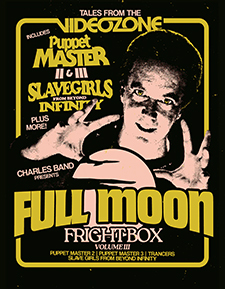
Umbrella Entertainment’s Full Moon Fright Box Vol. 3 (1990, 1991, 1984, 1987) Blu-ray Collector’s Edition is a four-disc set that includes Puppet Master II, Puppet Master III: Toulon’s Revenge, Trancers, and Slave Girls from Beyond Infinity. (If you’re wondering what happened to the first Puppet Master, that was already offered in Full Moon Fright Box Vol. 2.) It also includes a 48-page booklet with essays by Nat Brehmer and a Justin Beahm interview with Chris Alexander; individual slipcovers with new artwork by Johnny “Visibly Wasted” Bekavac; individual A3 reversible posters; and 4 standup counter cards with the original poster artwork. The set is limited to 1,500 units, and everything comes housed inside an individually numbered rigid storage case with illustrations by Bekavac.
Now, let’s get this out of the way up front: while all four discs have upgraded the standard Full Moon Dolby Digital audio to lossless DTS-HD Master Audio, the actual video masters are the same old ones that Full Moon has been using and re-using for years now (and in at least two cases, for many years now). Band is still Band, so don’t expect any expensive remastering efforts here. Umbrella’s versions do offer higher bitrates than the typically anemic Full Moon encodes, but there’s only so much that can be done with the base masters. Anyway, on to the show:
DISC ONE: PUPPET MASTER II
Full Moon Entertainment officially launched in 1989 with Puppet Master, a film that would come to define Full Moon in more ways than one. Directed by David Schmoeller (who had already brought mannequins to life for Charles Band a decade earlier with Tourist Trap), the tale of the late André Toulon’s killer puppets was originally intended as a theatrical release. Yet Band made the fateful decision to forgo the expense of theatrical distribution and take advantage of the burgeoning direct-to-video market instead, and Puppet Master proved so successful on home video that he never looked back. Full Moon Entertainment would remain a DTV label going forward, with the seemingly never-ending Puppet Master franchise as its centerpiece (and biggest cash cow).
Band wasted no time putting a sequel into production, this time directed by visual effects guru David Allen and written by David Pabian. Puppet Master II opens with a pre-credits sequence that shows some of the original puppets digging up Toulon’s grave near the Bodega Bay Inn and using his own formula to revive his desiccated corpse. From there, it introduces a new group of investigators who are trying to get to the bottom of the shenanigans at the Inn, including Carolyn (Elizabeth Maclellan), her brother Patrick (Gregg Webb), Lance (Jeff Weston), Wanda (the adorable Charlie Spradling), Camille (Nita Talbot), and her son Michael (Collin Berenson). They’re soon joined by the mysterious elderly gentleman Eriquee Chaneé (Steve Welles), and since he’s covered in bandages from head to toe, it’s not too difficult to guess where he came from. Before long, the investigators start getting bumped off one at a time by Toulon’s puppets, including a new one called Torch. But the revived puppet master’s ambitions are of a much bigger sort this time, and even his puppets are shocked when they discover what he’s really up to. Puppet Master II also stars George “Buck” Flower and Sage Allen as two rubes (naturally) who serve as more cannon fodder for the killer puppets.
Unlike the first film, Puppet Master II wastes no time getting straight into the carnage, and the promise established by the pre-credit sequence is paid off quickly. Tunneler and Blade have plenty of opportunity to do what they do best, and it’s not long before Torch gets to show off his new toolset as well, turning the two rubes into literal cannon fodder. Puppet Master II even gleefully jumps into horror movie taboo territory by having Torch knock off a young child (although to be fair, Allen was careful to show the kid as being anything but sympathetic). Perhaps most controversially for fans of the franchise, one of the puppets is killed off as well, either because Band didn’t care for it or else because he bowed to the wishes of distributor Paramount Pictures, depending on whom you choose to believe (although the latter seems more likely since Band recognized the merchandising potential of all the puppet characters). As with much in the realm of low-budget independent cinema, which usually isn’t documented very scrupulously, the “truth” of what happened tends to depend on the point of view of whoever is relaying it.
That principle extended to the production of Puppet Master II. Producer David DeCoteau wasted no time of his own getting his views on the record, telling Draculina Magazine in 1992 that “I really didn’t have a director on Puppet Master II, I had a guy who was an animator and who is one of the best animators in town but who commanded zero respect on set... he had absolutely no control with what was going on with the picture... We went five days over schedule and with sixty three (sic) incomplete scenes.” That may or may not be true (although the bit about 63 incomplete scenes sounds a little dubious), but it’s worth pointing out that Allen was a notorious perfectionist who had never been good at bringing things in on schedule. What’s undeniably true is that Puppet Master would be the only feature film that Allen completed during his own tragically brief lifetime, with his passion project The Primevals not being finished until more than two decades after he was gone. What’s equally true is that regardless of any supposed production issues, Puppet Master II has long been a fan favorite, and for good reason. It gave fans exactly what they wanted: more puppets, more carnage, a bit of gratuitous nudity, and plenty of weirdness. In other words, it’s the prototypical Full Moon title.
Cinematographer Thomas F. Denove shot Puppet Master II on 35mm film using spherical lenses. While the original Full Moon SD home video releases were produced open-matte at 1.33:1, all of their HD masters are reframed at 1.78:1, and since the compositions usually don’t look too tight at that ratio, everything was likely protected for potential projection matted to 1.85:1. There’s no information available regarding the source elements for the HD masters, but whatever was used in this case, it’s clean and reasonably well-detailed (there’s just a bit of debris on some of the optical work, and all of the opticals are naturally softer and less detailed). All of the fine details in the puppets and the costuming (like Toulon’s deteriorating bandages) have been preserved. The contrast range is good with a fair amount of shadow detail, so the source may have at least been an IP, if not the actual OCN. Like most Full Moon titles, there’s just a touch of a digitally “processed” look to the proceedings, maybe due to excessive sharpening, but whether or not that’s noticeable will probably depend on the size of your display.
Audio is offered in English 5.1 and 2.0 DTS-HD Master Audio, with optional English subtitles. Puppet Master II was produced in Ultra Stereo, and the 2.0 track here does appear to be the original matrix-encoded surround mix. Theoretically, the 5.1 track is just a discrete encoding of those same four channels (it’s highly unlikely that Band would ever pony up for a true remix), but it sounds a little constrained compared to 2.0, with less stereo spread and overall presence. In comparison, the 2.0 track sounds a little more robust, and while the two aren’t level matched, the same thing is true even when adjusting the volume level to compensate. The only real issue with both is that there’s some distortion and an odd clicking sound during Richard Band’s closing titles music.
The following extras are included:
- Commentary with Charles Band
- Commentary with Nat Brehmer
- Behind the Scenes: The Making of Puppet Master II (Upscaled SD – 21:38)
- Introduction by Charles Band (HD – 2:37)
- Devil Dolls: Puppeteer Chris Endicott on Puppet Master II (HD – 12:09)
- Toulon Is Risen: Writer David Pabian on Puppet Master II (HD – 5:02)
- 1997 Puppet Master Action Figure Commercial (Upscaled SD – 1:29)
- Killer Puppet Master Montage (Upscaled SD – 1:54)
- Trailer (HD – 2:09)
Umbrella has added three new extras here, kicking off with a commentary by Nat Brehmer, author of Puppet Master Complete: A Franchise History. He discusses the Gothic atmosphere in the second film, including multiple references to classic Universal horror movies, which is in distinction to the Italian horror influence in the original. The second film also established the idea of introducing a new puppet in each installment, while making changes to some of the existing ones like Jester. Brehmer also points out the loose continuity in the series, especially where Toulon is concerned, and while there are fan theories that try to explain some of the inconsistencies, he acknowledges that they’re simple mistakes.
The other new extras consist of interviews. Devil Dolls is with visual effects artist (and long-time Full Moon veteran) Chris Endicott. He first worked with David Allen on Puppet Master II, and since Allen was busy directing the main unit, Endicott was actually working directly under lead puppeteer John Teska. He breaks down some of the mechanisms and rigs that were used to control the various puppets, including the stop motion versions, with an emphasis on the new characters Torch and Mephisto. Toulon Is Risen is with writer David Pabian, who started at Full Moon doing rewrites on Crash and Burn, but halfway through working on that, he was assigned the full script for Puppet Master II. He discusses the process of putting it together, admitting that even he’s not sure if he likes it (DeCoteau actively hated it).
The archival extras include an introduction and a commentary track with Charles Band, both of which were recorded for the 2012 Full Moon Blu-ray. He offers his own views about the production of the film, as well as his thoughts about his relationship with David Allen going all the way back to Laserblast in 1978. As a result, he gives an overview not just of Full Moon and the Puppet Master franchise, but also of everything that led up to it in Band’s storied career. (At one point, he mentions that he hopes to finish The Primevals one day, although that still ended up taking another 11 years.)
The rest of the extras date back to the VHS days for Full Moon. While Band wasn’t exactly a pioneer in the world of DTV releases, he was arguably ahead of the curve in one specific way: VHS extras that played after the movie. While LaserDiscs already offered extras at that point, VHS rarely did, but Band included things like the Puppet Master toy commercial offered here, as well as a montage of kills from the series. But the big treat was episodes of his Video Zone video magazine, which offered behind-the-scenes looks at the making of the various films. This one naturally focuses on Puppet Master II, but it also provides some glimpses of other projects that were in the works like Stuart Gordon’s The Pit and the Pendulum.
PUPPET MASTER II (FILM/VIDEO/AUDIO/EXTRAS): C+/B-/B/B+
DISC TWO: PUPPET MASTER III: TOULON’S REVENGE
Charles Band wasted even less time putting the third Puppet Master installment into production, with the finished product hitting the shelves just eight months after Puppet Master II. This time, producer David DeCoteau took over as director (which isn’t particularly surprising, given his feelings about the making of the previous film), while David Allen stepped back to focus on the visual effects only. But those were far from the biggest changes that Puppet Master III: Toulon’s Revenge would introduce into the franchise. This time, it was a prequel, not a sequel, going all the way back to World War II in order to show Toulon’s original misadventures with his murderous puppets. And since those puppets were quickly becoming the face(s) of Full Moon Entertainment, they wouldn’t be bumping off innocent victims, either; instead, they’d be killin’ Nazis, three years before U.S. Army Lieutenant Aldo Raines would be leading his own band of basterds to do the exact same thing.
Of course, that made a complete hash of the already loose continuity in the other two films. The prologue for Puppet Master was set in 1939, with André Toulon hiding out at the Bodega Bay Inn in California, where he killed himself in order to stay out of the clutches of Nazi spies who were hot on his trail. Yet in Puppet Master II, Toulon’s gravestone says that he died in 1941. C. Courtney Joyner’s script for Puppet Master III is also set in 1941, but in Berlin instead of California, which introduces issues of its own. The story revolves around the Nazis trying to uncover the secrets of re-animation in order to relieve their strained troops on the Eastern Front, but Germany didn’t invade Russia until June of 1941, and things didn’t really start to go sour for them until the Battle of Stalingrad the following year. (Never mind the fact that the film featured the third different actor to play Toulon.) Still, if you’re looking for internal consistency or historical accuracy, then Full Moon Entertainment may not be the best place to start.
Puppet Master III: Toulon’s Revenge opens with Dr. Hess (Ian Abercrombie) working for the Nazis to create a serum that will re-animate dead soldiers to serve as cannon fodder on the Eastern Front. The Gestapo agent in charge, Major Kraus (Richard Lynch), isn’t satisfied with his lack of progress, and General Mueller (Walter Gotell) is even less satisfied with Kraus for failing to light a fire under Dr. Hess. That fire comes from an unexpected source when Kraus’ henchman Lieutenant Stein (Kristopher Logan) watches André Toulon’s (Guy Rolfe) scandalous puppet show and discovers that the puppet master has a magical secret. That leads to tragedy, with Toulon and his puppets on the run from Major Kraus and his minions. Aided by his young fan Peter (Aron Eisenberg), Toulon hides out and plots his revenge. Puppet Master III also stars Sarah Douglas, Matthew Faison, and Michelle Bauer (to provide a little extra T&A).
Puppet Master III remains one of the most ambitious films in the entire franchise, not just in terms of its World War II setting, but also because of its operatic scope and a cast of instantly recognizable character actors like Lynch, Abercrombie, Gotell, and Douglas. Oh, the miniscule budget still shows, with relatively small sets and limited quantities of extras, so most of the film is framed in close-ups or in medium shots—Puppet Master III is operatic in terms of emotional scope, not necessarily in terms of scale. Band had already explored a World War II setting on a bigger budget back in his Empire days with Zone Troopers, and it’s immediately obvious that Puppet Master III was made for much less money. But DeCoteau still scored by securing a few days on the Universal back lot, which gave him the opportunity to shoot exterior street scenes that never would have happened otherwise. And while this may or may not have been intentional, Puppet Master III transcends its historical setting and fantastic story to remain surprisingly relevant thematically, with Toulon reminding his authoritarian interlocutors that “Political satire is one of the marks of a healthy society.”
Naturally, Puppet Master III also introduces a new puppet, Six-Shooter, who would quickly become a fan favorite. It also provides an interesting backstory for Blade, and shows the tragic origins of the puppet that ended up being destroyed in Puppet Master II (which makes the decision to eliminate it in that film seem even more dubious). Come for the World War II setting and the tragic storytelling, but stay for those wonderful toys. They’re certainly what drew the fans, and Puppet Master III provided the first step in the journey that turned them from monsters into heroes—and just in case anyone missed that point, the film ends with a title card that reads “Coming Soon: Puppet Master 4: When Bad Puppets Turn Good.” (Of course, the next film actually ended up being titled Puppet Master 4: The Demon, but let’s not worry too much about continuity with Full Moon Entertainment titles, shall we?)
Cinematographer Adolfo Bartoli shot Puppet Master III: Toulon’s Revenge on 35mm film using spherical lenses. Like the second film, it was originally produced open-matte at 1.33:1, but protected for any potential projection matted to 1.85:1, and the HD version is reframed to 1.78:1. Once again, there’s no information available regarding the source elements for this HD master, but it was in excellent shape and the overall image quality is a slight improvement over Puppet Master II. The grain still shows some signs of sharpening, giving everything just a touch of a digital sheen, but less so than in its predecessor. The colors look natural, and the contrast range is solid, with deep blacks that aren’t prone to crush—it’s possible that the source element in this case really was the negative (and keep in mind that just because Band says that something was scanned from the camera negative doesn’t necessarily make it so).
Audio is offered in English 5.1 and 2.0 DTS-HD Master Audio, with optional English subtitles.
Puppet Master III was produced in Ultra Stereo, and the 2.0 track here does appear to be the original matrix-encoded surround mix. The 5.1 track is likely just a discrete encoding of those same four channels, and either way, surround activity is limited to light ambience. But the general atmospherics are strong, supported perfectly by Richard Band’s score (hey, if you want to be successful in the world of low-budget independent filmmaking, it never hurts to have a brother who is a talented musician).
The following extras are included:
- Commentary with David DeCoteau and C. Courtney Joyner
- Commentary with Nat Brehmer
- Behind the Scenes: The Making of Puppet Master III (Upscaled SD – 25:13)
- Introduction by Charles Band (HD – 5:37)
- My Bloody Bow: Mike Dean on Puppet Master III (HD – 9:32)
- The War from the Drawer: C. Courtney Joyner on Puppet Master III (HD – 16:57)
- Pull the Strings: Chris Endicott on Puppet Master III (HD – 9:51)
- 1997 Puppet Master Action Figure Commercial (Upscaled SD – 1:29)
- Killer Puppet Master Montage (Upscaled SD – 1:54)
- Trailer (HD – 2:18)
Umbrella has added four new extras here, kicking off with another commentary by Nat Brehmer. He feels that Puppet Master III isn’t just the best film in the franchise, but arguably the best film that Full Moon ever produced, and one of the greatest prequels ever made. He says that it was the right cast, right director, and right screenwriter, made at the right time, and admits that he’s going to struggle not to pull a Chris Farley and just keep saying “that was awesome” all throughout the track. He breaks down plenty of details about the production, including the cast and the story. Brehmer can be a little laid back as a commenter, but his love of Puppet Master III makes this one of his liveliest commentaries in the set.
The other new extras consist of interviews. My Bloody Bow is with Mike Deak, an effects artist who had a cameo in Puppet Master III as a German soldier. He recounts his long history of working with Band and shooting his brief scene in the film. The War from the Drawer is with C. Courtney Joyner, who had written Prison for Empire Pictures and when Band was looking for something different for the third Puppet Master, he approached Joyner. Joyner tells some interesting stories about the production of the third film and the whole Full Moon experience, including the way that Band merchandised everything. Pull the Strings is with Chris Endicott, who breaks down the design and construction of the new puppets and explains some of the tricks that they used in order to bring them to life.
The archival extras include another introduction with Band and a commentary track with DeCoteau and Joyner, both of which were recorded for the 2012 Full Moon Blu-ray release of Puppet Master III. They provide a history of the production, including the original intention to shoot the film in Romania, the story, the casting, the puppet effects, and much more. DeCoteau wishes that he’d had more time and money, but the two of them are still satisfied with what they were able to pull off with what they had. (They even address the dubious title card at the end.)
The rest of the extras are from the VHS days, although the Puppet Master toy commercial and the montage of kills from the series are both just duplicates of the ones that were included with Puppet Master II. But there is a new Video Zone, this one starting out with the making of Puppet Master III and then moving on to a profile of David Schmoeller plus a few other promotional pieces (including more Charlie Spradling, which is always welcome).
PUPPET MASTER III: TOULON’S REVENGE (FILM/VIDEO/AUDIO/EXTRAS): B/B/B+/B+
DISC THREE: TRANCERS
All that glitters is not gold, and all that is part of the Full Moon catalogue didn’t necessarily have its origins there. Such is the case with Trancers, a film that Charles Band produced and directed back in 1984 under his Empire International Pictures label. But it eventually found a home at Full Moon after Empire collapsed, spawning a total of five different sequels (to date) starting with Trancers II: The Return of Jack Deth in 1991. Still, all of that was in the future when Band made Trancers, which is perfectly appropriate since the plot revolves around time travel. The basic storyline of a man sent back from the future in order to protect ancestors from assassination is an obvious nod to The Terminator, but Trancers is oh so much more than that. It’s the time travel plot from The Terminator mixed with the neo-noir trappings of Blade Runner, with a few of the zombies from Night of the Living Dead thrown in for good measure. And yet even that description is selling Trancers short, since it’s got an attitude all its own—and the lion’s share of the credit for that belongs to writers Danny Bilson and Paul DeMeo.
Bilson and DeMeo had an uncanny knack for being able to combine various genre elements into a whole that still managed to feel internally consistent, regardless of the disparate nature of the sources from which they borrowed those elements. The key was to find a tonal framework that held everything together. The year after Trancers, they wrote and directed the no less wonderful Zone Troopers for Band, which is an alien invasion story in a World War II setting. The key in that case was that they treated it not just like a science fiction tale set during WWII, but rather like one as it might have been imagined during WWII—they opted for a form of retro-futurism. For Trancers, they hit upon hardboiled detective fiction as their tonal framework, and no matter what kind of science fiction, fantasy, or even horror elements that they wove into their story, they never lost sight of that fact. That means the key to Trancers is their conception of the character of Jack Deth, which also means that the other key to Trancers is the man who brought him to life, Tim Thomerson.
Thomerson may have gotten his start as a stand-up comic, but he understood that roles like Deth needed to be played perfectly straight, and that’s exactly the tone that Bilson and DeMeo’s story needed. There are plenty of tongue-in-cheek elements in Trancers, but none of them came from Thomerson. If he had let his guard down for a moment, or ever gave the impression that he was winking at the audience, even a single time, the whole film would have fallen apart. In fact (and please hang onto your pitchforks for a moment here), Thomerson was arguably better at playing this sort of character than Harrison Ford was in Blade Runner. Yes, Trancers is no Blade Runner, but Thomerson perfectly embodied the gruff, no-nonsense cops and detectives from hardboiled crime fiction that became such an integral part of film noir. Sure, Deckard was supposed to be a reluctant killer, but he was also supposed to be one of the best killers in the business, and Ford’s equivocal performance always made it feel like Deckard was in over his head. In other words, he sometimes felt like a tonal mismatch with the story (especially with the voiceover in the original theatrical version). Not so with Thomerson in Trancers, who plays Deth without a hint of equivocation, and so he ended up carrying Bilson and DeMeo’s neo-noir story on his gloriously padded shoulders.
Trancers opens in the 23rd century, where Jack Deth has gone rogue while hunting Trancers, otherwise normal-looking people who have been secretly brainwashed by Deth’s old nemesis Martin Whistler (Michael Stefani) and can be transformed into murderous zombies at a moment’s notice. Whistler, meanwhile, has hit upon a plan to go back in time and kill the ancestors of the ruling council in Angel City. Deth is reluctantly roped into going back in time as well to track down Whistler and protect the council’s progenitors. The trick is that the only way to travel into the past is to have your consciousness injected through the space-time continuum directly into the body of one of your own ancestors, temporarily possessing it. So, Deth ends up not just in Los Angeles circa 1984, but also in the form of his profligate forerunner Phil Dethton. Phil had just hooked up with Lena (Helen Hunt), providing Deth with an equally reluctant helper in his mission to protect ancestors like the drunken former baseball player Hap Ashby (Biff Manard). But will they be able to get to Whistler’s potential victims in time (no pun intended)? Trancers also stars Art LaFleur, Richard Herd, Anne Seymour, Telma Hopkins, and Alyson Croft.
Okay, sure. So, instead of an emo warrior from the future, you’ve got a hardboiled cop from the future. Instead of a Voight-Kampff test, you’ve got a Trancer Suspect Examination. Instead of Replicants, you’ve got mind-controlled zombies. That which we call a rose, by any other name would smell as sweet. No matter how you slice it, you’ve still got the time travel plot from The Terminator grafted into the retro-futuristic setting of Blade Runner. Yet the remarkable thing about Trancers is that it doesn’t feel like The Terminator, or Blade Runner, or even Night of the Living Dead. Instead, it feels like Trancers, through and through. That’s a testament to the way that Bilson and DeMeo were able to tie together all of their borrowed influences into something that seemed entirely their own. And that’s not even the end of their influences, either. They also threw in a James Bond element in the form of Ruthie Raines (Hopkins), who serves as the Q of the Trancers universe by supplying Jack Deth with the gadgets that he needs in order to survive his time-traveling misadventures. And yet, somehow, she feels at home in Angel City, too. Regardless of any flights of fancy, Trancers always feels internally consistent.
Trancers didn’t exactly light up the box office in 1984, but to be fair, it was never intended to. Empire International Pictures was a theatrical production and distribution company, but the titles that Band released through it always had the home video market as their end goal. But he still realized that he had a good thing going with Trancers. The following year, not only did he let Bilson and DeMeo write and direct Zone Troopers, but he also reunited Thomerson, LaFleur, and Manard for it. And when Empire fell apart a few years after that and Full Moon Entertainment rose out of its ashes, he reunited the same actors once again to launch a new direct-to-video franchise with Trancers II. Unfortunately, Bilson and DeMeo had already moved on at that point to write Disney’s big budget retro-futuristic comic book adaptation The Rocketeer, and the world of Trancers would never be the same without them.
Because always remember: dry hair’s for squids.
Cinematographer Mac Ahlberg shot Trancers on 35mm film using spherical lenses, framed at 1.85:1 for its theatrical release (it’s been opened up slightly to 1.78:1 here). Like many of Band’s earlier films that have been grandfathered into the Full Moon family, the source element for this version appears to have been a print. And before you ask, “Hey, wait a minute, didn’t Full Moon scan the original camera negative for their 4K release in 2022?”, the answer is: No. Hell, no. Instead, it was just an upscaled and even more heavily processed version of this exact same 1080p master, source element and all—and it actually looked worse than it does on Blu-ray. But the deficiencies are similar. While the color reproduction and contrast range are both serviceable, everything has a harsh digital sheen to it, with so much sharpening that whatever film grain may have existed has been transformed into pure noise. It almost looks like upscaled standard definition, especially during any shots featuring opticals, but it really is an HD scan. It’s just one that’s been bastardized out of all recognition. Trancers deserves better.
Audio is offered in English 5.1 and 2.0 mono DTS-HD Master Audio, with optional English subtitles. Trancers was released theatrically in mono, and the 5.1 track here just feeds an attenuated version of the mono signal into all five channels—it’s not a 5.1 remix in any sense of the term. Otherwise, they’re not too different from each other. But unlike Full Moon’s UHD, at least they’re both lossless here—yes, Full Moon stuck with Dolby Digital, even in 4K.
The following extras are included:
- Commentary with Tim Thomerson and Charles Band
- Commentary with Nat Brehmer
- Cybercrime: The Making of Trancers (HD – 14:27)
- 1984 Interviews with Tim Thomerson, Megan Ward, and Helen Hunt (Upscaled SD – 2:00)
- Deth Proof: Howard Berger on Trancers (HD – 9:44)
- Small Wonders: John Naulin on Trancers (HD – 7:47)
- Trancers: City of Lost Angels 1984 Short Film (Upscaled SD – 24:39)
- Stills Gallery (HD – 1:39)
- Trailer (HD – 3:00)
Umbrella has added three new extras here, kicking off with another commentary by Nat Brehmer. He considers Trancers to be one of the Full Moon greats—even though it’s not really Full Moon, and he already stated his preference for Puppet Master III, but let’s not split hairs. (On the other hand, he does say that Band considers his Empire titles as part of the Full Moon family, so fair enough.) Brehmer offers his own views on what makes Trancers work, from the story to the cast, and isn’t afraid to point out a few questionable details like the fact that Deth’s relationship with Lena is essentially ancestor incest.
The other two new extras consist of interviews. Deth Proof is with KNB’s Howard Berger, who had just gotten out of high school the year before working on Trancers, but he already knew that makeup effects were what he wanted to do with his life. He had been hired by John Carl Buechler, which is why he ended up working for Charles Band at Empire and Full Moon. For Trancers, he did the exploding Whistler body and the mall Santa who turns into a Trancer. Small Wonders is with model maker John Naulin, who explains some of the cheap but clever techniques that they used to shoot the miniature sequences with virtually no budget.
The rest of the extras are archival, starting with a commentary by Charles Band and Tim Thomerson that was recorded for the 2014 Full Moon Blu-ray. Band and Thomerson may not quite be John Carpenter and Kurt Russell, but they still play off each other well and do a good job of refreshing each other’s memories (even if Thomerson thought that they were going to edit his bad language out later, which they definitely didn’t). There’s also a set of vintage interviews with Thomerson, Hunt, and Megan Ward. The menu says that they’re all from 1984, but they were actually recorded in 1991 to promote Trancers II (the presence of Ward should be a tipoff there). But there’s also a brief addendum with Thomerson in 2013.
Cybercrime: The Making of Trancers is an amiable 2014 documentary by Ballyhoo Motion Pictures, featuring interviews with Band, Thomerson, Danny Bilson, and Paul DeMeo. The writers explain how they took Band’s original idea of a cop from the future and tossed out nearly everything else in favor of their own story. They’re the ones responsible for the hard-boiled detective stuff, including the line that was lifted directly from Robert Montgomery’s Lady in the Lake. Cybercrime also explores the casting process and the theatrical release, including various test screenings under different titles.
Finally, Trancers: City of Lost Angels is a short that was originally intended to be a segment of the 1988 anthology Pulse Pounders, but that film fell apart along with Empire International Pictures. Thomerson, Helen Hunt, Art LeFleur, Telma Hopkins, and Alyson Croft all reprised their roles, joined this time by Grace Zabriskie. It’s another time-traveling adventure, with Jack Deth having to balance his pursuit of Edlin Shock (Velvet Rhodes) with his increasingly rocky relationship with Lena.
TRANCERS (FILM/VIDEO/AUDIO/EXTRAS): B+/C/B-/B+
DISC FOUR: SLAVE GIRLS FROM BEYOND INFINITY
Slave Girls from Beyond Infinity is an ultra-low budget science fiction exploitation film that uncredited executive producer Charles Band financed as a way to pay off a personal debt to writer/director Ken Dixon. (A substantial portion of Band’s career has arguably consisted of little more than either paying off debts or avoiding them altogether). While Band did give Slave Girls from Beyond Infinity a limited theatrical release in 1987 through his Urban Classics distribution company, most people would end up catching it for the first time on late night cable television—including the constituents of one prominent figure in the United States government, but more on that debacle in a moment.
Given the eccentric title and the obvious budgetary limitations of Slave Girls from Beyond Infinity, it would be all too easy to dismiss it as little more than softcore exploitation, but as open-minded viewers will quickly discover, it’s actually a surprisingly ambitious remake of The Most Dangerous Game. Many other films and television shows have been inspired by that classic 1932 film, from Hard Target to Hart to Hart, but Slave Girls from Beyond Infinity goes beyond mere inspiration to fall squarely into the remake category instead. It may change the basic setting into a science fiction context, but in terms of narrative structure, it follows the storyline from the original film closer than you might think. It even pays homage to some iconic imagery from the original film, like the famed log bridge that would later re-appear in the 1933 version of King Kong.
Ken Dixon threw in a bit of wit to the proceedings, and he provided an interesting take on the usual "babes in bikinis" trope common to many exploitation films. Oh, his heroines Daria and Tisa (Elizabeth Kaitan and Cindy Beal) do wear bikinis and even lingerie for a substantial portion of the film, but they’re actually intelligent, capable, and inventive women, and they can easily handle themselves in dangerous situations (or games). These are no mere scream queens, and back in 1987, it was a refreshing change of pace to see what was essentially a female buddy film that allowed these characters to have some good-natured banter with each other while passing the Bechdel Test with flying colors. Dixon wrote some decent dialogue for them, and they were more than up to the task of delivering it in suitably droll fashion:
“Where’s the ignition?”
“It’s voice activated.”
“Well, that shouldn’t be a problem for you.”
They’re even more than capable of holding their own against their antagonist Zed the Hunter (Don Scribner). When he attempts to wax eloquent in order to provide a dubious justification for his predatory lifestyle, they’re ready, willing, and able to take the piss out of his pretentiousness:
“I’ve always felt that the best of life lies closest to death... living on the edge; that’s where you find the thrill of life.”
“I couldn’t agree with you less. The best of life lies as far from death as possible.”
“In the end, no one wins the game of life.”
“Yes. But I prefer to lose as slowly as I can.”
For such a micro-budgeted film (reportedly only $90,000), Dixon managed to give Slave Girls from Beyond Infinity a decent sense of scale and scope. The effects are inventive and fun, even when they’re not exactly seamless. That includes a few nice glass matte shots such as the one that’s used during the aforementioned log bridge homage to The Most Dangerous Game (a film that also reveled in stylish glass matte shots). They’re hardly the most realistic visual effects to be had, but they still punch well above their weight class. Dixon even managed to find enough spare change in order to squeeze in a familiar scream queen in the form of Brinke Stevens (and yes, she also gets to squeeze into a bikini).
Oh, and that governmental figure who wanted to protect his constituents from being exposed to Slave Girls from Beyond Infinity on late night cable television? It was none other than the odious Jesse Helms, who condemned it on the Senate floor in 1992. He offered a subsequent amendment to the Cable Act of 1992 that would have required cable companies to block indecent programming, but it was torpedoed by federal courts in 1993, and their decision was affirmed by SCOTUS in 1996. It’s nice to think that Ken Dixon and a nearly forgotten film like Slave Girls from Beyond Infinity played a small role in frustrating the aims of the hypocritical Puritans in congress. Even if it wasn’t an enjoyable film—and for the record, it most definitely is an enjoyable film—it would still deserve a place in cinematic history for that fact alone. Come for the babes in bikinis, but stay for the opportunity to see what the justifiably forgotten fuss was about. It truly was much ado about nothing.
Cinematographers Ken Wiatrak and Tom Callaway shot Slave Girls from Beyond Infinity on 35mm film using spherical lenses, framed at 1.85:1 for its theatrical release (it’s been opened up slightly to 1.78:1 here). Once again, the source for this one was a print, and not one that was in the best of shape. There’s some speckling, scratches, and other small damage marks visible, but they’re not too distracting. What’s more distracting is the persistent “digital” appearance due to excessive sharpening and other processing, with the original grain now looking more like digital noise. It almost looks like upscaled standard definition, but it’s just another title that’s been hit too hard by the sharpening stick.
Audio is offered in English 5.1 and 2.0 DTS-HD Master Audio, with optional English SDH subtitles. While there aren’t any Ultra Stereo or Dolby Stereo logos during the closing credits, this ultra-low budget indie does appear to have been granted a stereo surround mix. As usual, the 5.1 version is just a discrete encoding of the original matrix-encoded channels, not a true remix, but there’s a perplexing difference between the two. The 2.0 track arguably sounds smoother than the 5.1, but that’s because it appears to have the top end rolled off. The 5.1 sounds brighter, but a little too bright, almost harsh in comparison. You’ll have to sample both for yourself to decide which one you prefer.
The following extras are included:
- Commentary with Brinke Stevens and Tom Callaway
- Commentary with Nat Brehmer
- Thrill of the Hunt (HD – 11:38)
- Land of the Zed (HD – 9:30)
- A Tribute to Elizabeth Kaitan (Upscaled SD & HD – 6:25)
- Trailer (HD – 1:20)
Umbrella has added four new extras here, kicking off with another commentary by Nat Brehmer. He immediately dives into the limited budgets of Band’s Urban Classic titles like this one, acknowledging that it looks much better than the miniscule funding would promise. He also gets into the elements borrowed from The Most Dangerous Game, as well as the cast and crew that includes Band veterans from the Empire days who would also end up working for Full Moon. Brehmer honestly sounds a little sleepier this time than he did on the commentaries for Puppet Master III and Trancers, so his heart may not have been in it as much as it was for those titles, but there’s still some interesting stuff here.
This time, there’s also a second new commentary instead of an archival one. Moderated by Justin Beahm (who produced most of the new extras through his Reverend Entertainment), it’s with Brinke Stevens and cinematographer Tom Callaway. That means it gets a little more detailed in the nuts-and-bolts about making Slave Girls from Beyond Infinity than any of the other extras. As with many moderated tracks, it’s as much an interview as it is a commentary, but they do provide some screen-specific details as they go along.
The other two new extras consist of interviews. Thrill of the Hunt is with Elizabeth Kaitan, who is just as bright and energetic as she was nearly forty years ago. She explains how she was cast, and how much she enjoyed playing such a tough character (both physically and mentally). She and Cindy Beal hit it off immediately (although she keeps calling her Tisa throughout the interview!). Land of the Zed is with Don Scribner, who grew up in Wisconsin as a hunter, so he thought he could bring that experience to bear on Slave Girls from Beyond Infinity. He loved playing such a duplicitous character—he says that he deliberately kept a little distance from the other actors, which fits with what Kaitan has to say about him being a bit of a method actor.
The sole archival extra is A Tribute to Elizabeth Kaitan, which was originally included on Full Moon’s 2019 Blu-ray. Let’s just say that it’s not so much a tribute to Kaitan as it is a tribute to certain parts of her, and leave it at that.
SLAVE GIRLS FROM BEYOND INFINITY (FILM/VIDEO/AUDIO/EXTRAS): B-/C/B-/B-

Whew! Hopefully you haven’t fallen asleep yet. That’s nearly all the extras from the previous individual Full Moon releases of all these films, with the with the exceptions of the Gone Down the Line video essay that was on Full Moon's 2022 UHD for Trancers and some brief behind-the-scenes footage that was included on their 2023 UHD release of Puppet Master III. And on that score, Full Moon’s Puppet Master 12 Blu-ray Boxed Set includes the Arcana of Puppet Master bonus disc, which offers a couple of brief interviews with David Allen and then a whopping eight hours of behind-the-scenes footage from four of the first five films. Various 88 Films releases in the U.K. also offered some arcana of their own like a second vintage toy commercial for Puppet Master; footage from the premiere of the previously lost footage for Trancers: City of Angels in 2013; and the Show West promo reel for Pulse Pounders.
Still, depending on your tolerance for watching eight hours of completely random footage, Umbrella’s Full Moon Fright Box Vol. 3 has the edge in terms of extras. And Charles Band being Charles Band, the video quality is what it is, even though the lossless audio is a bonus. (If you’re waiting for Band to remaster Slave Girls from Beyond Infinity, you might want to invest in having yourself cryogenically preserved). Yes, the selection of titles might seem a bit random, especially since Umbrella’s Vol. 1 focused on the Dollman and Demonic Toys franchises, but since then, they’ve been offering sets that provide more of a broad selection of what Full Moon has to offer. And since Vol 3. includes the best of the entire Puppet Master franchise, the wonder that is Slave Girls from Beyond Infinity, and arguably the single best Charles Band production from any era, Trancers, it’s a helluva selection. Recommended for anyone who wants a diverse taste of what Full Moon has to offer.
- Stephen Bjork
(You can follow Stephen on social media at these links: Twitter, Facebook, BlueSky, and Letterboxd).