
St. Elmo’s Fire: 40th Anniversary (4K UHD Review)
- Review Date: Sep 10, 2025
- Format: 4K Ultra HD
-


Director
Joel SchumacherRelease Date(s)
1985 (June 24, 2025)Studio(s)
Columbia Pictures (Sony Pictures Home Entertainment)- Film/Program Grade: B+
- Video Grade: A-
- Audio Grade: A-
- Extras Grade: B+


Review
The 1980s saw a string of films about teenagers and young adults that were made for teenagers and young adults, from The Breakfast Club to About Last Night.... It was also the era in which Joel Schumacher would come into his own as a filmmaker, with films like The Lost Boys and Flatliners. These paths converged in the summer of 1985 with St. Elmo’s Fire, with a script co-written by Schumacher and Carl Kurlander based upon their collective college days that had been repeatedly rejected for containing lead characters that were considered “loathsome.” Ned Tannen’s Channel Productions eventually co-produced the film, and despite initial negative reactions from critics, it was a hit at the box office. Combined with the success of David Foster’s score and John Parr’s hit song St. Elmo’s Fire (Man in Motion), the film found itself a firm foothold in popular culture, with a cast that would later be known derogatorily as the “Brat Pack.”
Having recently graduated from Georgetown University, a group of close friends find themselves navigating the realities of the real world. Among them are Kirby (Emilio Estevez), a law student who becomes obsessed with another former student, Dale (Andie MacDowell); Billy (Rob Lowe), a directionless saxophone player who shirks his responsibilities, including those to his wife Felicia (Jenny Wright); Kevin (Andrew McCarthy), a newspaper writer who doesn’t believe in love or marriage; Jules (Demi Moore), a party girl who chases money and good times to her detriment; Alec (Judd Nelson), an adulterous social climber who pursues a career in politics; Leslie (Ally Sheedy), an architect and possible future wife to Alec; and Wendy (Mare Winningham), a shy social worker who wants to shed the wealth of her father (Martin Balsam) while pining for Billy’s affections. The seven meet regularly at Saint Elmo’s Bar, but as they grow older, they realize that their interpersonal issues and the pressures of society could potentially drive them apart.
The reactions to St. Elmo’s Fire over the years have been somewhat filled with negative hyperbole, primarily because of the leading cast, whose popularity and “Brat Pack” labeling ultimately wound up being an albatross around their collective necks. In truth, St. Elmo’s Fire isn’t much more than a soap opera for young people, but because it mixes eternal human truths with poetic examinations of life and the world at large, it received an unusual amount of contempt. It’s true that not all of the lead characters in the film are “likable,” but isn’t that the point? These feel more like real people with real flaws, and not necessarily movie characters. You can like them one minute and be disgusted or disappointed by them the next. What helps is the chemistry between the cast. Even at their worst, you kind of like hanging out with these people and want them to get their shit together, and it’s clear early on that things aren’t going to totally work out for everyone. Billy’s character is the obvious barometer for everything that’s wrong with these people, but by the time he gets himself straightened out and attempts to be a more responsible person, most of the other characters are in some of their darkest places. His speech about “St. Elmo’s Fire” that takes place during a moment when everyone is at a low point magically heals a lot of wounds, which is unrealistic, but in story and human terms, it feels right.
That all said, there’s still some problematic aspects to the film, chiefly Kirby’s obsession with Dale and the lengths that he goes to in order to grasp her affections, as well as Wendy giving herself over to Billy in the film’s final minutes. There’s not much of a defense to be made for Kirby’s behavior, but then again, this feels uncomfortably tangible. The least authentic aspect of it is the conclusion to it, which ends on a non-consensual moment, though audiences have cheered for it ever since its release. In a different film, Kirby would have gone down a much darker path, which is perhaps why it feels more controversial than it actually is. Had it ended in tragedy, perhaps with more of a Dead Poets Society vibe, then it may have been a little more accepted. Who knows? As for Wendy giving up her virginity to a man who’s been nothing but unappreciative and awful to her for the whole film... well, that’s not exactly unrealistic either, is it? It’s part and parcel as to why the film gets under the skin of some people but speaks to others. There’s some legitimacy in the behavior of these characters, perhaps in an overly exaggerated or melodramatic way at times, but nonetheless sound.
In all fairness, many of the films from this era have proved to not fully hold up to modern scrutiny. Celebrating them for some feels almost like a cardinal sin, neglecting the fact that times were indeed different, not better. In other words, St. Elmo’s Fire, as well as films like Sixteen Candles, The Breakfast Club, Pretty in Pink, and Ferris Bueller’s Day Off, all have their share of moments that can be challenging to younger audiences. In the case of St. Elmo’s Fire, it was challenging upon its release, regardless of how well it performed theatrically and on home video. Far be it from me to tell anyone how to feel, but my advice going into these films would be to accept them on their own terms, and perhaps think a little more beyond knee-jerk reaction before forming an opinion about them. For me personally, St. Elmo’s Fire is immensely complicated, and that’s one of the reasons why I appreciate it.
St. Elmo’s Fire was shot by cinematographer Stephen H. Burum on 35mm film (Eastman 125T 5247, 400T 5294) using Panavision Panaflex Gold cameras and Panavision C-Series anamorphic lenses, finished photochemically, and presented in the aspect ratio of 2.40:1. Sony Pictures Home Entertainment debuts the film on Ultra HD for its 40th Anniversary with a new 4K scan and restoration of the original camera negative, which has been graded for High Dynamic Range (HDR10 and Dolby Vision), and presented on a dual-layered BD-66 disc. This is a mostly solid presentation, but it comes with a couple of caveats. Detail is much crisper with a bitrate that sits between 40 and 60Mbps most of the time, though grain isn’t always as tight as it could be. The biggest issue is in some of the grading choices. For the most part, the film looks the way it’s always looked, but in a few scenes, the colors are decidedly different than what’s been seen in previous presentations. There are a couple of moments where an overt golden glow is laid on top, sometimes changing from shot to shot, such as the jeep ride between the group in the beginning of the film. Later on, there are some blue pushes in Alec’s and Leslie’s apartment that make flesh tones appear quite pallid. Even though these moments tend to stick out, the HDR passes certainly widen the gamut in terms of color and contrast, boosting the film’s palette and deepening black levels. The overall presentation is otherwise spotless, but if it didn’t contain any signs of revisionist (?) color grading, there would be no question that it’s the finest the film has ever looked on home video.
The main audio option is a newly-mixed English Dolby Atmos (7.1 Dolby TrueHD compatible) track. The film was recorded in Dolby Stereo, and previous DVD and Blu-ray releases included a 4.0 option to represent that. That track isn’t included here, but the Atmos track gives the soundtrack some additional low end and really boosts the score and music selections. Dialogue exchanges are clear and discernible, as they should be, and there are even some atmospherics that occasionally come into play. It’s a terrific aural upgrade. Additional audio options included English 5.1 and 2.0 DTS-HD Master Audio, as well as French and Spanish 5.1 DTS-HD Master Audio. Subtitle options include English, English SDH, French, and Spanish.
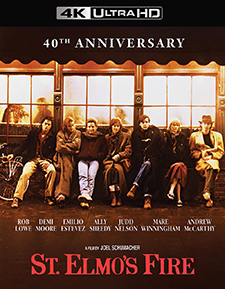
The 40th Anniversary 4K Ultra HD release of St. Elmo’s Fire from Sony Pictures Home Entertainment sits a standard black Amaray case alongside a Movies Anywhere Digital code and an insert featuring the original theatrical artwork, as does the slipcover. The following extras are included:
- Audio Commentary with Joel Schumacher
- Joel Schumacher Remembers St. Elmo’s Fire (HD – 14:21)
- Deleted Scenes (Upscaled SD – 16:18):
- Too Young
- A New Car
- How About Lunch?
- There Is No Billy the Kid
- The Woman in the Fur Coat
- Someone Tell Me What Happened
- I’m a Loser
- Secret Obsession
- Just Pick a Date
- A Very Well Dressed Fool
- Where’s the Defroster?
- That’s My Dad!
- Original Making Of Featurette (Upscaled SD – 8:42)
- John Parr’s Man in Motion Music Video (Upscaled SD – 4:14)
- Theatrical Trailer (HD – 1:31)
Most of the extras included on this release are carried over from as far back as the original DVD release. The audio commentary with Joel Schumacher, recorded in 2000, is quite excellent. It’s an unfiltered and unedited sit-down with the co-writer and director who gives an account of the making of the film. More importantly, he goes on the defensive against the critics who went after the film when it came out, as well as those who pigeonholed the actors into a label of vilification. There are no pauses and Schumacher is more than up to the task of discussing his feelings about the film, and it’s truly a shame that his reputation was derailed by a single film and never really recovered before his death in 2020. Next is the 2009 featurette Joel Schumacher Remembers St. Elmo’s Fire which covers much of the same ground. There are also a set of twelve Deleted Scenes that are clearly sourced from the film’s workprint and unnecessarily flesh out some of the characters even further. Last is the Original Making Of Featurette used to promote the film in 1985; the John Parr music video for St. Elmo’s Fire (Man in Motion), which serves as a sort of sequel to the film; and the theatrical trailer.
St. Elmo’s Fire simultaneously courted controversy while also becoming a favorite among young people at the time of its release and beyond. Joel Schumacher points out in his commentary that many people came up to him and expressed their love for the film, including many creative types. It will certainly be off-putting to the uninitiated, but for others, it will be like revisiting their early 20s. Sony’s 4K upgrade of the film has some minor video issues, but it’s still a solid release with a nice selection of extras.
- Tim Salmons
(You can follow Tim on social media at these links: Twitter, Facebook, BlueSky, and Letterboxd. And be sure to subscribe to his YouTube channel here.)