
Clark Gable Collection (Blu-ray Review)
- Review Date: Jul 31, 2025
- Format: Blu-ray Disc
-


Director
Frank Lloyd/W.S. Van Dyke/Clarence BrownRelease Date(s)
1935-1939 (June 10, 2025)Studio(s)
Metro-Goldwyn-Mayer (Warner Archive Collection)- Film/Program Grade: See Below
- Video Grade: See Below
- Audio Grade: See Below
- Extras Grade: B-
- Overall Grade: A-

Review
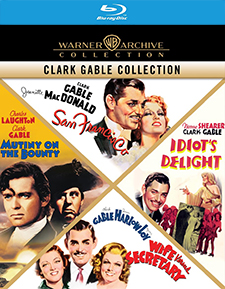
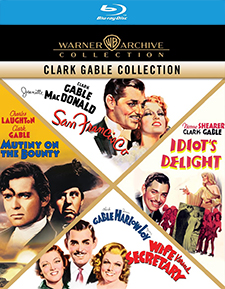
The Clark Gable Collection is a repackaging by the Warner Archive Collection of four movies starring the “King of Hollywood,” Clark Gable (1901-1960), all previously released as single-film Blu-rays. With a list price of $39.99 (and usually available online at a discount), that’s less than $10 per movie, a good deal if you don’t have them already.
Mutiny on the Bounty (1935) is one of those rare old, black-and-white movies that even those normally averse to old, black-and-white movies find irresistible, like Casablanca and It’s a Wonderful Life. I’ve probably seen it five or six times through the decades, but not in at least 30 years, and what most impressed me on this viewing was how credibly the voyage of the HMS Bounty is. For the lavish, filmed-in-Ultra Panavision 70 remake from 1962, the production went all the way to Tahiti, but MGM’s 1935 version never got further than Catalina Island off the California coast, yet it’s no less believable.
Idealistic aristocrat Roger Byam (Franchot Tone), from a naval family, joins the Bounty as a midshipman under its executive officer Fletcher Christian (Gable) and its captain, William Bligh (Charles Laughton), on a voyage to transport breadfruit from the Polynesian Islands to Jamaica, as a cheap food source for African slaves.
After press ganging a crew that includes married man Thomas Ellison (Eddie Quillan), the Bounty sets sail but not before Bligh orders his crew to watch the lashing of a condemned, already dead man—an ominous sign of things to come. Christian and Byam are increasingly troubled by Bligh’s seemingly random cruelty, meting out cruel physical punishment (including keel-hauling) at the drop of a hat. By the time they reach Tahiti, tensions run high between Bligh and Christian, finally boiling to the surface when, at the beginning of the return voyage, Bligh’s insistence that the ship’s doctor, the dying alcoholic Mr. Bacchus (Dudley Digges), attend yet another public punishment of men, the physician collapses and dies on deck.
Ignoring Byam’s pleas, Christian agrees with the majority of men eager to mutiny, he motivated partly by a desire to return to his Tahitian girlfriend, Maimiti (Mamo Clark). Bligh and his loyalists (though some, like Byam, are stranded aboard the Bounty) are cast adrift in a whale boat, the nearest friendly port thousands of miles away. Christian and his mutineers, meanwhile, search for a tropical paradise where they won’t be found.
Reviews of the 1935 Mutiny on the Bounty typically describe Captain Bligh as a sadist, but I don’t think that’s quite right. The screenplay suggests that while Bligh is an undisputed master seaman second-to-none, as a “self-made man” having risen to his position from England’s lower-class, he suffers from a crippling inferiority complex, particularly in the presence of his aristocracy-bred officers. Dictatorial, he rules with an iron-fist, hoping all his men will fear him, since earning their respect, in his eyes, is unattainable. Evidence of this is that once cast adrift, Bligh’s leadership approach changes radically; rather than terrorize the others aboard the small craft with little chance of surviving, he rallies them into fighting for their lives, adamantly insisting they survive. Needless to say, Laughton is superb in his signature role.
Produced at a then-near-record cost of $1.95 million, the money is up there on the screen. In Portsmouth, there’s not only the full-scale reproduction of the Bounty but several other 18th century sailing ships are visible in the background. How’d they do that? They might be partial sets; men aboard them move a little, suggesting standee-type “extras” integrating with a few living people, but I can’t quite tell, it’s so well integrated. Likewise, in heavy, stormy seas, exteriors of the Bounty show it swaying violently in the swells and wind, yet it’s almost impossible to tell if what we’re seeing is the full-scale vessel or an unusually large miniature.
The picture is tense and exciting throughout, with much historical verisimilitude, though watching Mutiny on the Bounty as a child, I wrongly assumed Fletcher Christian and his mutineers lived happily ever-after, as the film implies. As the 1962 remake dramatizes, they and the Tahitians they brought with them fought and murdered one another within a few years. By 1809, nineteen years after the mutiny, only one of the original mutineers, John Adams, was still alive, and Bligh outlived Fletcher Christian by a quarter-century.
It also has a rather schizophrenic attitude toward the British Navy and the British class system. A prologue and epilogue are overly forceful in proclaiming how just and fair the British Navy is today, while the picture simply ignores the obvious fact that Byam avoided the hangman’s noose only because of his social status and the influence of his rich family. Without that advantage, crewman like Thomas Ellison were executed en masse, nor does Byam make any effort to save him. In this Bounty, we’re supposed to identify with Byam, not everyman Ellison. Overall, it’s still a great film, however, and deserving of its Academy Award as Best Picture.
Wife vs. Secretary (1936) is an unexpected delight. I anticipated something akin to Libeled Lady (also 1936), the great screwball comedy starring, as here, Jean Harlow and Myrna Loy. Instead, though the film, really a romantic drama, has the usual MGM gloss and involves an overly familiar love triangle, husband-wife-secretary (more precisely, a quadrangle, the secretary’s boyfriend added to the mix), it’s told with great subtlety and intelligence, with progressive and even feminist themes, none of these adjectives normally applicable to conservative, middle-brow MGM of the 1930s. (The picture’s fine director, Clarence Brown, was also notoriously conservative.) Clark Gable headlines the film, with Harlow successfully breaking away somewhat from her street-talking, platinum-blonde image in an impressive performance. James Stewart is billed sixth but is really the fourth lead, and he’s excellent also.
Millionaire magazine publisher Van Stanhope (Gable) is blissfully married to Linda (Myrna Loy), they celebrating their third wedding anniversary as the film opens. Much of his success is due to his crack secretary, Helen “Whitey” Wilson (Harlow), she devoted to her boss while engaged to working man Dave (Stewart).
Whitey is proactive and emphatically professional, utterly invaluable to Van. The problem is she’s also younger and sexier than all the other women in the company’s secretarial pool. The terrific screenplay by Norman Krasna, John Lee Mahin, and Alice Duer Miller (from Faith Baldwin’s same-named story) has all four characters behaving like responsible adults. Van and Linda love and trust one another, she unconcerned that her husband spends more than half the day with another woman. But at the office and at parties Van and Linda host or attend, friends and co-workers invariably gossip and speculate about Whitey’s relationship with her boss. Van, for his part, is logical yet naïve about the optics. “Since when,” he asks Linda, “do we care what people think?”
Dave surprises Whitey with news he’s been given a substantial raise at work. Now, when they get married, he argues, she won’t have to work anymore. Whitey surprises him by refusing to put in her notice—she likes her stimulating job. Dave, not unreasonably, is concerned that the glamor of working for millionaire Van may be setting Whitey up for a huge disappointment. She’s not part of that world and, after all, is merely an employee.
Linda, meanwhile, can’t help but wonder about Van’s fidelity, since Van thinks nothing of dancing and ice skating with Whitey in public and, in the film’s third act, flies her down to Havana for a business convention, she in his room well past midnight. Van may be unconcerned with how this might be perceived, but his overconfidence in that regard borders on irresponsibility, especially when both Van and Whitey begin to think that, just maybe, something more than a boss-secretary relationship might be possible.
All four principal characters are smartly written. Dave might easily have been the jealous, possessive type, but the script, aided by Stewart’s sensitive performance, make his frustrations entirely rational. Van expects Whitey to be on-call 24/7, and he understandably resents him calling her into work at all hours, such as when they have theater tickets, Dave blaming Van for his unreasonable expectations, but also Whitey for her unhesitating willingness to jump anytime he calls, she craving the excitement of his world.
Van, for his part, is a loving husband, but he’s maybe just a tad conceited, thinking he can have both women in his life (if serving entirely different purposes) exactly the way he wants without really considering their feelings, Linda especially.
Whitey is, by 1930s Hollywood standards, a much more realistic career woman, with believable shading. Her boss busy, she sits alone in a nightclub awaiting his return when she eyes a couple at a nearby table, very much in love. Without dialogue Harlow beautifully expresses Whitey’s realization, perhaps for the first time, that her career is getting in the way of quiet moments like this with Dave. Though long an admirer of her talents, I was never particularly a Harlow fan until this film. Her final moments in the picture, a half-smile Whitey gives to Linda, is quite touching and beautifully realized.
Too often with such stories, the wife is an unholy shrew and the boyfriend is a jerk, allowing the girl to run off with her man in the end, or the boss turns out to be philander keeping another woman hidden until the third act, or the girl does an abrupt turnabout yearning for motherhood and domesticity. None of this happens in Wife vs. Secretary, which keeps its characters, all four, smart and likable until the fade-out.
San Francisco exemplifies MGM at its best and worst. On the plus side, the film is incredibly lavish, featuring many hundreds of extras, big sets, luxurious costumes, low- and high-brow (opera) music, a great cast of stars and character actors, and its earthquake climax is superbly done with great editing and special effects—even Universal’s later Earthquake (1974) could only equal it in terms of nerve-wracking spectacle. On the downside is its incredibly hoary, almost insulting screenplay (by Anita Loos); it takes the 1906 San Francisco Earthquake to get Gable’s hedonistic, self-centered, cocksure saloon keeper to go down on his knees and humbly pray to God.
On New Year’s Eve 1905, “Blackie” Norton (Gable) hires aspiring operatic singer Mary Blake (Jeanette MacDonald), virginal daughter of a preacher, no less, to sing at his saloon, the Paradise Club. At the behest of childhood pal, Father Tim Mullen (Spencer Tracy), Blackie agrees to run for the San Francisco Board of Supervisors to implement reform, especially housing safety, largely ignored during the city’s explosive growth.
Do-gooder Father Mullen watches warily as innocent Mary falls in love with morally corrupt Blackie, while Nob Hill scion Jack Burley (Jack Holt), he in love with her, urges her not to waste her talents, inviting her to sing at his prestigious (and respectable) Tivoli Opera House on Market Street. Various conflicts come to a head at 5:12 am on April 18, 1906, when a massive 7.9 magnitude earthquake and subsequent fire destroys most of the city and kills thousands.
Gable’s Blackie is San Francisco’s weakest link. He’s charismatic but also so utterly dismissive and clueless to Mary’s professional and emotional needs that he’s completely blind to his own selfishness, with a toddler’s lack of self-awareness. Playing an almost equally hoary cliché, Jeanette MacDonald is surprisingly acceptable; the part may be absurd, but she plays it truthfully, while Gable’s performance seems like an attempt to be larger-than-life to hide his own disbelief in the character’s actions. (He reportedly hated his big scene at the climax, asking for God’s forgiveness. (As well he might.) The rest of the cast fares better: Tracy is excellent, Jack Holt is good, while Ted Healy (minus his Three Stooges) is funny as a music hall comedian and Blackie’s friend, and Al Shean (real-life uncle of the Marx Bros.) is fun as a passionate music lover.
The climactic earthquake and subsequent firestorm are visually spectacular. Some sources claim D.W. Griffith directed the sequence, but it was created mainly by Slavko Vorkapich (primarily MGM’s director of montage sequences during this period) and second unit director John Hoffman, aided considerably by MGM’s special effects unit. For San Francisco, this team built very detailed miniatures of local landmarks combining them with fleeing citizens via the use of traveling mattes. Superbly done by 1930s standards, they’re still impressive if obviously special effects when seen today, yet so perfectly integrated with full-scale scenes of destruction and edited for maximum impact the sequence, even now, is still pretty hair-raising.
If 1939 was a Golden Year for the movies, it wasn’t because of Idiot’s Delight, a mostly dreadful adaptation of Robert E. Sherwood’s Pulitzer Prize-winning play. The film has its admirers, but that’s mostly for the couple of minutes-worth of Clark Gable performing Puttin’ on the Ritz, the only song-and-dance number of his long career.
Sherwood’s 1936 play was about a disparate group of travelers stranded in an Italian Alps hotel during the outbreak of a new World War involving Germany, France, the United States and Great Britain. Although primarily a comedy, it recognized the growing unrest in Europe with the rise of Hitler three-and-a-half years prior to the actual outbreak of World War II. MGM’s film version, released in January 1939, just seven months before the war, might have worked had its premise had been bitingly brought up to date, but instead MGM opted to go in the opposite direction. Concerned that it might offend moviegoers in Germany, Italy, etc., the setting is changed to a fictitious Alpine country where, bizarrely, everyone speaks Esperanto. Countries involved in the war go unnamed rendering that aspect of the film utterly toothless.
Sherwood himself wrote the screenplay, albeit under orders to make the above-mentioned changes, and also to add a 30-minute prologue not in the original play: Harry Van (Gable), after being discharged from the army at the end of World War I, works at the lowest levels of show business. In Omaha, Nebraska, while partnering with alcoholic mentalist Madame Zuleika (Laura Hope Crews), Harry meets trapeze artist Irene (top-billed Norma Shearer), who hopes to replace Harry’s hopeless partner, she innocently charming but also very flaky with flights of fancy, including claims to be a refugee from the Russian Revolution. Though attracted to Irene, Harry doesn’t pursue the romance further, their trains departing Omaha in opposite directions leaving him wondering if he’ll ever see her again.
Twenty years later (and where the original play begins), Van is the lead performer of Les Blondes, a troupe of six women dancers (more obviously strippers in the play) en route to Geneva when they become stranded at that Alpine hotel in … whatever country they’re supposed to be. From the hotel lounge’s expansive balcony, they and other guests look down on an airfield where they see dozens of military planes fly off in formation. (This is a good but overworked miniature.)
Other stranded guests include Dr. Waldersee (Charles Coburn), a scientist on the verge of finding a cure for cancer; English newlyweds Mr. and Mrs. Cherry (Peter Willes and Pat Paterson); ardent pacifist Quillery (Burgess Meredith); wealthy arms manufacturer Achille Weber (Edward Arnold) and his extravagantly exotic and theatrical mistress, Irene (Shearer). For most of the film, Harry thinks this Irene and the garrulous but mousy Irene from Omaha are one and the same, but he’s not sure.
Shearer, as a phony White Russian, is clearly enjoying herself, decked out in a platinum-blonde pageboy cut wig—who got that in MGM’s 1971 auction, I wonder?—but her florid accent and gesturing becomes wearisome and the movie audience becomes impatient waiting for her to finally admit she’s Irene from Omaha. Gable delivers a good performance, his tentative romance in the first part of the story is rather sweet, and he’s believable managing a troupe of leggy blonde dancers (one of whom is Virginia Gray, later a character actress with a long career in film and television). Though hardly Nicholas Bros. acrobatics, Gable performs Puttin’ on the Ritz with aplomb.
The problem, though, is that the film of Idiot’s Delight is absurdly unbelievable, from its rather tacky soundstage alpine hotel settings to its meaningless, superficial political content. At one point, Meredith’s pacifist has an emotionally charged anti-war outburst in front of everybody, prompting Harry to exclaim, dismissively, “That’s a good idea, pal. Stick with it!” Even Stanley Kramer’s later, bludgeoning but not dissimilar Ship of Fools (1965) had more bite.
For the Clark Gable Collection, each movie gets its own disc, presumably identical to the discs pressed for their individual releases. All four are in black-and-white and 1.37:1 standard frame, with all four video transfers at least very good, with Mutiny and San Francisco slightly weaker than the other two, probably the result of over-printing and reissues. All four have strong DTS-HD Master Audio (2.0 mono), supported by optional English subtitles and the discs themselves are all Region-Free.
MUTINY ON THE BOUNTY (FILM/VIDEO/AUDIO): A/A-/A
WIFE VS. SECRETARY (FILM/VIDEO/AUDIO): A/A-/A
SAN FRANCISCO (FILM/VIDEO/AUDIO): A-/A-/A
IDIOT’S DELIGHT (FILM/VIDEO/AUDIO): C/A-/A
Mutiny’s extras consist of a standard-def Pitcarin Island Today featurette running just under ten minutes, a newsreel excerpt of its Academy Award win, and trailers including one in poor condition for the 1962 remake. It does NOT include the booklet that accompanied the original Blu-ray release. Wife vs. Secretary’s supplements are limited to a two-reel entry in MGM’s Crime Does Not Pay series, The Public Pays (1936), partly re-using sets leftover from the feature attraction. Sourcing an old master, it runs 18:20. Also included is an original trailer. San Francisco offers a 46-minute TNT documentary, Clark Gable: Tall, Dark, and Handsome, plus the cartoon Bottles and two one-reel shorts, Cavalcade of San Francisco and Night Descends on Treasure Island, along with the film’s alternate (shortened) ending montage and a reissue trailer. Idiot’s Delight also has an alternate, slightly inferior ending that originally accompanied the domestic release of the film. Also included on that disc are two more cartoons, The Good Egg and It’s an Ill Wind, along with a trailer.
Three of the four films are great and the fourth is at least fascinating on one level. For the price, it’s an excellent deal and recommended.
- Stuart Galbraith IV