
Blue Light, The (Blu-ray Review)
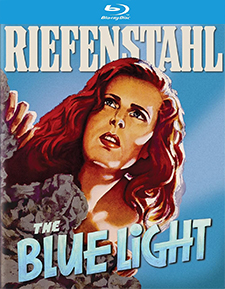
Director
Leni RiefenstahlRelease Date(s)
1932 (March 31, 2026)Studio(s)
Leni Riefenstahl-Produktion/DuWorld Pictures (Kino Classics)- Film/Program Grade: B-
- Video Grade: B
- Audio Grade: B-
- Extras Grade: C
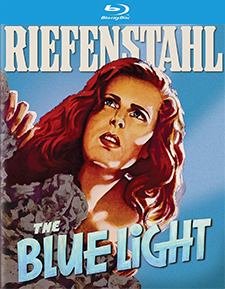

Review
Despite all of the numerous problematic details regarding her personal life and politics, Leni Riefenstahl remains one of the greatest (if not the greatest) documentary filmmakers of all time. She may have led a wonderful, horrible life, to borrow a phrase from fellow documentarian Ray Müller, but her skills as a filmmaker were nonpareil. If she had done nothing else, Triumph of the Will, Olympia Part One: Festival of the Nations, and Olympia Part Two: Beauty of the Festival would have cemented her lofty status for all time (leaving their ideological bent out the equation, which is an argument for another day). Her earlier propaganda documentary The Victory of Faith was arguably a dry run for Triumph of the Will, and Day of Freedom: Our Armed Forces only exists in fragments, but Triumph of the Will and Olympia tower over not just her own work, but over that of all other documentary filmmakers as well (Müller included).
Yet while her wonderful, horrible choices in life may appear to have led her down a predestined path, it certainly didn’t start out that way. Riefenstahl originally worked as a dancer before becoming enamored with the fictional mountaineering films directed by Arnold Franck, and after arranging a meeting with him, she persuaded him to cast her in his 1926 film The Holy Mountain. Riefenstahl ended up risking life and limb doing many of her own stunts in a series of mountaineering films for Franck (and others), but more importantly, she absorbed everything that she could about filmmaking from him. When she finally made her directorial debut in 1932 with The Blue Light (aka Das blaue Licht), the student had surpassed the teacher, and she would never look back—in more ways than one. (That wonderful, horrible life would always be marred by a lack of introspection.)
The Blue Light opens with a pair of travellers arriving at an inn located in Santa Maria, where they glimpse the haunting photo of a young woman. After asking the innkeeper (Max Holzboer) about it, he explains that it’s a picture of Junta (Riefenstahl), and then proceeds to tell them about her tragic life story. Junta was an outcast who lived a solitary life, with only the shephard boy Guzzi (Franz Maldacea) as her occasional companion. The villagers considered her to be a witch, partly because of her preternatural climbing abilities. Only she could reach a mysterious grotto at the top of the mountain, where glittering crystals acted as a blue beacon that enticed young men up the mountain only to inevitably fall to their deaths. When a painter named Vigo (Mathias Wieman) visited the village, he fell in love with Junta, and he proved to be the first man who was capable of following her all the way up to the grotto. But his love for her was overpowered by his greed for the crystals, which led to tragedy. The Blue Light also stars Martha Mair and Beni Führer (you just can’t make that kind of thing up).
Whatever dramatic flaws may exist in The Blue Light, it demonstrates Riefenstahl’s incomparable eye for visuals. The compositions are suitably dramatic, frequently shot from below with the foreground elements framed against the equally dramatic skies that are visible in the background. While Arnold Fanck’s mountaineering films had primarily been shot on some form of orthochromatic stock, which resulted in flat, blown-out, and featureless skies, Riefenstahl was able to use Agfa panchromatic stock and heavily red filter her exterior shots, which resulted in dramatic contrast between the mountains, clouds, and skies. And while she still had much to learn about the art of editing, she was already starting to experiment with the associative cutting that she would end up using to great effect in Triumph of the Will and Olympia.
Yet The Blue Light also demonstrates the way that Riefenstahl shamelessly manipulated her own image, on both sides of the camera. Whatever aesthetic or ideological perspectives that she may have held, controlling the way that she appeared to others was always one of her primary concerns. Needless to say, she gets all of the best closeups, but the way that she protected her image extended far beyond how beautiful that she appeared in front of the cameras—and that’s where her wonderful, horrible life started to take a dark turn. While there’s no denying her talent, she was more than willing to take credit for the work of others, especially after they had fallen out of favor with the powers that be.
The original 1932 version of The Blue Light opened with a title card that described the film as being “A Legend from the Dolemite Mountains, Retold in Pictures by Leni Reifenstahl, Béla Balázs, and Hans Schneeberger,” splitting the possessory credit between the director, writer, and cinematographer. By 1934, the revised titles simply called it “A Mountain Legend by Leni Riefenstahl,” although Béla Balázs was still credited later as the writer. There was just one remaining inconvenient truth: the Austria-Hungarian Balázs was Jewish. So, for the 1938 re-release, his name was omitted entirely, with Riefenstahl now credited as the writer. After the war ended, she created a revised and re-edited version of The Blue Light in 1952 that restored all of the proper attributions, Balázs included. But there’s no getting around the fact that she was willing to erase his authorship when it could have proven detrimental to her career.
Still, while all of that may prove illuminating when assessing the wonderful, horrible choices that Leni Riefenstahl made during her life, it has little to do with The Blue Light as a film. From a purely aesthetic perspective, it’s an early example of the masterful cinematic techniques that Riefenstahl used in order to mythologize her chosen subject matter. Granted, she used those same techniques later to mythologize the reprehensible ideology of the Third Reich, but in the case of The Blue Light, they’re used in service of a story that was already openly mythological in the first place. Melodrama may not have been Riefenstahl’s forte, but The Blue Light is still an example of her unparalleled command of the grammar of film.
Cinematographer Hans Schneeberger shot The Blue Light on 35mm film using spherical lenses, framed at the 1.19:1 aspect ratio of early sound films. While there were multiple revisions of the film, including the 1952 version that was produced by Leni Riefenstahl herself, this is the original 1932 premiere version. It’s based on a 2K scan of a nitrate print that was held in Riefenstahl’s archive, with scanning and remastering work done by ALPHA OMEGA Digital in Munich. (The original 1932 titles were derived from a different source.) There are some density fluctuations, light scratches, and other minor damage still visible (including some hairs at the edges of the frame), but the print was otherwise still in good condition. It’s reasonably well detailed given the source, and while shadow detail has inevitably been crushed, the contrast range is still quite good. Those dramatic skies are breathtaking in HD.
Audio is offered in German 2.0 mono DTS-HD Master Audio, with removable English subtitles. The Blue Light was shot silent with all of the audio added later, but it wasn’t merely post-synced. Instead, like some other early sound films, it was shot as a silent film with the optional music, sound effects, and dialogue added on top later, and it could be exhibited either way. The performances are theatrical, and the limited onscreen dialogue doesn’t always sync with the visuals (in fact, it’s frequently used when characters are facing away from the camera in order to disguise the mismatch). Like an actual silent film, the musical score by Dr. Giuseppe Becce does most of the talking. The source element was presumably the optical tracks on the nitrate print, and while most of the noise has been filtered out, that also means the frequency response is quite limited.
The following extras are included:
- Commentary by Anthony Slide
- Alternate Title Sequences (HD – 5:57, 5 in all)
The commentary features historian and prolific writer Anthony Slide, author of (among other things) Early Women Directors. He wastes no time delving into the thorny question of how to separate the art from the artist (or if they should be separated in the first place), including how his own answers to that question have been used against him in the past. From there, he explores Riefenstahl’s background, her work with Arnold Frank, the mountaineering genre, and the production of The Blue Light. He discusses the score, the cinematography, how it fits into the rest of her filmography, and more. Naturally, he also considers some of those problematic personal details that defined who (and what) Leni Riefenstahl was.
There’s also a collection of Alternate Title Sequences for The Blue Light, including the original 1932 version; the 1934 version with an alternate score; The Secret of Monte Cristallo titles (with no audio); The Witch of Santa Maria titles (no audio); and finally, the Italian La Luce Azzurra titles (no audio). While none of the alternate cuts of the film itself have been included, the various titles at least provide a glimpse of how The Blue Light evolved back and forth. The 2006 DVD from Pathfinder did offer both the German sound version of the film and the U.S. silent version with intertitles, but that’s the only significant thing from previous releases that’s not included here. You’ll want to hang onto the Pathfinder disc for that reason alone, but in all other respects, this HD upgrade for The Blue Light was long overdue, and it’s much appreciated.
- Stephen Bjork
(You can follow Stephen on social media at these links: Twitter, Facebook, BlueSky, and Letterboxd).