
Hard Boiled (4K UHD Review)
Director
John WooRelease Date(s)
1992 (April 29, 2026)Studio(s)
Golden Princess Film Production/Milestone Pictures (Imprint Asia/Via Vision Entertainment)- Film/Program Grade: A-
- Video Grade: A-
- Audio Grade: B+
- Extras Grade: A+

Review
[Editor’s Note: This is a Region-Free Australian 4K Ultra HD Blu-ray import.]
When John Woo set out to make Hard Boiled (aka Lat sau san taam) in 1992, he may or may not have known that it would end up being his swan song to the world of Hong Kong New Wave filmmaking, but either way, he still pulled out all the stops like a man possessed. Hard Boiled amplifies everything that he had already done in previous crime films like A Better Tomorrow, Bullet in the Head, and The Killer, raising it exponentially and taking the action to such ridiculous extremes that only a visionary genius like Woo could have possibly made all of it work. If Hard Boiled wasn’t an intentional swan song, it certainly summed up everything that defined a John Woo film as a proper John Woo Film.
Unsurprisingly, Hollywood came a-calling, so Woo made the leap across the Pacific and left Hard Boiled behind him as his ultimate thesis statement. Of course, Hollywood can be a fickle mistress, and Woo quickly discovered that they wanted him to give up the kind of creative freedom that he had enjoyed in his homeland. Eventually, he gave up on Hollywood entirely and returned to Hong Kong in 2007, but that was also a return to his Wuxia roots with the two-part historical epic Red Cliff. He’s made crime films since then, and even ping-ponged back across the ocean to direct an English-language remake of The Killer, but Hard Boiled remains his definitive statement on the genre.
And yet... definitive statement or not, Hard Boiled is still something of an inversion of Woo’s previous crime films. He was getting a bit tired of glorifying the Hong Kong underworld, and he was also disturbed by the fact that real-world thugs like Yip Kai-foon were leading a burgeoning wave of violent armed robberies using automatic weapons. All of that informed the story of Hard Boiled, both in terms of the basic narrative and the narrative structure that surrounded it. The story revolves around criminal gun runners, but for a change of pace, Woo’s lead characters would be the police officers who were hunting them down. Woo still found a way to incorporate one of his patented unholy duos (or an unholy trinities, if you count the main villain) by having one of the officers be an undercover cop, and one who was so deep undercover that he was having a difficult time staying on the right side of the law.
Getting to that point wasn’t easy, however. Woo’s original story was a riff on Dirty Harry, with maverick cop Tequila (Chow Yun-fat) being a badass who insisted on doing things his own way, rules be damned. But as the script developed through multiple drafts by Barry Wong, Gordon Chan, and Chan Hing-Ka (the latter two working uncredited), he ended up with an opposite number in the form of Alan (Tony Leung), and even Tequila doesn’t realize at first that Alan is actually an undercover cop. Alan has been pretending to work for mob boss Uncle Hoi (Kwan Hoi-San), but while tracing the source of illegal gun smuggling, he shifts to working under Johnny Wong (Anthony Wong) instead. Superintendent Pang (Phillip Chan) orders Tequila to back off in order to protect Alan, but Tequila’s doesn’t listen, which turns up the heat between Alan, Johnny, and Johnny’s brutal enforcer Mad Dog (Phillip Kowk). It also leads to the hospital that Johnny has been using as cover for the gun smuggling, with the police on one side and the criminals on the other—and with Tequila, Alan, Tequila’s girlfriend Teresa (Teresa Mo), and a whole bunch of innocent babies caught in the middle.
Those babies were also part of the evolving nature of Hard Boiled, with Woo originally wanting the villain to be someone who poisons baby food—a concept that even he ultimately rejected as being a bridge too far. The story evolved so much, so quickly, that the film ended up going into production without a finished script. But while that might have proved disastrous in the world of Hollywood filmmaking, Woo’s career in Hong Kong was marked by his gift for improvisation. His action scenes were usually invented on the fly without being meticulously storyboarded in advance. That may be difficult to believe given how perfectly that all his shots cut together in the final film, but Woo cut everything together in his head while he was shooting, and it helped that he served as one of the actual film editors on Hard Boiled as well. He always got the results that he wanted, even when he was making everything up as he went along.
All three of the major set pieces in Hard Boiled were largely improvised: the teahouse massacre at the beginning of the film; the confrontation between Uncle Hoi’s and Johnny’s crews in the middle; and the hospital shootout at the end. “At the end” might be selling the finale short, however, since the whole hospital sequence runs for the last 40 minutes of the film. There’s nothing quite like it in Woo’s entire filmography, and if he really did pull out all the stops for Hard Boiled as a whole, they’re all visible during those last 40 minutes. It’s the single most sustained action set piece that he’s ever crafted, and with those creative juices flowing, he even varied his usual editorial tendencies by staging an astonishing extended take that runs nearly three minutes and covers two floors of the hospital (with a classic Texas switch occurring in the background behind the doors of a fake elevator).
To make all of that work, Woo being Woo, the guns have infinite ammo, and the characters reload only when it makes dramatic sense for them to do so (not necessarily logical sense). As a result, Hard Boiled is the apotheosis not just of Woo’s Hong Kong films, but of the entire “gun fu” subgenre as well. “In this world, whoever’s got the gun wins,” Johnny Wong notes at one point, but that’s not entirely true. It’s not the guns, it’s how you use them, and that applies to Woo as a filmmaker as much as it does to Tequila as a character. Any director can fill a crime film with non-stop gunplay, but it’s usually in the service of tales told by idiots, full of sound and fury, signifying nothing. It takes an artist like John Woo to turn gun violence into visual poetry, and no one else has ever done that better, either in Hong Kong or elsewhere. Woo’s career has had its ups and downs over the decades, but Hard Boiled still stands as the film that defines the essence of what a John Woo Film really is. Swan song or not, it’s his indelible gift to the world of cinema.
Cinematographer Wing-Hang Wong shot Hard Boiled on 35mm film using Arriflex cameras with spherical lenses, framed at 1.85:1 for its theatrical release. This version uses the same master as the Shout! Studios release, which is based on a 4K scan of the original camera negative with digital restoration and grading performed by Duplitech (both Dolby Vision and HDR10 are included). While it’s a different encode here, any actual differences between the two in motion are minimal. (Note that while Via Vision uses the same grade as the Shout! versions of all these Golden Princess titles, Arrow has been altering the grades for many of them, but that’s a discussion for another day.)
Hard Boiled is filled with optical work like freeze frames, superimpositions, dissolves, fades, and step-printed slow motion, all of which affect the entire leading and trailing shots, so there’s a fair quantity of dupe footage cut into the negative. Those shots are unavoidably softer, but the camera negative footage looks sharp and well-resolved (at least when Wong wasn’t utilizing smoke and other diffusion). All of that doesn’t necessarily require scoring this 4K presentation of Hard Boiled on a curve, but it does mean that expectations need to be adjusted accordingly. The good news is that there’s no significant damage, and the robust encoding handles all of the varying levels of grain quite well. The HDR grade is relatively tame, but the colors and contrast all look exactly like they should, not flat and washed-out like on most previous releases. Is Hard Boiled dazzling in 4K? No. Is it still a huge upgrade over the previous Blu-ray versions? Oh, yes indeed it is.
One minor side note: despite the fact that the opening title sequence was all dupe footage anyway, this 4K version still used a clean version of the sequence sans titles, so they were all recreated digitally. Supposedly, there are some errors with the Chinese characters in the new titles, but anyone who doesn’t speak Chinese would never notice the difference (I certainly didn’t). It’s still something to be aware of.
Audio is offered in Cantonese 2.0 mono LPCM and 5.1 DTS-HD Master Audio; Mandarin 5.1 DTS-HD Master Audio; and English 2.0 LPCM, all of them with optional English subtitles. The mono version is a pretty typical Hong Kong mix from that era, with somewhat compressed dynamics and post-synced dialogue that doesn’t integrate well into the soundstage. But there’s not much in the way of distortion, noise, or other artifacts, and the driving jazz/fusion score by Michael Gibbs is still as much the heart and soul of Hard Boiled as is the non-stop gunfire and explosions. Speaking of which, the interesting wrinkle here is the Cantonese 5.1 track. The 7.1 remixes on many other Via Vision Imprint Asia titles contain newly added sound effects, but for the most part, this 5.1 mix retains the original mono dialogue and effects while offering Gibbs’ score in full stereo. The mono effects are occasionally panned across the front soundstage to add some stereo spread, a little awkwardly in a few places but generally without calling too much attention to themselves. So, it’s the best of both worlds, and for the first time on an Imprint Asia title, I lean toward the 5.1 track because it offers more room for the Gibbs score to breathe, without making any other significant alterations. But the original mono is still an option in case that’s a bridge too far for you.
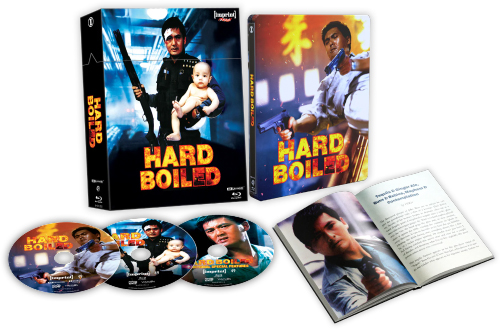
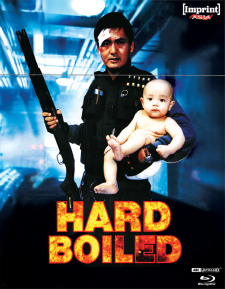
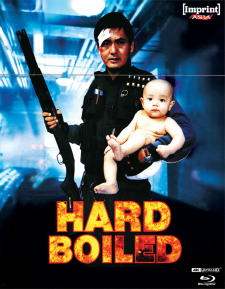
Via Vision’s Region-Free Limited Edition Steelbook 4K Ultra HD release of Hard Boiled is #50 in their Imprint Asia line, and it’s limited to 1,500 units. It’s a two-disc set that includes a Blu-ray with a 1080p copy of the film, as well as a 60-page hardbound booklet featuring essays by Paul Kotzathanasis and VERN. Everything comes housed in one of Imprint’s rigid Hardboxes that opens up at the top (the Hardbox uses the infamous “baby” artwork, while the Steelbook uses the two-fisted gunplay artwork that may be more familiar to North American audiences). The following extras are included:
DISC ONE: UHD
- Commentary by John Woo and Drew Taylor
- Commentary by Frank Djeng
- Commentary by John Woo, Terence Chang, Roger Avery, and Dave Kehr
- Commentary by John Woo and Terence Chang
DISC TWO: BD
- Commentary by John Woo and Drew Taylor
- Commentary by Frank Djeng
- Commentary by John Woo, Terence Chang, Roger Avery, and Dave Kehr
- Commentary by John Woo and Terence Chang
- Violent Night (HD – 41:06)
- No Time for Failure (HD – 11:59)
- Boiled to Perfection (HD – 16:42)
- Body Count Blues (HD – 10:00)
- Hong Kong Confidential: Inside Hard Boiled (HD – 13:03)
- Gun-Fu Fever (HD – 18:38)
- Chewing the Fat (HD – 12:43)
- Deleted and Extended Scenes (HD & Upscaled SD – 13:58)
- Trailers (HD – 6:28, 2 in all)
- Image Gallery (HD, 66 in all)
With the exception of fourth commentary track with John Woo and Terence Chang, the rest of the extras on the second disc are all carried over from the Shout! Studios UHD set. The first two commentaries were newly recorded for Shout!, starting with one that pairs Woo with The Wrap journalist Drew Taylor, who acts as a moderator. Woo discusses the real-life crimes and police officers that inspired the film; developing the story and changing it at the last minute when had second thoughts about his original concept; collaborating with Chow Yun-Fat (Woo’s cameo was the actor’s idea); shooting the complex action scenes; why he decided to soften the ending; and much more. The nearly 80-year-old Woo is a little difficult to follow sometimes, but his memories are sound, so it’s an interesting track.
The second Shout! commentary features programmer and former Tai Seng Entertainment marketing manager Frank Djeng, who dives into the proceedings with his usual loquacious enthusiasm. He considers Hard Boiled to be one of the most important Hong Kong action movies ever made, so he’s really in his element here. As usual, he identifies all of the cast and crew down to the smallest roles, including which actors were dubbed (unfortunately, Woo was one of them). He also identifies many of the locations and other practical details about the making of the film, but he offers some thoughts about the film on a thematic, dramatic, and stylistic level as well.
The archival “group” commentary is from the 1995 Criterion Collection LaserDisc (which was ported over to their 1998 DVD), and it’s a rare example of Criterion commentary from that era being ported over elsewhere. It’s one of Criterion’s patented curated tracks, with John Woo, producer Terence Chang, filmmaker Roger Avary, and critic David Kehr all recorded separately and edited together. This was just three years after Woo and Chang made Hard Boiled, so their memories were even fresher, while Avary and Kehr are on hand to provide an appreciation for what they accomplished.
The archival commentary with Woo and Change (omitted from the Shout! set) was originally recorded for the 2000 DVD from Fox Lorber. While it understandably covers similar territory to the other commentaries, like the Criterion track, it was recorded less than a decade down the road from the production of Hard Boiled, so their memories were fresher. And unlike the Criterion track, the two of them sat down together to record it, so it’s more of a dialogue between the two of them. They do occasionally get caught up in what’s happening on screen, but for the most part, it’s a lively commentary that’s a nice complement to the other ones.
The rest of the extras on this disc consist of interviews conducted by High Rising Productions and Ballyhoo Motion Pictures, with the first six focusing on members of the cast and crew. Violent Night is with the man himself, the legendary John Woo. He discusses his inspirations for the story and then breaks down the making of the film in some detail. He also explains why he made the leap to Hollywood after Hard Boiled was released. Boiling Over is with actor Anthony Wong, who doesn’t appear to be a fan of Woo’s over-the-top style in general and Hard Boiled in particular (although he admits that he hasn’t rewatched the film since they made it). No Time for Failure is with Terence Chang, who explains why he and Woo decided to make a film that glorified law enforcement rather than the criminals, and how the story evolved during shooting. Hard to Resist and Boiled to Perfection are with screenwriters Gordon Chan and Chan Hing-Ka, respectively. They also cover the evolution of the story, including the way that the lead characters were redefined as they polished the script. Finally, Body Count Blues is with composer Michael Gibbs, who describes the challenges of developing the music without being given clear direction about what Chang and Woo wanted from him.
The last three interviews are with various authors and academics. Hong Kong Confidential is the latest in a continuing series with Grady Hendrix, co-author of These Fists Break Bricks, who calls Hard Boiled “the Wooiest Woo movie that John Woo ever Wooed”—and it’s hard to argue with that. Hendrix focuses on the improvisatory nature of Woo’s filmmaking, demonstrating just how much that Hard Boiled was made up on the fly. Gun-Fu Fever is with Dr. Leon Hunt, lecturer and co-editor of East Asian Cinemas: Exploring Transnational Connections on Film. As the title suggests, he explores how gun-fu films like Hard Boiled, A Better Tomorrow, and City on Fire developed out of the traditional wuxia genre. He also cross-references Peckinpah films like The Wild Bunch. In Chewing the Fat, author and lecturer Dr. Lin Feng takes a different tack, exploring how Hard Boiled fits into Chow Yun-Fat’s filmography rather than Woo’s—and considering that she wrote Chow Yun-Fat and the Territories of Hong Kong Stardom, she’s working comfortably in her zone.
Finally, in addition to the Theatrical Trailer and an Image Gallery, there’s a collection of Deleted and Extended Scenes. It includes footage from the Taiwanese cut of Hard Boiled, most of which consists of scene extensions and sometimes even alternate takes. It’s not all-inclusive of every single difference between the two versions, but it does comprise the most noteworthy changes. (The footage has been cut into the existing scenes from the new 4K master, so it’s easy to tell which shots are the added ones.) There’s also footage from the censored South Korean cut, which has two additional scenes of Tequila playing clarinet, but the big difference is that it includes the original downbeat ending of the film before Woo decided to soften it for the Hong Kong version. (It’s even easier to spot the footage this time since it’s been upscaled from a South Korean VHS copy of the film.)
But don’t turn that dial, because we’re just getting started here:
DISC THREE: BD
- Extended Taiwanese Cut (Upscaled SD – 131:36 – 1.66:1, Chinese 2.0 mono LPCM)
- The Test of Time: The Genesis of Hard Boiled (SD – 75:49)
- A Baptism of Fire (SD – 38:22)
- Partner in Crime (Upscaled SD – 24:56)
- Art Imitates Life (SD – 15:17)
- Mad Dog Bites Again (SD – 24:03)
- Interview with Tony Leung (SD – 11:01)
- Interview with John Woo (Upscaled SD – 29:40)
- American Cinematheque Q&A with John Woo (SD – 11:35)
- Location Guide (SD – 8:28)
- Alternate Opening Sequence (Upscaled SD – 11:32)
While Shout! only included the montage of deleted and extended scenes from the Taiwanese cut of Hard Boiled, Via Vision is also offering the whole thing, upscaled from an SD home video master. It’s framed 1.85:1, but it’s been windowboxed in a 1.66:1 frame with just a single black bar across the top, with audio in Mandarin 2.0 mono LPCM. It looks like the source was some kind of a studio master, because while it’s upscaled here from SD, the video quality isn’t too bad—it’s definitely not a VHS rip (hold that thought for when we get to Via Vision’s release of The Killer). While the montage is still included here so that you can cut to the chase and see the major differences, it’s arguably better to see them in context, and without the switching back-and-forth between upscaled SD and remastered HD. (As always, see the Movie-Censorship website for a complete breakdown of the differences.)
Via Vision has also collected the majority of the extras from previous domestic and international releases of Hard Boiled, including three from the 2002 DVD from HK Video in France (both of which were carried over to the 2025 French UHD from Metropolitan Film). The Test of Time: The Genesis of Hard Boiled is a feature-length documentary that offers interviews with John Woo, Terence Chang, David Wu, and Philip Kwok (aka Kwok Choi). It breaks down everything to do with Hard Boiled from conception to production and release, including Woo’s shift to Hollywood. Except for Kwok, most of the interviews are in English, and thankfully there aren’t any burned-in French subtitles (although there also aren’t any English subtitles for the French title cards and onscreen text). There’s also a separate interview with Tony Leung, once again in English, who explains his background and discusses his work with Woo. Finally, there’s an Alternate Opening Sequence, although it’s been stripped of context since the original French version was introduced by Christophe Gans, and he’s been completely removed from this one.
Four different interviews and a featurette are taken from Dragon Dynasty’s 2007 DVD and 2010 Blu-ray. A Baptism of Fire is with John Woo, who discusses his influences (including Clint Eastwood and Steve McQueen), his evolving concept for Hard Boiled, the production of the film, and some of the loose connections between Hard Boiled and The Killer. Partner in Crime is with Terence Chang, who talks about his work with Woo during that period, and how everything was intertwined with the rising stardom of Chow Yun-Fat. Art Imitates Life is with Philip Chan, and the title is no joke since he actually served as a police officer in Hong Kong. He tells some stories about those experiences and how it informed his work on Hard Boiled. Mad Dog Bites Again is with Philip Kwok, who details his contributions to the action sequences in the film. There’s also a Location Guide, hosted by Kea Wong, who takes viewers on a journey through the original locations from the film and showing how much that they had already changed.
There’s an interview with John Woo that was originally included on the 2001 DVD from Tartan Video in the U.K., although it’s actually an episode from a 1994 Hong Kong television show, so it’s in Cantonese with English subtitles. But that also means it’s the freshest interview of all in terms of Woo’s experiences during that period, including his recent work in Hollywood on Hard Target. While it does include references to Hard Boiled, it’s really a broader examination of his recent work up until that point, including A Better Tomorrow, The Killer, Bullet in the Head, and Once a Thief.
Finally (no, for real this time), there’s a Q&A with Woo that took place at a screening of Hard Boiled that was hosted by the American Cinematheque. It’s a relatively new addition to the Hard Boiled extras canon, first appearing on the 2026 UHD from Arrow Films in the U.K. But while it’s not dated, it took place somewhere between 1992 and 2005, when Dennis Bartok was serving as head of programming. Bartok acts as moderator, looking impossibly young and fresh-faced (no beard!). Woo explains his idea(s) for the film and offers a few stories about the production.
All that, and yet there’s still a few things missing here, but they’re all small potatoes in the grand scheme of things. Criterion’s LaserDisc offered various essays and some behind-the-scenes footage from the set of Hard Target, while their subsequent DVD added Woo’s student film Accidentally and trailers for 10 of his other Hong Kong films. The Dragon Dynasty DVD and Blu-ray included a commentary with Bey Logan (and to be fair, it’s probably never going to see the light of day again.) Arrow’s UHD in the U.K. included a brief archival interview with Chow-Yun Fat that’s not included here, as well as the English-language opening credits, and they also offered their own Atmos remix for the audio. All that, plus Hard Boiled itself was included as an extra on Midway’s 2007 Collector’s Edition release of their Woo-inspired video game Stranglehold.
So, what’s the bottom line? This Via Vision UHD set for Hard Boiled is a clear winner over the Shout! Studios version thanks to the addition of a disc’s worth of additional archival extras. Arrow’s UHD has all of the Shout! extras plus most of these archival extras, but they’re missing the Hong Kong television interview with Woo, and more importantly, they don’t offer the complete Taiwanese cut of the film. Compared to the Chow Yun-Fat interview and the English credits that aren’t included here, the balance sheet definitely tips in favor of Via Vision. While your mileage may vary regarding Arrow’s Atmos remix and alternate color grading, from my perspective, the 5.1 mix that Via Vision offers is a mono remix done right, adding stereo music but mostly leaving the original sound effects intact. All that, plus Steelbook packaging and a Hardbox. While it may or may not be worth the upgrade if you already own the Arrow set, it’s definitely a worthy upgrade from the Shout! Studios version. And if you don’t own any version of Hard Boiled in 4K, first of all, what’s wrong with you, but more importantly, Via Vision’s set is probably the best place to start. It’s as close to a definitive release of Hard Boiled as you’re likely to get. Highly recommended.
-Stephen Bjork
(You can follow Stephen on social media at these links: Twitter, Facebook, BlueSky, and Letterboxd).