
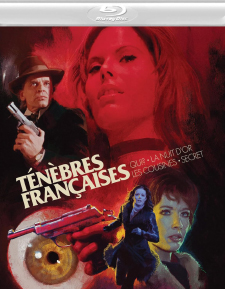
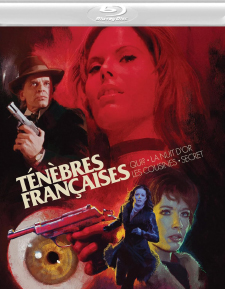
Ténèbres Françaises (Blu-ray Review)
Director
Louis Soulanes/Léonard Keigel/Robert Enrico/Serge MoatiRelease Date(s)
1970/1974/1977 (May 26, 2026)Studio(s)
Various (Vinegar Syndrome)- Film/Program Grade: See Below
- Video Grade: See Below
- Audio Grade: See Below
- Extras Grade: B
- Overall Grade: B+

Review
Not the usual Vinegar Syndrome release, Ténèbres Françaises is a collection of four little-seen French thrillers. I wasn’t familiar with any of these titles, despite the presence of big-name actors in all but one of them. The films—The Cousins, Who? (both 1970), The Secret (1974), and Golden Night (1977)—vary widely in terms of their ambitions and quality. The Cousins is the anomaly of this collection; the others are slick, first-rate productions with major stars, while it’s pure Euro-sleaze, cheaply-made with a no-name cast. However, overall, this set yields a number of pleasant, even gob-smacking surprises.
The four features are collected on two Region “A” discs, all in 1.66:1 widescreen with DTS-HD Master Audio 2.0 mono French audio with new English subtitles. Despite the lower bit-rate necessitated by having two features per disc, even on my projection system and big screen, the films all looked great.
The packaging design less so—the text identifying which films are on which disc is a little hard to read, the back-cover text font is a tad too small readability-wise and, confusingly, the extras for the films on Disc 1 are all inconveniently located on Disc 2. But the movies look great and kudos to Vinegar Syndrome for releasing such obscure titles.
Dreadful, The Cousins (Les Cousines, 1970) is a crude hodgepodge of sadism and supposed eroticism, but the movie is amateurish, uninteresting, and would be unpleasant were it better than it is. At a decaying château, paralyzed and mute Lucile (Solange Pradel), disabled since the age of 10 following a childhood trauma, depends on her mother, Béatrice (Liliane Bert), sister Josine (Danièle Argence), and cousin Élisa (Nicole Debonne) to look after her, but the younger women especially resent being her caregivers, as well as the high cost of Lucile’s medicine, which threatens their relatively carefree, indulgent lifestyles.
Sexually voracious Élisa and Josine seduce men left and right when not making love with one another. (An early scene has the half-naked Josine in bed, reading Psychopathia Sexualis.) Throughout the picture, they can’t keep their hands off each other, while also sexually abusing the infirm Lucile. Their mother isn’t much better; she’s involved with married attorney Georges Borgo (Robert Lombard), making no secret of her active sex life. Josine becomes attracted to comparatively straight-laced next-door neighbor André (Alain Doutey), but is jealous when Élisa tries to muscle in, especially since she’s already involved with sleazy Bruno (Jean Gemin). Predictably, the women’s sadism toward Lucile escalates, especially when Mom’s away and the girls host a drug-fueled sex party.
Unlike the other three titles, The Cousins has no redeeming qualities, and is crudely-made in the low-budget style of other Euro-sex films with poor lighting, out-of-focus shots, poor sound recording, etc. The musical score alternates between what sounds like a droning church organ with cues imitative of For a Few Dollars More. The acting is amateurish; most of the cast only appeared in other films of this type, though Liliane Bert had supporting roles in many major French movies decades earlier; this was her first feature since 1962 and, understandably, her last. Even Solange Pradel as paralyzed Lucile is terrible, despite a performance involving little more than reacting with her eyes. She later turns up in a one-scene role in The Secret, her last film, and is much better there.
One particularly tasteless aspect of The Cousins is its references to Thalidomide birth defects. In the movie, Béatrice gave birth to an armless child years before, which figures into the story’s “surprise” ending, which exploits such deformities as monstrous horrors, like the acromegaly of Rondo Hatton decades earlier.
As with the other films in this set, The Cousins is licensed from StudioCanal, presented with a strong video transfer. The lone extra feature is a video interview with film historian Christophe Bier.
THE COUSINS (FILM/VIDEO/AUDIO/EXTRAS): D-/A-/A-/B-
Who? (Qui ?, 1970), not to be confused with Who? (1974), the bizarre science fiction film starring Elliott Gould, is a French-Italian thriller, a borderline giallo. (The more sensationalistic Italian title is Il cadavere dagli artigli d’acciaio—“The Corpse with Steel Claws.”) Yet it’s not a cheap exploitation film by any means, given its big-name French stars, Romy Schneider and Maurice Ronet. Nevertheless, the makers of the film wisely keep it compact and to the point. The picture runs just 78 minutes.
During the opening titles, lovers Marina (Schneider) and Claude (Gabriele Tinti) argue in a hotel parking lot in La Bretagne (Brittany). The audience can’t hear their conversation, but he becomes physically abusive and she pulls a gun; he overpowers her and throws her into his convertible. They drive headlong toward the cliffs overlooking the British Channel and the car plunges into the ocean. Marina, from the top of the cliffs, peers over the ledge to see the car sink to the bottom. Police are unable to recover the car or retrieve the body.
At the accident scene, Claude’s brother, Serge (Ronet), arrives. He offers her a ride back to Paris, and en route he is visibly surprised when, during their conversation, she claims she and Claude got along just great. Back in Paris, haunted by the accident, Marina is reluctant to return to her apartment, so Serge offers to let her stay at his home. She gradually admits to Claude’s abusive behavior, that she’s glad he’s dead, and she and Serge become lovers days later. She’s obviously better off with Serge, and she even becomes friends with his ex-wife, Dorothy (Simone Bach, wife of the director, in a good performance), but Serge can’t help but obsess about the circumstances of the fatal accident. Marina is suspiciously circumspect, insisting that she didn’t kill him and wants to forget the whole thing. To her annoyance, he begins probing deeper, hoping to unravel the mystery.
Director Léonard Keigel, stepson of Léonide Keigel, one of the founders of Cahiers du Cinéma, studied as an assistant director under René Clément but apparently made few feature films, working mostly in television. Who? (also known under the title The Sensuous Assassin) seems to have been produced on a modest budget, but Keigel’s direction is effectively eerie at times, and the two leads are excellent. An “actors’ film,” it could almost be reworked as a twofer on the stage.
There’s a well-known joke about a court ruling that Meryl Streep is unable to be tried by jury as she has no peers, but Romy Schneider is surely an exception. She was especially good playing free-spirit types trying to suppress dark, disturbing pasts that are scarring her emotionally. That comes into play here, she flashing vaguely sad smiles at Serge, making love with him, but also so emotionally a mess that, for the movie audience, it’s hard to know for most of the film whether or not she was responsible for Claude’s death. Schneider’s great performance carries the film along to the eventual payoff during the last 20 minutes.
Maurice Ronet, like Schneider, always carried an air of tragedy in nearly every film he made, many classics of French cinema; he looked like the emotionally conflicted characters he played. Sadly, both died young less than a year apart, he of cancer at 55, she at 43 from a heart attack probably brought on by grief over the death of her teenage son nine months earlier in a horrific accident.
Significantly more polished than The Cousins, Who? offers excellent cinematography by Jean Bourgoin, enhanced by StudioCanal’s excellent video transfer. Alas, no extras accompanying this particular feature.
WHO? (FILM/VIDEO/AUDIO/EXTRAS): A-/A/A/F
The best of the four features, The Secret (Le Secret, 1974) is uniquely riveting and disturbing. The only other film even remotely like it is Ingmar Bergman’s Shame (1968), which like The Secret is about an isolated couple living in the country, their relationship tested by ambiguous but dangers they don’t fully understand but which introduce extreme stress into their formerly peaceful lives. Barely released in English-speaking countries when it was new—Roger Ebert awarded it just one-star out of four—The Secret really is an unsung masterpiece.
The film opens with David (Jean-Louis Trintignant) escaping from some kind of medieval-like prison/psychiatric hospital/torture chamber, killing a male nurse in the process. Making his way to Ardèche, a mountainous region in southeastern France, David, looking for an abandoned sheepfold to hide in, encounters Thomas (Philippe Noiret), a bored Parisian writer vacationing in a remote, crumbling castle/farmhouse nearby with his wife, Julia (Marlène Jobert). Though sensing David is on the run from something and potentially dangerous, they invite him to stay at their home.
Julia and especially Thomas are intrigued by the mysterious, taciturn David, who claims he was imprisoned after accidentally learning “something that shouldn’t be known.” He’s grateful for the couple’s kindness toward him but warns if he’s captured or killed by those looking for him, they will surely be killed, too. They want to help him but are frightened by his actions, especially when he takes possession of a handgun Thomas kept, forgotten, at the bottom of a drawer. Search helicopters passing overhead cue the trio that those looking for him are closing in, and Thomas offers to drive David to Mimizan-Plage and, from there, smuggle him into Spain by boat. Julia, by this point, opposes the idea—she’d rather David would simply leave them in peace—but also doesn’t want to leave her husband alone with David, either, so she reluctantly joins them...
Is David an unjustly persecuted man being hunted down like a dog, as he claims, or a dangerous madman who might kill Thomas and Julia at any moment? Are they aiding and abetting a fugitive? Are their lives also really in danger from those tracking David? The screenplay, by Francis Ryck, Pascal Garden, and director Robert Enrico keeps the movie audience guessing until the very end, but that’s just one of The Secret’s many qualities.
Thomas and Julia initially welcome David into their isolated home partly because Thomas is bored and while David could be dangerous, at first they feel reasonably safe in his presence. He’s circumspect and jumpy, but his story seems vaguely plausible. Thomas quickly commits to helping this new “friend” he knows nothing about, while Julia is more skeptical about his assertions. Throughout the story, David notices cars following them, innocent-looking passersby he insists are actually agents on the lookout for him, and this paranoia gradually infects Thomas and Julia. The idea that they’d risk their lives to protect this man they really know nothing about, and who seems increasingly paranoid, is made believable because of the intelligent screenplay and direction, and the performances of three actors, who are 95% of the show.
Philippe Noiret, most remembered today as the crotchety projectionist in Cinema Paradiso, is superb, credibly expressing a kind of casual, nearly unflappable fatalism. He loves Julia and she him, but he craves excitement like a narcotic, and wants to believe David’s story and help him. In several scenes Julia makes him take some kind of medication, hinting that he’s chronically or maybe even terminally ill. Marlène Jobert is equally good as Julia, she physically attracted to this dangerous, handsome man, but more practical than her dreamy husband about the danger they may be putting themselves in, whether from the authorities as David suggests, or from David himself.
The cinematography by Étienne Becker (son of Jacques), who also shot the superlative Last Known Address, makes moody use of the film’s unusual locations, while Ennio Morricone’s sparse but effectively mournful score adds immensely to the picture’s haunting tone. Both video and sound are first-rate here.
Good extras enhance the viewing experience. They include archival footage and interviews of the director and cast on location, an interview with Enrico and Jobert for French television, and an interview with Enrico on Belgian TV.
THE SECRET (FILM/VIDEO/AUDIO/EXTRAS): A/A/A/A-
Terminally weird, Golden Night (Nuit d’or, 1977) is an unrewarding journey into the surreal, with giallo-like elements. A little like Mario Bava’s Lisa and the Devil, it’s the kind of a movie without any clear narrative or characterizations, employing instead loosely-connected, visually-stylish and indulgent actorly set pieces, the movie audience left to try and unravel what’s going on (and the point of it all). Further cluttering things is that director and co-writer Serge Moati doesn’t seem interested in creating a “movie reality.” What’s onscreen might be distortions filtered through its characters; certain aspects of the “story” seem contradictory and/or incomplete.
Michel Fournier (Klaus Kinski, speaking French), a man thought dead, inexplicably turns up very much alive, to the consternation of his brother, Henri (Jean-Luc Bideau), father Charles (Charles Vanel), police Commissaire Pidoux (Bernard Blier), and Henry (Maurice Ronet), owner of the Nuit d’or, a gambling hall. Unclear is whether Michel committed suicide, was murdered by one of the above, or maybe executed by the state after Michel reportedly murdered a little girl. Nor is it ever explained who was cremated in Michel’s place. Regardless, he turns up again apparently operating a doll and puppetry shop, where Michel keeps marionettes of himself and others. (A marionette Klaus Kinski is predictably unsettling.) Michel also sends out voodoo-like dolls to those he intends to wreak his vengeance.
There’s also a visually arresting but equally inexplicable subplot involving Michel’s past association with a bizarre religious cult operated mainly by Andreé (Anny Duperey), which seems to revolve around a Jim Jones-like messiah, a dwarf, preserved in a coffin. The plot, such as it is, has Michel kidnapping Catherine (Valérie Pascale), Henri’s daughter.
Just what is director Moati trying to accomplish with Golden Night? Beats me. There are plenty of atmospheric, visually interesting moments peppered throughout, and the performances are generally good, but none of it seems to be leading anywhere. Klaus Kinski reportedly hated the script, and in almost every scene he’s in Michel lashes out, breaking glass bottles, throwing chairs, etc., and/or violently assaulting the other characters. (Kinski, being Kinski, doesn’t hold back or pull punches; everything looks uncomfortably real.) The exception is that in some scenes he’s tender, if creepily so, with little Catherine, in retrospect as unsettling as anything else, given that Kinski’s daughters later claimed he had sexually abused them, behaving inappropriately with Natasha and raping Pola Kinski from the age of five.
Probably 7/8 of entire history of great French cinema could be split among Charles Vanel, Bernard Blier, and Maurice Ronet, but their talents are wasted here, particularly Ronet who, wearing pasty-faced makeup, appears only briefly at the beginning and end of the picture.
Films like Golden Night are a matter of personal taste; some may find it fascinating. But, for this reviewer, when a movie delves so completely into the surreal, the end result better be worth the trip, and this film just didn’t click with me.
As with the other titles, Golden Night’s video transfer is excellent. In this case, the bright primary colors that suggest a neo-noir really come through here. The lone extra here is an interview with director Moati for Belgian television.
GOLDEN NIGHT (FILM/VIDEO/AUDIO/EXTRAS): C/A/A/B-
So, final tally, The Secret is an unheralded masterwork of its kind, Who? is very good, and Golden Night, while ultimately unsatisfying, is stylish with a top-tier cast, leaving The Cousins as the only dud of the set, though there exists some cult film interest even for that obscure title. Highly Recommended.
- Stuart Galbraith IV